Select to expand quotePaducah said..BSN101 said..Paducah said..BSN101 said..Francone said..ducati said..Francone said..
I have a Bic Windsup and I am planning to make a " back to the basics'' DIY hydrofoil ( or..quasi-hydrofoil!) wing, possibly by using a 3D
I made this a while ago out of layers or 3mm marine ply with glass between each layer for a slalom board.
while it planed up a bit earlier, gaining any speed was restricted as the extra drag forced the nose down cancelling out any advantage.

Good idea about the ply, Ducati !! What is the wingspan of your foil?
I wonder if a longer( or the longest possible) wingspan and perhaps a larger width ( i.e. a larger surface) could not increase the lift. On my board I can give the wing as much as a 55 cm span, which is the width of the board around the fin area. Probably more, if there are no counter indications in having the wingtips protruding a couple of inches on the sides of the board, but I am not an engineer or a hydrodynamics expert and I don't know.
Also, a critical factor for the lift is what I call, for lack of a better word, the the taper-down effect in the wing. In other word the distance between leading edge and trailing edge should be longer ( curved ) on the upper face than on the lower face ( flat, or even slightly concave ) to create the pressure differential necessary for lift, just as in an airplane's wing. This is best visible by looking at the cross section of the wing . In fact, also the two side-thrusters I put on my Bic have one side slightly convex and the other one slightly concave, probably with the same rationale. .
I think this is a the trickiest part in building the wing. Probably it has to be done manually by careful sanding . I suppose you glued the wing to the fin and probably made some reinforcement ( fiberglas?) around the insertion point. If you have done it already, would you mind giving me some tips about how you did it, in a few words?
Also, I wonder whether it would make a difference by attaching the wing at the end of the fin instead of at midway.
Thanks for your ( or anybody's help ) on this issue.
Francone
The guys at WindTech are successfully using a fin with small wings at the tip. Have a look at their thread here on SB
Is this the same one at 6.5 seconds in to their video?
That's it. WT are testing it and I gather it may be made available at some later date
Then that's quite different than what Francone is trying to do as this looks more like a winglet but is serving a different surface than a proper lifting foil.
Francone, yes, getting the center of lift right is going to be important if you want to "skim" just above the surface. Putting a big wing on the back of your car doesn't automatically turn it into an airplane :). Good luck.
Gorgesailor
I am impressed by the feed-back I am getting. Very helpful.
You seem to leave the door open to the possibility of skimming above the water with a hydrofoil wing, if, as you say, we get the center of lift right. I agree, but then you end with a note of skepticism by using the analogy of the wing on a car.
As to the argument of the vise raised in your previous post against using a hydrofoil wing on a US box, I can see how easily you can break fin and fin box if the fin was clamped in a vise and you tried to twist the board by applying force against its grip.
In other words, clamp a chopstick in a vise and then try to bend it full strength. Of course it will break! But the fin and wing are in the water, not clamped by a vise ! Whichever way you move on the board or you pull it around, the fin will follow .
Where would the resistance come from? The fin is in the water, not sunken in concrete ! Yes, water can be as hard as concrete and break your body after a 1000 m. free fall, but the velocity of the windsurfer in the water is not 300 km/hr, just a puny 10-15 knts. How can it break or twist fin and finbox in any way, unless it hits a rock ?
The hydrofoil wing of a board moving relatively slow in light winds doesn't encounter strong enough water resistance to rip off a US fin box, unless,( not being an engineer conversant with the mathematics and physics of hydrodynamics) I underestimate the fact that water has a higher density than air.. Still does this really make a difference at the speed a windsurfer goes in light winds, to the point of breaking or ripping off the fin box ? May be an engineer can tell. I maybe wrong..Just curious..
it also occurs occurs to me that flimsy, ultra light model airplanes manage to fly in ( and against!) the air, sometimes turbulent at that , without breaking their wings or being shattered, even though they go much faster than a windsurfer in light winds.
I think that If you can plane on a board without any sort of hydrofoil wing, it should be " a fortiori" even easier to plane or rise above the water with the additional lift of the hydrofoil wing, provided, of course, that the wing doesn't come off.
I wonder, though, if a hydrofoil wing ( whether DIY or commercially available) will work on a long board like the Windsup ( 11.6 ft), because the longer the board the greater is the weight ahead of the hydrofoil wing.
Can the board rise more easily and be more balanced, to begin with, if the hydrofoil wing is attached more towards the middle of the hull, perhaps even directly on the centerboard box? I have seen hydrofoil wings attached to a fin in a reversed position, i.e.with the tip pointing towards the nose of the board . May be this is why ....
Regarding my DIY project, with a 3D printer ( my son has one ) a small 9" wingspan prototype can be easily built by feeding the computer with the proper hydrodynamic specs of the wing provided by www.thingiverse.com/search/page:1?q=hydrofoil&sa=&dwh=885aa59e191a60b or similar sites.
A full scale wing can eventually be 3D printed in steps , i.e. by breaking down the wing in sections ( probably 4 or 5 for a 28" wingspan) printing them and then joining them. The wing will be to an aircraft wing specs ,in plastic and with a hollow inside for lightness, filled with expanding foam. Eventually it will be reinforced with fiberglas resin for more rigidity and strength , but it should have sufficient flexibility to withstand the stress of the water, so that the US fin box doesn't get damaged.
If one already has a 3D printer, the cost will be minimal: just the material and a few hours work, certainly a far cry from the $ 1000 + cost of the commercially available products.
Thanks
Francone
Francone, Once again, I repeat ...I hate to PooPoo your idea, but I don't think you should do this. If you do succeed in building a wing powerful enough to lift the Windsup clear of the water(very doubtful) - even barely clear.... You seriously risk ripping the finbox out. Imagine clamping your fin in a vise while attached to the board: Now get up on the board & walk around on it while only supported by the fin... you think your fin box will hold up to that? I don't...
In addition, I have a commercial grade 3D printer & I would NEVER expect anything printed with it to handle these kind of loads.
IMHO your plan in its current incarnation will not provide lift in the right places due to several flaws in the physics, but is also structurally unsound intrinsically & will likely result in damage to your board. Though if you do build it from 3D printed parts it is unlikely to hold up long enough to damage the board.
just my $.02
Francone,
People who make foils for a living make them pretty stout.
Select to expand quotegorgesailor said..
Francone, Once again, I repeat ...I hate to PooPoo your idea, but I don't think you should do this. If you do succeed in building a wing powerful enough to lift the Windsup clear of the water(very doubtful) - even barely clear.... You seriously risk ripping the finbox out. Imagine clamping your fin in a vise while attached to the board: Now get up on the board & walk around on it while only supported by the fin... you think your fin box will hold up to that? I don't...
In addition, I have a commercial grade 3D printer & I would NEVER expect anything printed with it to handle these kind of loads.
IMHO your plan in its current incarnation will not provide lift in the right places due to several flaws in the physics, but is also structurally unsound intrinsically & will likely result in damage to your board. Though if you do build it from 3D printed parts it is unlikely to hold up long enough to damage the board.
just my $.02
I appreciate your coming back with further comments.
I am sure by now somebody is looking at me as a misguided fellow, unable to understand something almost as simple as that jumping from an airplane without parachute can be rather dangerous..
You speak of a dangerous load on the wing . Paducah even brings in the Foil.co video showing 4 people ( and even a car !) weighing on their wing/fin without breaking it is Fantastic! It doesn't however do more than prove very convincingly the incredible strength of their product , but it doesn't speak to my original question, namely,how can water exert such a tremendous load on the hydrofoil wing as to break the ( US )fin box ?
I have brought in some arguments, which, for some, may have been debatable. I was ready to have them refuted individually . this would have been the best way to convince me, not that video, because it is based on a setup which , for the reasons explained below, does not correspond to the way a board interacts with water in " real life" .
The point is that the sailor doesn't weigh on the center of a fin /wing resting flat between two cement blocks acting as a vise , as in the video. rather , he stands on a board floating (!) in the water . This makes the whole difference, because the water is not a cement block and it yields!
His dead weight is not supported ( and resisted) by the two cement blocks, but counterbalanced and absorbed by the board floating by dint of the equivalent upward hydro-static force.
In my opinion, the only way that the wing/fin could break the fin box would be by swaying/twisting laterally, as you would do by grabbing it by the tip and pulling towards you. Again, I can't see , in spite of the video, how water can exert such an incredible lateral twist on the fin as to break the fin box, especially at the speed the board goes, which is not the 300 km/hr speed at which a body would fall in the water , ( and break) from a height of 1000 ft) as I had pointed out in my example.
Would the wing, like that unfortunate fellow, perhaps break because of the water density? Even at the board's slow speed? Again nobody has picked up on this..
In my opinion, the board would have to sink first under he sailor's weight , but then the wing, too , which is attached under it , would yield and sink .. It would possibly break only when hitting the bottom.
There is also another point I should mention: even admitting that the hydrofoil wing can break by analogy with the foil.co video setup, can the length of the vertical mast where the wing is attached be a factor ? Perhaps the longer the mast, the greater the force on the fin box, according to the lever principle. This would perhaps vindicate your point, at least partially...
Indeed, these commercial hydrofoil wings are normally almost one meter long and they also have a fuselage with a rear wing attached to it. This may increase the stress on the fin box.
To the contrary, in my case, as many people have done, the hydrofoil wing has no mast and no back wing. It is attached directly to the fin, either at the tip or even in the middle. This means that the wing can be placed as close to the hull as one foot or so. I can even place it on my Dolphin fin, which is even shorter..Does the distance of the hydrofoil wing from the hull have a bearing also on the lift of the board?
If so, the worst that can happen is that the board won't rise even an inch, but , again, I can't see how the fin box can be affected.
It would also be interesting to know if the length of the board has a negative impact on the lift of the hydrofoil wing, perhaps because there is more weight to be lifted ahead of the hydrofoil wing ( I have a longish Windsup ( 11.6 ft )
Francone
Select to expand quoteFrancone said..gorgesailor said..
Francone, Once again, I repeat ...I hate to PooPoo your idea, but I don't think you should do this. If you do succeed in building a wing powerful enough to lift the Windsup clear of the water(very doubtful) - even barely clear.... You seriously risk ripping the finbox out. Imagine clamping your fin in a vise while attached to the board: Now get up on the board & walk around on it while only supported by the fin... you think your fin box will hold up to that? I don't...
In addition, I have a commercial grade 3D printer & I would NEVER expect anything printed with it to handle these kind of loads.
IMHO your plan in its current incarnation will not provide lift in the right places due to several flaws in the physics, but is also structurally unsound intrinsically & will likely result in damage to your board. Though if you do build it from 3D printed parts it is unlikely to hold up long enough to damage the board.
just my $.02
....
It would also be interesting to know if the length of the board has a negative impact on the lift of the hydrofoil wing, perhaps because there is more weight to be lifted ahead of the hydrofoil wing ( I have a longish Windsup ( 11.6 ft )
Francone
Yes
After building a carbon windfoil and a Kitefoil I find it interesting people talking about 3D printing to build a foil. After trial and error I now know the key to a good foil is rigidity, any joins cause flex and instability. To have 5 or more joins would make for a very difficult foil to ride unless of course you plan just to 3D print the core then glass the whole thing in carbon.
My foils have 2 joins, one between the mast and board and one between the rear stab and fuselage for adjustability.
And you only need to look at the bent Pryde foil masts to realise the load exerted on the mast to board join.
Select to expand quotegorgesailor said..Francone said..gorgesailor said..
Francone, Once again, I repeat ...I hate to PooPoo your idea, but I don't think you should do this. If you do succeed in building a wing powerful enough to lift the Windsup clear of the water(very doubtful) - even barely clear.... You seriously risk ripping the finbox out. Imagine clamping your fin in a vise while attached to the board: Now get up on the board & walk around on it while only supported by the fin... you think your fin box will hold up to that? I don't...
In addition, I have a commercial grade 3D printer & I would NEVER expect anything printed with it to handle these kind of loads.
IMHO your plan in its current incarnation will not provide lift in the right places due to several flaws in the physics, but is also structurally unsound intrinsically & will likely result in damage to your board. Though if you do build it from 3D printed parts it is unlikely to hold up long enough to damage the board.
just my $.02
....
It would also be interesting to know if the length of the board has a negative impact on the lift of the hydrofoil wing, perhaps because there is more weight to be lifted ahead of the hydrofoil wing ( I have a longish Windsup ( 11.6 ft )
Francone
Yes
1.How does the length of the board affect the pitch with a hydrofoil? Does it increase with the length or decrease? In other words, is the pitch better controlled on a longer board or a shorter board?
2. Is the pitch problem less serious or easier to handle if riding low on the water, in quasi-planing conditions or few inches above it?
THanks
Francone
I think it's time for a separate Seabreese section for the foilers, same level as 'wave sailors'?
hahahahahah now that would be an idea....
www.seabreeze.com.au/forums/Windsurfing/General/Windfoil-section--
too bad the mods to see the point 
or switch to the "australian foilers" fb page
Many people here and elsewhere have expressed concern that a hydrofoil wing, even a monofoil mounted directly on the fin, can produce enough mechanical stress on a US fin box to damage it or even rip it off, assumedly because of the density of water creating resistance ..
As an experiment, I tried to push, pull and twist ( with moderate force) on the fin , but the US fin box withstood the action pretty well.
I could have probably succeeded in breaking or damaging it by applying full strength or leaning on the fin with half or even all my body weight , at least 40 kg, but I can't see how a force of 20 or 40 kg can be created on the hydrofoil wing , simply on account of the water resistance.
It would be interesting to have an idea, based o physics, of the magnitude of this force, in kg/cm2, once we know the surface of a wing and the velocity of the hydrofoil.
There is a number, the Reynolds number, which can be googled up at
airfoiltools.com/calculator/reynoldsnumber?MReNumForm%5Bvel%5D=10&MReNumForm%5Bchord%5D=0.2&MReNumForm%5Bkvisc%5D=9.7937E-7&yt0=Calculate
This number expresses the viscosity coefficient of water or air in function of the velocity of the wing foil, the density of the medium,(air or water) the length of the wing chord and the temperature . The site has a calculator. You just fill in the data and it calculates the Reynolds number.
For a hydrofoil having a wing chord of 0.20 m( or about 8"), moving in 20 degr. C water at 20 knts/hr, the Reynolds number is 2,042,129.
Since the viscosity of a medium resists the movement of a body through it ( and can therefore be viewed as a force exerted on it) , I wonder if there is a formula allowing to extract this force ( kg/cm2) from the Reynolds number .
This is the only way to assess, in a scientific way, beyond hearsay, the risk that the US fin box can be ripped off by hydrofoiling the board onl y at 15, possibly 20 knts/hr.
I wonder if anybody, may be an engineer reading this post has any comments,
Thanks
Francone
Select to expand quoteFrancone said..
Many people here and elsewhere have expressed concern that a hydrofoil wing, even a monofoil mounted directly on the fin, can produce enough mechanical stress on a US fin box to damage it or even rip it off, assumedly because of the density of water creating resistance ..
As an experiment, I tried to push, pull and twist ( with moderate force) on the fin , but the US fin box withstood the action pretty well.
I could have probably succeeded in breaking or damaging it by applying full strength or leaning on the fin with half or even all my body weight , at least 40 kg, but I can't see how a force of 20 or 40 kg can be created on the hydrofoil wing , simply on account of the water resistance.
It would be interesting to have an idea, based o physics, of the magnitude of this force, in kg/cm2, once we know the surface of a wing and the velocity of the hydrofoil.
There is a number, the Reynolds number, which can be googled up at
airfoiltools.com/calculator/reynoldsnumber?MReNumForm%5Bvel%5D=10&MReNumForm%5Bchord%5D=0.2&MReNumForm%5Bkvisc%5D=9.7937E-7&yt0=Calculate
This number expresses the viscosity coefficient of water or air in function of the velocity of the wing foil, the density of the medium,(air or water) the length of the wing chord and the temperature . The site has a calculator. You just fill in the data and it calculates the Reynolds number.
For a hydrofoil having a wing chord of 0.20 m( or about 8"), moving in 20 degr. C water at 20 knts/hr, the Reynolds number is 2,042,129.
Since the viscosity of a medium resists the movement of a body through it ( and can therefore be viewed as a force exerted on it) , I wonder if there is a formula allowing to extract this force ( kg/cm2) from the Reynolds number .
This is the only way to assess, in a scientific way, beyond hearsay, the risk that the US fin box can be ripped off by hydrofoiling the board onl y at 15, possibly 20 knts/hr.
I wonder if anybody, may be an engineer reading this post has any comments,
Thanks
Francone
An engineer reading this post will not bother because the drag coefficient of the foil is a negligible factor when speaking of the structural concerns here expressed. The fact that this is not obvious to you, shows exactly why you should not be undertaking such an endeavor. Sorry to be blunt but it must be said.
Select to expand quotegorgesailor said..Francone said..
Many people here and elsewhere have expressed concern that a hydrofoil wing, even a monofoil mounted directly on the fin, can produce enough mechanical stress on a US fin box to damage it or even rip it off, assumedly because of the density of water creating resistance ..
As an experiment, I tried to push, pull and twist ( with moderate force) on the fin , but the US fin box withstood the action pretty well.
I could have probably succeeded in breaking or damaging it by applying full strength or leaning on the fin with half or even all my body weight , at least 40 kg, but I can't see how a force of 20 or 40 kg can be created on the hydrofoil wing , simply on account of the water resistance.
It would be interesting to have an idea, based o physics, of the magnitude of this force, in kg/cm2, once we know the surface of a wing and the velocity of the hydrofoil.
There is a number, the Reynolds number, which can be googled up at
airfoiltools.com/calculator/reynoldsnumber?MReNumForm%5Bvel%5D=10&MReNumForm%5Bchord%5D=0.2&MReNumForm%5Bkvisc%5D=9.7937E-7&yt0=Calculate
This number expresses the viscosity coefficient of water or air in function of the velocity of the wing foil, the density of the medium,(air or water) the length of the wing chord and the temperature . The site has a calculator. You just fill in the data and it calculates the Reynolds number.
For a hydrofoil having a wing chord of 0.20 m( or about 8"), moving in 20 degr. C water at 20 knts/hr, the Reynolds number is 2,042,129.
Since the viscosity of a medium resists the movement of a body through it ( and can therefore be viewed as a force exerted on it) , I wonder if there is a formula allowing to extract this force ( kg/cm2) from the Reynolds number .
This is the only way to assess, in a scientific way, beyond hearsay, the risk that the US fin box can be ripped off by hydrofoiling the board onl y at 15, possibly 20 knts/hr.
I wonder if anybody, may be an engineer reading this post has any comments,
Thanks
Francone
An engineer reading this post will not bother because the drag coefficient of the foil is a negligible factor when speaking of the structural concerns here expressed. The fact that this is not obvious to you, shows exactly why you should not be undertaking such an endeavor. Sorry to be blunt but it must be said.
Thanks fot the comment.
It is apparent that you don't have an answer to my question, but then it is a rather technical question, beyond the ken of most windsurfers and it is therefore understandable that you don't know.
I posted this question, just in case ., with no great expectations that it would find somebody with an attentive ear and sufficient knowledge of physics to answer it.
First, you say that an engineer won't bother (?) to answer, because the drag coefficient of the foil is negligible. The fact that , as you say, this is not obvious to me is true, but I am an inquisitive mind and I don't see why I should desists from anything, in this case attaching a hydrofoil wing to the US fin box of my board just because something is not obvious, i.e, I don't understand it.
I think that I owe it to myself, as a supposedly intelligent person, at least to try I
I certainly wouldn't want to damage my fin box by embarking in this project without being reasonably satisfied of its feasibility beyond the hearsay and my question was prejudicial to this effect.
Secondly, I can't see why you say that an engineer won't bother to answer my question.
In making this assumption, you sound rather dismissive and perhaps hurriedly so , because in this Forum as in others I found many times people willing to explain the more theoretical aspects of our sport, like the windsurfer who mentioned the Reynolds number .
Perhaps it would have made more sense if you said that an engineer will be UNABLE to answer , for the reason you mentioned, (regardless of whether or not I agree or even I understand it) because usually the term bother has a somewhat negative connotation, meaning to be unwilling to do something and not necessarily unable.
I have not lost hope that somebody will clarify this point, here or elsewhere.. I'll even post this question on a Physics Forum to which I am registered. and I if I get an answer that I find it relevant to windsurfers, I'll post it here. .
Thanks again for your feedback
Francone
Select to expand quoteFrancone said..gorgesailor said..Francone said..
Many people here and elsewhere have expressed concern that a hydrofoil wing, even a monofoil mounted directly on the fin, can produce enough mechanical stress on a US fin box to damage it or even rip it off, assumedly because of the density of water creating resistance ..
As an experiment, I tried to push, pull and twist ( with moderate force) on the fin , but the US fin box withstood the action pretty well.
I could have probably succeeded in breaking or damaging it by applying full strength or leaning on the fin with half or even all my body weight , at least 40 kg, but I can't see how a force of 20 or 40 kg can be created on the hydrofoil wing , simply on account of the water resistance.
It would be interesting to have an idea, based o physics, of the magnitude of this force, in kg/cm2, once we know the surface of a wing and the velocity of the hydrofoil.
There is a number, the Reynolds number, which can be googled up at
airfoiltools.com/calculator/reynoldsnumber?MReNumForm%5Bvel%5D=10&MReNumForm%5Bchord%5D=0.2&MReNumForm%5Bkvisc%5D=9.7937E-7&yt0=Calculate
This number expresses the viscosity coefficient of water or air in function of the velocity of the wing foil, the density of the medium,(air or water) the length of the wing chord and the temperature . The site has a calculator. You just fill in the data and it calculates the Reynolds number.
For a hydrofoil having a wing chord of 0.20 m( or about 8"), moving in 20 degr. C water at 20 knts/hr, the Reynolds number is 2,042,129.
Since the viscosity of a medium resists the movement of a body through it ( and can therefore be viewed as a force exerted on it) , I wonder if there is a formula allowing to extract this force ( kg/cm2) from the Reynolds number .
This is the only way to assess, in a scientific way, beyond hearsay, the risk that the US fin box can be ripped off by hydrofoiling the board onl y at 15, possibly 20 knts/hr.
I wonder if anybody, may be an engineer reading this post has any comments,
Thanks
Francone
An engineer reading this post will not bother because the drag coefficient of the foil is a negligible factor when speaking of the structural concerns here expressed. The fact that this is not obvious to you, shows exactly why you should not be undertaking such an endeavor. Sorry to be blunt but it must be said.
Thanks fot the comment.
It is apparent that you don't have an answer to my question, but then it is a rather technical question, beyond the ken of most windsurfers and it is therefore understandable that you don't know.
I posted this question, just in case ., with no great expectations that it would find somebody with an attentive ear and sufficient knowledge of physics to answer it.
First, you say that an engineer won't bother (?) to answer, because the drag coefficient of the foil is negligible. The fact that , as you say, this is not obvious to me is true, but I am an inquisitive mind and I don't see why I should desists from anything, in this case attaching a hydrofoil wing to the US fin box of my board just because something is not obvious, i.e, I don't understand it.
I think that I owe it to myself, as a supposedly intelligent person, at least to try I
I certainly wouldn't want to damage my fin box by embarking in this project without being reasonably satisfied of its feasibility beyond the hearsay and my question was prejudicial to this effect.
Secondly, I can't see why you say that an engineer won't bother to answer my question.
In making this assumption, you sound rather dismissive and perhaps hurriedly so , because in this Forum as in others I found many times people willing to explain the more theoretical aspects of our sport, like the windsurfer who mentioned the Reynolds number .
Perhaps it would have made more sense if you said that an engineer will be UNABLE to answer , for the reason you mentioned, (regardless of whether or not I agree or even I understand it) because usually the term bother has a somewhat negative connotation, meaning to be unwilling to do something and not necessarily unable.
I have not lost hope that somebody will clarify this point, here or elsewhere.. I'll even post this question on a Physics Forum to which I am registered. and I if I get an answer that I find it relevant to windsurfers, I'll post it here. .
Thanks again for your feedback
Francone
Hi Francone, It was a condescending reply - intentionally so. You are intelligent & must have an engineering oriented mind, but you have blinders on. Posting to a physics forum will be even more pointless. The reason I say this is because the hydrodynamic drag is the least of your worries when it comes to the forces on a fin box. A physicist or indeed an engineer won't be able to help either unless they have a good understanding of the forces involved. I have seen many armchair engineers & physicists try to simplify the forces generated in windsurfing into terms that can easily be calculated - they almost always oversimplify & overlook many of the factors involved. The best way to get this understanding is to be a windsurfer - especially if you have been around the sport for many years & seen all manner of failures including many US boxes torn from boards. There is a reason US base fins are only sold up to about 30cm or a little over. The larger fins put too much load on the box. This is not load caused by hydrodynamic drag. This is load caused by the lift generated by the fin to counteract the force from the sail. Now going back to a foil rather than a fin, in addition to lateral & torsional loads on the box, you also have a strong vertical component & cantilevered fore & aft component since the foil is essentially supporting the entire weight of the board & rider regardless of how far out of the water you are lifted. Remember my vise analogy? Now you say the water cushions this load, but if you are lifting the board out of the water at all, the load is still there. Here is another analogy: Imagine if you could stand on the board & balance it on its fin alone on a cement floor. Easy to see this would damage the fin & the box likely. Now if you put cushions under the fin you may prevent the cement from damaging the tip of the fin, but the same load is there. Now I am only addressing the structural issues here. In my opinion there are allot of reasons why this idea wont work - in its current form(fin based foil). Also, other more compelling reasons to look elsewhere for the performance gains you seek.
This is just my opinion - I am not an engineer or phycisist though I use these disciplines in my work. I have been windsurfing at high level since 1984 & used to build & repair allot of boards...
Select to expand quoteLeeD said..
I'm with GS. Sounds like any "engineer" who ignores reality is a useless voice.
I think everyone is with GS
With Deep tuttle boxes requiring reinforcing and aluminium mast's being bent it seems fairly obvious a US box won't be strong enough to handle a foil
too much discussion about the fin BOX - for Franco's foil design
now what if it was a tuttle, deep tuttle or perhaps even a PB\power box ??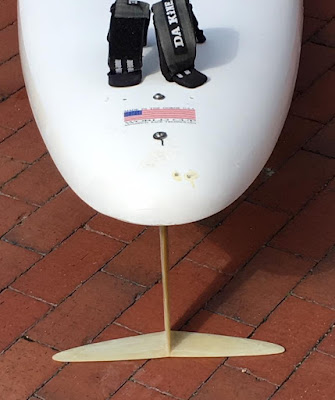
this one is called frpgear
when i discussed it on US windsurf forum called iwindsurf
www.iwindsurf.com/forums/viewtopic.php?t=33059&highlight=frpgear&sid=4c8fd99f79149e4f7848e69af1bd1d15
people felt it was not worth the effort - just use longer fins, more fins, etc
the company itself is odd in that the first fin cost double and next ones half price
sorry - no candu $%^&*()
Select to expand quotejoe windsurf said..
too much discussion about the fin BOX - for Franco's foil design
now what if it was a tuttle, deep tuttle or perhaps even a PB\power box ??
this one is called frpgear
when i discussed it on US windsurf forum called iwindsurf
www.iwindsurf.com/forums/viewtopic.php?t=33059&highlight=frpgear&sid=4c8fd99f79149e4f7848e69af1bd1d15
people felt it was not worth the effort - just use longer fins, more fins, etc
the company itself is odd in that the first fin cost double and next ones half price
sorry - no candu $%^&*()
We've already discussed the general issues of creating lift behind the center of gravity earlier in the thread. Right now, gorgesailor and the rest of us are trying to keep Francone from ripping the fin box out of his board.
fyi, you may want to actually look at their site before giving them publicity ;)
"[a blog at blogspost.com] -A person from Canada is trying to look important in windsurfing. But still interesting to review." (web address obscured to protect the innocent)
xxx/case-study.html (links broken on purpose. no need to goose is search ranking )
Latest FRP designs indicate much wider chord, same depth. I assume it will work, when you're perfectly underpowered. Any more breeze would result in more drag, any less would result in slower slog, if such were possible. That nether world of
almost planing is one we'd love to avoid anytime possible.
Select to expand quotegorgesailor said..Francone said..gorgesailor said..Francone said..
Many people here and elsewhere have expressed concern that a hydrofoil wing, even a monofoil mounted directly on the fin, can produce enough mechanical stress on a US fin box to damage it or even rip it off, assumedly because of the density of water creating resistance ..
As an experiment, I tried to push, pull and twist ( with moderate force) on the fin , but the US fin box withstood the action pretty well.
I could have probably succeeded in breaking or damaging it by applying full strength or leaning on the fin with half or even all my body weight , at least 40 kg, but I can't see how a force of 20 or 40 kg can be created on the hydrofoil wing , simply on account of the water resistance.
It would be interesting to have an idea, based o physics, of the magnitude of this force, in kg/cm2, once we know the surface of a wing and the velocity of the hydrofoil.
There is a number, the Reynolds number, which can be googled up at
airfoiltools.com/calculator/reynoldsnumber?MReNumForm%5Bvel%5D=10&MReNumForm%5Bchord%5D=0.2&MReNumForm%5Bkvisc%5D=9.7937E-7&yt0=Calculate
This number expresses the viscosity coefficient of water or air in function of the velocity of the wing foil, the density of the medium,(air or water) the length of the wing chord and the temperature . The site has a calculator. You just fill in the data and it calculates the Reynolds number.
For a hydrofoil having a wing chord of 0.20 m( or about 8"), moving in 20 degr. C water at 20 knts/hr, the Reynolds number is 2,042,129.
Since the viscosity of a medium resists the movement of a body through it ( and can therefore be viewed as a force exerted on it) , I wonder if there is a formula allowing to extract this force ( kg/cm2) from the Reynolds number .
This is the only way to assess, in a scientific way, beyond hearsay, the risk that the US fin box can be ripped off by hydrofoiling the board onl y at 15, possibly 20 knts/hr.
I wonder if anybody, may be an engineer reading this post has any comments,
Thanks
Francone
An engineer reading this post will not bother because the drag coefficient of the foil is a negligible factor when speaking of the structural concerns here expressed. The fact that this is not obvious to you, shows exactly why you should not be undertaking such an endeavor. Sorry to be blunt but it must be said.
Thanks fot the comment.
It is apparent that you don't have an answer to my question, but then it is a rather technical question, beyond the ken of most windsurfers and it is therefore understandable that you don't know.
I posted this question, just in case ., with no great expectations that it would find somebody with an attentive ear and sufficient knowledge of physics to answer it.
First, you say that an engineer won't bother (?) to answer, because the drag coefficient of the foil is negligible. The fact that , as you say, this is not obvious to me is true, but I am an inquisitive mind and I don't see why I should desists from anything, in this case attaching a hydrofoil wing to the US fin box of my board just because something is not obvious, i.e, I don't understand it.
I think that I owe it to myself, as a supposedly intelligent person, at least to try I
I certainly wouldn't want to damage my fin box by embarking in this project without being reasonably satisfied of its feasibility beyond the hearsay and my question was prejudicial to this effect.
Secondly, I can't see why you say that an engineer won't bother to answer my question.
In making this assumption, you sound rather dismissive and perhaps hurriedly so , because in this Forum as in others I found many times people willing to explain the more theoretical aspects of our sport, like the windsurfer who mentioned the Reynolds number .
Perhaps it would have made more sense if you said that an engineer will be UNABLE to answer , for the reason you mentioned, (regardless of whether or not I agree or even I understand it) because usually the term bother has a somewhat negative connotation, meaning to be unwilling to do something and not necessarily unable.
I have not lost hope that somebody will clarify this point, here or elsewhere.. I'll even post this question on a Physics Forum to which I am registered. and I if I get an answer that I find it relevant to windsurfers, I'll post it here. .
Thanks again for your feedback
Francone
Hi Francone, It was a condescending reply - intentionally so. You are intelligent & must have an engineering oriented mind, but you have blinders on. Posting to a physics forum will be even more pointless. The reason I say this is because the hydrodynamic drag is the least of your worries when it comes to the forces on a fin box. A physicist or indeed an engineer won't be able to help either unless they have a good understanding of the forces involved. I have seen many armchair engineers & physicists try to simplify the forces generated in windsurfing into terms that can easily be calculated - they almost always oversimplify & overlook many of the factors involved. The best way to get this understanding is to be a windsurfer - especially if you have been around the sport for many years & seen all manner of failures including many US boxes torn from boards. There is a reason US base fins are only sold up to about 30cm or a little over. The larger fins put too much load on the box. This is not load caused by hydrodynamic drag. This is load caused by the lift generated by the fin to counteract the force from the sail. Now going back to a foil rather than a fin, in addition to lateral & torsional loads on the box, you also have a strong vertical component & cantilevered fore & aft component since the foil is essentially supporting the entire weight of the board & rider regardless of how far out of the water you are lifted. Remember my vise analogy? Now you say the water cushions this load, but if you are lifting the board out of the water at all, the load is still there. Here is another analogy: Imagine if you could stand on the board & balance it on its fin alone on a cement floor. Easy to see this would damage the fin & the box likely. Now if you put cushions under the fin you may prevent the cement from damaging the tip of the fin, but the same load is there. Now I am only addressing the structural issues here. In my opinion there are allot of reasons why this idea wont work - in its current form(fin based foil). Also, other more compelling reasons to look elsewhere for the performance gains you seek.
This is just my opinion - I am not an engineer or phycisist though I use these disciplines in my work. I have been windsurfing at high level since 1984 & used to build & repair allot of boards...
You say that the foil is essentially supporting the entire weight of the board & rider regardless of how far out of the water you are lifted.
I believe what I meant is that as long as the board is floating, your weight is absorbed by it and does not transfer directly onto the underwater hydrofoil wing , thereby breaking it.. But even when the board is off the water, I have reasons to believe that a wing is unlikely to break under the weight of the average sailor, unless the wing is made of... balsa wood or one weighs 400 lbs : I just did a test today with my 0.5 " thick pinewood wing prototype ( 85X 27 cm ) by laying it between two chairs and stepping on it with my full 85 kg weight. Well, the wing didn't even come close to breaking!
Why, leaving aside other issues like torsional load caused by the sail, etc, should it break when sailing just because of the sailor's weight on it?
Unless I am underestimating Mother Nature, I have difficulties envisaging that the forces generated by the sail put a stress of 85 kg or more on the fin and finbox to the point of breaking it, unless winds are very strong.
As to your example of the fin resting on a cement floor, I agree that the load would be the same, whether or not you put a cushion under it.
I must however reiterate what I said in a previous post: water is not cement! It yields under your weight.
If I am driving my 4000 lbs car at 100 mph and I hit a car ahead of me moving forward at 60 kmh, the force exerted by my vehicle on the other car does not correspond to 4000 lbs moving at 100 mph but 4000 lbs moving 40 mph, which substantially reduces the mass to less than 4000 lbs, therefore lessening the force of the impact .
Conversely, in a front collision, the velocities ( and the masses) add.
Similarly, the load exerted on the water by the wing sinking under the sailor's weight will be offset as long as it is keeps sinking. Only when the wing hits the solid bottom of the water and stops sinking, then, and only then, is the full load restored.
Perhaps the upward hydrostatic force can create a resistance to sinking and put back some of the initial load, but even so, it will not be the same as a cement floor..
You also seem to imply that engineers or physicists cannot (?) have the same understanding of the complex forces governing windsurfing as windsurfers do by experience.
You certainly sound as somebody who know as much as an engineer, but why couldn't an engineer know as much as you do? Just because he is not a windsurfer?
This is the same narrative, often heard, that a garage mechanic understands a car and a car engine just as well as an engineer, because he fixes cars everyday..
This is true only regarding how a car works, but certainly not true when it comes to know WHY a car works in that way and how its performance can be possibly improved by changes in engine's design or the design of other parts of the car.
All this involves the knowledge of complex physical forces embedded in mathematical and physical equations, which are not within the purview of a mechanic,( even though, in all fairness, I must concede that an engineer may not be able to.. repair the car because he doesn't probably know the operation of tools and machines required for the repairs). Does this mean that he doesn't know as much as a mechanic? Obviously not!
Yes, an engineer who is not a windsurfer may not know, by direct experience, as a windsurfer does, how it feels when these the forces play out while sailing, but he will probably know that they exist and their interactions..
Francone

Select to expand quoteFrancone said..gorgesailor said..Francone said..gorgesailor said..Francone said..
Many people here and elsewhere have expressed concern that a hydrofoil wing, even a monofoil mounted directly on the fin, can produce enough mechanical stress on a US fin box to damage it or even rip it off, assumedly because of the density of water creating resistance ..
As an experiment, I tried to push, pull and twist ( with moderate force) on the fin , but the US fin box withstood the action pretty well.
I could have probably succeeded in breaking or damaging it by applying full strength or leaning on the fin with half or even all my body weight , at least 40 kg, but I can't see how a force of 20 or 40 kg can be created on the hydrofoil wing , simply on account of the water resistance.
It would be interesting to have an idea, based o physics, of the magnitude of this force, in kg/cm2, once we know the surface of a wing and the velocity of the hydrofoil.
There is a number, the Reynolds number, which can be googled up at
airfoiltools.com/calculator/reynoldsnumber?MReNumForm%5Bvel%5D=10&MReNumForm%5Bchord%5D=0.2&MReNumForm%5Bkvisc%5D=9.7937E-7&yt0=Calculate
This number expresses the viscosity coefficient of water or air in function of the velocity of the wing foil, the density of the medium,(air or water) the length of the wing chord and the temperature . The site has a calculator. You just fill in the data and it calculates the Reynolds number.
For a hydrofoil having a wing chord of 0.20 m( or about 8"), moving in 20 degr. C water at 20 knts/hr, the Reynolds number is 2,042,129.
Since the viscosity of a medium resists the movement of a body through it ( and can therefore be viewed as a force exerted on it) , I wonder if there is a formula allowing to extract this force ( kg/cm2) from the Reynolds number .
This is the only way to assess, in a scientific way, beyond hearsay, the risk that the US fin box can be ripped off by hydrofoiling the board onl y at 15, possibly 20 knts/hr.
I wonder if anybody, may be an engineer reading this post has any comments,
Thanks
Francone
An engineer reading this post will not bother because the drag coefficient of the foil is a negligible factor when speaking of the structural concerns here expressed. The fact that this is not obvious to you, shows exactly why you should not be undertaking such an endeavor. Sorry to be blunt but it must be said.
Thanks fot the comment.
It is apparent that you don't have an answer to my question, but then it is a rather technical question, beyond the ken of most windsurfers and it is therefore understandable that you don't know.
I posted this question, just in case ., with no great expectations that it would find somebody with an attentive ear and sufficient knowledge of physics to answer it.
First, you say that an engineer won't bother (?) to answer, because the drag coefficient of the foil is negligible. The fact that , as you say, this is not obvious to me is true, but I am an inquisitive mind and I don't see why I should desists from anything, in this case attaching a hydrofoil wing to the US fin box of my board just because something is not obvious, i.e, I don't understand it.
I think that I owe it to myself, as a supposedly intelligent person, at least to try I
I certainly wouldn't want to damage my fin box by embarking in this project without being reasonably satisfied of its feasibility beyond the hearsay and my question was prejudicial to this effect.
Secondly, I can't see why you say that an engineer won't bother to answer my question.
In making this assumption, you sound rather dismissive and perhaps hurriedly so , because in this Forum as in others I found many times people willing to explain the more theoretical aspects of our sport, like the windsurfer who mentioned the Reynolds number .
Perhaps it would have made more sense if you said that an engineer will be UNABLE to answer , for the reason you mentioned, (regardless of whether or not I agree or even I understand it) because usually the term bother has a somewhat negative connotation, meaning to be unwilling to do something and not necessarily unable.
I have not lost hope that somebody will clarify this point, here or elsewhere.. I'll even post this question on a Physics Forum to which I am registered. and I if I get an answer that I find it relevant to windsurfers, I'll post it here. .
Thanks again for your feedback
Francone
Hi Francone, It was a condescending reply - intentionally so. You are intelligent & must have an engineering oriented mind, but you have blinders on. Posting to a physics forum will be even more pointless. The reason I say this is because the hydrodynamic drag is the least of your worries when it comes to the forces on a fin box. A physicist or indeed an engineer won't be able to help either unless they have a good understanding of the forces involved. I have seen many armchair engineers & physicists try to simplify the forces generated in windsurfing into terms that can easily be calculated - they almost always oversimplify & overlook many of the factors involved. The best way to get this understanding is to be a windsurfer - especially if you have been around the sport for many years & seen all manner of failures including many US boxes torn from boards. There is a reason US base fins are only sold up to about 30cm or a little over. The larger fins put too much load on the box. This is not load caused by hydrodynamic drag. This is load caused by the lift generated by the fin to counteract the force from the sail. Now going back to a foil rather than a fin, in addition to lateral & torsional loads on the box, you also have a strong vertical component & cantilevered fore & aft component since the foil is essentially supporting the entire weight of the board & rider regardless of how far out of the water you are lifted. Remember my vise analogy? Now you say the water cushions this load, but if you are lifting the board out of the water at all, the load is still there. Here is another analogy: Imagine if you could stand on the board & balance it on its fin alone on a cement floor. Easy to see this would damage the fin & the box likely. Now if you put cushions under the fin you may prevent the cement from damaging the tip of the fin, but the same load is there. Now I am only addressing the structural issues here. In my opinion there are allot of reasons why this idea wont work - in its current form(fin based foil). Also, other more compelling reasons to look elsewhere for the performance gains you seek.
This is just my opinion - I am not an engineer or phycisist though I use these disciplines in my work. I have been windsurfing at high level since 1984 & used to build & repair allot of boards...
You say that the foil is essentially supporting the entire weight of the board & rider regardless of how far out of the water you are lifted.
I believe what I meant is that as long as the board is floating, your weight is absorbed by it and does not transfer directly onto the underwater hydrofoil wing , thereby breaking it.. But even when the board is off the water, I have reasons to believe that a wing is unlikely to break under the weight of the average sailor, unless the wing is made of... balsa wood or one weighs 400 lbs : I just did a test today with my 0.5 " thick pinewood wing prototype ( 85X 27 cm ) by laying it between two chairs and stepping on it with my full 85 kg weight. Well, the wing didn't even come close to breaking!
Why, leaving aside other issues like torsional load caused by the sail, etc, should it break when sailing just because of the sailor's weight on it?
Unless I am underestimating Mother Nature, I have difficulties envisaging that the forces generated by the sail put a stress of 85 kg or more on the fin and finbox to the point of breaking it, unless winds are very strong.
As to your example of the fin resting on a cement floor, I agree that the load would be the same, whether or not you put a cushion under it.
I must however reiterate what I said in a previous post: water is not cement! It yields under your weight.
If I am driving my 4000 lbs car at 100 mph and I hit a car ahead of me moving forward at 60 kmh, the force exerted by my vehicle on the other car does not correspond to 4000 lbs moving at 100 mph but 4000 lbs moving 40 mph, which substantially reduces the mass to less than 4000 lbs, therefore lessening the force of the impact .
Conversely, in a front collision, the velocities ( and the masses) add.
Similarly, the load exerted on the water by the wing sinking under the sailor's weight will be offset as long as it is keeps sinking. Only when the wing hits the solid bottom of the water and stops sinking, then, and only then, is the full load restored.
Perhaps the upward hydrostatic force can create a resistance to sinking and put back some of the initial load, but even so, it will not be the same as a cement floor..
You also seem to imply that engineers or physicists cannot (?) have the same understanding of the complex forces governing windsurfing as windsurfers do by experience.
You certainly sound as somebody who know as much as an engineer, but why couldn't an engineer know as much as you do? Just because he is not a windsurfer?
This is the same narrative, often heard, that a garage mechanic understands a car and a car engine just as well as an engineer, because he fixes cars everyday..
This is true only regarding how a car works, but certainly not true when it comes to know WHY a car works in that way and how its performance can be possibly improved by changes in engine's design or the design of other parts of the car.
All this involves the knowledge of complex physical forces embedded in mathematical and physical equations, which are not within the purview of a mechanic,( even though, in all fairness, I must concede that an engineer may not be able to.. repair the car because he doesn't probably know the operation of tools and machines required for the repairs). Does this mean that he doesn't know as much as a mechanic? Obviously not!
Yes, an engineer who is not a windsurfer may not know, by direct experience, as a windsurfer does, how it feels when these the forces play out while sailing, but he will probably know that they exist and their interactions..
Francone
oh boy... Well I am not putting down the engineers. Like I said my work involves some "engineering" though I don't call myself such. However the engineer is only accurate if he is working from a correct premise. He will only be working from a correct premise if he has enough information. In some cases the only way to get enough information is to actually use the device or at least to listen carefully to those that have a lot of experience using the device(windsurf). In your mechanic/engineer illustration, unfortunately too often the reason the mechanic is fixing the car is because the engineer who designed the parts failed to accurately see the the load/strain/wear the part would see. In fact there are mechanics who re-engineer & improve old designs precisely because they have had such experiences. In my experience, the best engineers are ones that lean heavily on real world feedback vs theoretical data. In any case, you have a range of feedback already from many sailors who have many years experience with the forces involved. Run all the calculations you want, but listen to the feedback... or don't.
Well I'm impressed, had a wind foiler turn up at Queens, Scarborough, Qld today. I was just finishing up on my kitefoil, fairly light, was out on my 12mtr foil kite. He was a euro, had some very nice Starboard foil gear and what looked like a 7 mtr Severne race sail. Had a chat and told him where the rocks were, very low tide.
Anyway, I measured 8 knots on the beach, he tacked out, a few pumps onto the foil and off he went across the bay. I've wind foiled myself but this gear is in another league altogether. 8 knots is my minimum, thought kites would rule the light wind stuff, I was wrong.
There is nothing more dangerous to productivity, than an Engineer fresh out of Uni with a CAD program.
I might be misunderstanding the debate about fin boxes and foiling so forgive me if I'm off track. I've been involved in some testing of foils so have seen a couple of boxes break. These are all deep tuttles on slalom boards. In my experience, fin boxes on modern slalom boards don't break under normal load and only ever break on impact with something in the water.
A normal fin only generates a tiny vertical lift component (upwards from under the board) as a result of the fin bending. The fin generates sideways lift because it is essentially a wing running vertically through the water. That puts a sideways force on the leeward and windward edges of the fin box, so the fin box is very well reinforced on the sides. Since there is almost no force on the top of the box, that part is very lightly reinforced and may just be pressing up against the foam between the box and the deck.
The foil runs at 90 degrees to a normal fin so it is running horizontally through the water and generating vertical lift that eventually lifts the rider and all his gear out of the water. That force, in normal windsurfing, is spread out over the entire wetted area of the board. When you put a foil in a normal tuttle box, and when the board is out of the water, all of that weight is now concentrated on the top of the foil box. Every time you lift out of the water, the top of the box is taking all of that load. Now add some chop, pumping the foil to get going, perhaps jumping and eventually the box moves up inside the board and then either twists, rocks backwards or just goes straight through the deck. So it's not really the fin box itself that breaks but the part of the board above the fin box.
The new "foil ready" boards have carbon or glass reinforcement above the fin box, between the fin box and the deck to spread that load over the back of the board. A lot of the foils now also have a flange to spread some of that load across the bottom of the board.
Select to expand quoteLeeD said..
Latest FRP designs indicate much wider chord, same depth.
Hi,
My apology for intruding into this discussions. But I cannot hold it for myself to tell about my success with finfoil that I built out of frp 2017 model. I cut frp fin in the middle and inserted a longer section. I think somebody from Canada modified frp low depth fin the same way. So, it makes it a least two customers improving frp very first model (used to be $199.00). The original frp 2017 fin worked well only on my long board. After modification it works well on my custom formula but not so good on my old Mistral.
Interestingly to notice that the latest frp design (-700) looks nearly identical to what the customers made (at least two of us) out of the frp first design.
Please allow me to comment on an advantage to be an engineer in developing hydrofoils and fins for windsurfing. You find several fin foils design attempts on the Internet from experienced windsurfers. Let's look at such of an attempt from Robby Naish politely presented to the world by some Canadian blogger. As I understand, Robby used to windsurf all his life instead of becoming an engineer. In result, he designed his fin foil similar to what his father used to build. Roddy's design looks like windsurfing fins attached together. Result - nothing yet,while it has been over a year. Probably did not work. I agree that frpgear engineers do not know how to windsurf. They seem to be gone to school for advanced engineering degrees instead of learning windsurfing. Result - a dozen of different designs in production that do not look like anything Robby and us used to windsurf before frp. For now we put aside if frp fins work for you or not. The facts are:
- experienced windsurfer contributed to the sport with only one design without reporting any results.
- experienced engineers have contributed to the sport with dozens of options for sale (obviously sold some).
As an enthusiast of windsurfing I see how engineers are contributing into the sport of windsurfing and I see an experienced windsurfer trying to benefit himself from the sport. Different motivation.
We, the engineers, often design because of the inspiration and only sometimes we design for money. It is the same as most of average Joe king of windsurfers participate in the sport not for money (only sometimes). Because engineers do engineering for love the results are better.
While working as an engineer in aerospace for 30+ years I have never met a test pilot telling to a designer how to design better airplanes. Test pilot is not even as good as an electronic sensor.
Select to expand quoteXYZ said..LeeD said..
Latest FRP designs indicate much wider chord, same depth.
Hi,
My apology for intruding into this discussions. But I cannot hold it for myself to tell about my success with finfoil that I built out of frp 2017 model. I cut frp fin in the middle and inserted a longer section. I think somebody from Canada modified frp low depth fin the same way. So, it makes it a least two customers improving frp very first model (used to be $199.00). The original frp 2017 fin worked well only on my long board. After modification it works well on my custom formula but not so good on my old Mistral.
Interestingly to notice that the latest frp design (-700) looks nearly identical to what the customers made (at least two of us) out of the frp first design.
Please allow me to comment on an advantage to be an engineer in developing hydrofoils and fins for windsurfing. You find several fin foils design attempts on the Internet from experienced windsurfers. Let's look at such of an attempt from Robby Naish politely presented to the world by some Canadian blogger. As I understand, Robby used to windsurf all his life instead of becoming an engineer. In result, he designed his fin foil similar to what his father used to build. Roddy's design looks like windsurfing fins attached together. Result - nothing yet,while it has been over a year. Probably did not work. I agree that frpgear engineers do not know how to windsurf. They seem to be gone to school for advanced engineering degrees instead of learning windsurfing. Result - a dozen of different designs in production that do not look like anything Robby and us used to windsurf before frp. For now we put aside if frp fins work for you or not. The facts are:
- experienced windsurfer contributed to the sport with only one design without reporting any results.
- experienced engineers have contributed to the sport with dozens of options for sale (obviously sold some).
As an enthusiast of windsurfing I see how engineers are contributing into the sport of windsurfing and I see an experienced windsurfer trying to benefit himself from the sport. Different motivation.
We, the engineers, often design because of the inspiration and only sometimes we design for money. It is the same as most of average Joe king of windsurfers participate in the sport not for money (only sometimes). Because engineers do engineering for love the results are better.
While working as an engineer in aerospace for 30+ years I have never met a test pilot telling to a designer how to design better airplanes. Test pilot is not even as good as an electronic sensor.
There is so much fail in this post. Please go away and quit shilling for a company that foisted a bunch of fins on people knowing they were crap. I know that FRP got feedback on that first generation but wouldn't listen because they "knew better" and still put them on ebay. If the best advice you have for those buyers is to saw them in half and glue them on a proper fin (because, you know, frp didn't even know what size fin to build for a modern light wind freeride board in the first place) go back an engineer somewhere else and take your electronic sensors with you.
Select to expand quotePaducah said..
... Please go away ...
...put them on ebay...
... saw them in half and glue them on a proper fin (because, you know, frp didn't even know what size fin to build for a modern light wind freeride board in the first place)
....go back an engineer ...
I do not see any frpgear windsurfer foils on eBay for less money than on their website. Somebody puts some frp foils on eBay (serch for grpgear) auction but these are for SUP and traditional surfing, not for windsurfing. There is one SUP foil that looks like the foil I modified. But the bids are already at $60 with 3 days left. As an engineer I predict the winning bid above my engineering budget. Besides, it has SUP box and I need tuttle for my custom engineered Formula. In respect to garage modified fins I am just making a note that frp customers have modifed frp fins instead of returning them for a refund. The reason I did not return my fin is because I can modify it in my garage. And frp gives 50% discount to its customers as Joe Windsurfer has already noted here. It means that my purchase price for the fin I made out of 2017, but the size I need will be $450/2=$225. For $250 I would not buy a $150 smaller fin to modify it. I absolutely agree with you that laminating composite materials at home is not a simple task, particularly for not engineers. You noted that experienced windsurfers (board makers) cannot always laminate deep tuttle box to carry loads from foils. My attached picture is an example from this forum how an experienced engineer builds windsurfing equipment compare to an experienced windsurfer. Look at my engineering garage work that came out of my hands and a belt sander on the picture attached and compare it to the same task completed by Kitchenerram from this forum:www.seabreeze.com.au/forums/Windsurfing/General/Light-wind-extra-lift-fin-project-MK-1?page=2#2235985
On my work product I circled the area where you can see the subs from the original frp 2017. My fiberglass is more transparent so you can see the original material and how it was shaped. When you tell me "go away" I take it as compliment meaning that I have done a very good engineering work on my minifoil, which you think very few can do as nice. You can find many example on the Internet when experienced windsurfers attempted to build a minifoil fin. You can see the pictures of these work products. Now you can compare the fin work product delivered in a garage by an engineer (attached) and by experienced windsurfers (Internet). I think it is safe to assume that most of the experienced windsurfers are not experienced engineers, unless you give me an example.
I agree with you that frp does not know what exactly size of the fin you need for your setup: board + sail + weight + your experience. There is an engineering reason for this that only an experienced engineer would know. Let me try to explain. You know about cavitation. Right? Fin-foil has low pressure on the same side of the wing and the fin: upper side of wing and upwind fide of the fin. If you do not see cavitation on your regular fin you may have cavitation on the same size foilfin because the wing contributes to cavitation by reducing of pressure on the suction side of the fin. It means that nobody knows what size of fin you need from frp foilfin because this phenomena of pressure distribution does not exist on regular fins. But the same phenomena also makes fly-fin more efficient by increasing lift and efficiency of the fin. I assume you are referring to your experience to tell what fin size you need for a given setup. Yes, an experienced windsurfer can tell very accurate. But not with fin foil. Fin foil needs more fin area because of the additional pressure reduction from the wing. Because flyfins have been around for not so long it is just not enough time to collect enough experience about this phenomena. This is why neither engineers nor experienced windsurfers know the correct size of the fin with a wing attached to it. The only way to find out is to try different sizes. In aerospace business engineers would calculate that with help of Computational Fluid Dynamics (CFD) at a budget of about $100K. In windsurfing low budget small business environment making variety of designs and selecting the best is more practical. In my particular situation, as a customer, I am completely satisfied with frp poor experience in suggesting the right fin size as long as I can return incorrectly selected fin. I see no issue there. Perhaps, I am in a better location - local to frp. Can probably drive there or meet them on our local spot to avoid shipping cost. Can you return foils to JP if JP foil does not work for you?

P.S. You can see my potato plants blooming on the background. - other things that engineers do in addition to windsurfing :)
XYZ, have you ever met MW sails?
and by the way, shouldn't this be in the wind foiling section?
In one of the videos from the PWA Tour from Japan one of the competitors mentions the conditions were 4-6 knots,"perfect for foiling", and then said he couldn't understand why the race was cancelled
If that's true then I see a huge future for foiling,potentially becoming bigger than windsurfing.
That said,I guess most were on 10m sails.
Came looking for foils, found walls of text... #sussinctplz
Also that pwa race they cancelled was more than 6kts....imo it was more like 10-12 but a lot of the pwa guys a big...most of them still foiled back to the beach. The first race at the nsw state titles this year was right on the limit of what you could race in and that was 8-12kts. Any less and it's very difficult to get a good angle upwind. Now way anyone can foil in 4kts, not what I've calibrated as 4kts anyway.