Select to expand quote
Ricardo1709 said..
One thing Id like to hear from Roy is- what design facets do you incorporate into your boards that make them superior to the boards ridden by big wave surfers at the moment.What are these shapers, (many who have been shaping boards for decades) doing wrong in their designs.Id like to know your theories on design in relation to your boards as this thread has had very little information on actual design theories but a hell of a lot superficial statements that this design works and that design has major problems etc- fill us in on why these designs will work compared to whats being ridden at the present.
It's a good question thanks for raising it... I've also been shaping for decades by the way.
I've written a lot about the design facets you are asking about, much of it is on my blog.
The problems with existing designs are plain to see via existing video. Spend some time looking at the wipeouts happening and the control issues are obvious. The question is what is causing them and what is the solution.
In my past experience explaining the design features doesn't lead to a design conversation, it goes over people's heads and they just revert to saying 'let's see it in the water' or 'the board is a piece of ****' and that sort of thing. It takes a lot of detailed explanation and a lot of visualisation is involved. Most people lack the concentration span needed for the task.
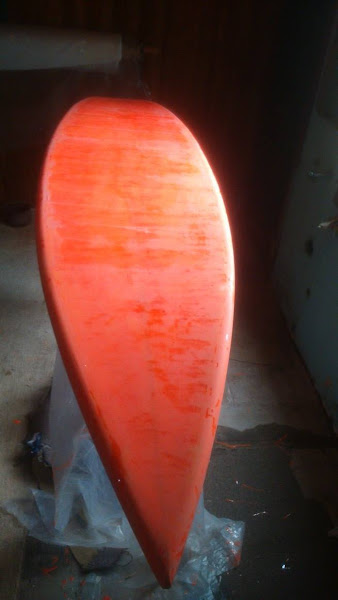
Anyway the number one problem is the position of the pitch fulcrum, that's the axis about which the board rotates when the nose is pitching up and down. With existing boards this fulcrum moves fore and aft through a big range as the board changes speed, when it pitches up and down due to surface chop and when the rider tries to turn. This movement is a natural thing in planing hulls but it requires the rider to apply a lot of input to keep it under control as it changes the handling reaction of the board as it moves. You'll notice the soft railed very narrow tail on my boards. That is a displacement tail. It produces very little planing lift, which reduces the fore and aft movement of the pitch fulcrum.It can also be sunk beneath the surface when under pressure, this further reduces the movement of the pitch fulcrum and at the same time gives the effect of a variable rocker .
To put it another way the tail on conventional boards produces a lot of lift, and this lift increases dramatically ( by the square) as speed increases and also as the leading edge of the wetted surface area and associated high pressure zone moves aft. The tail then takes over causing the board to pitch wildly, drive the nose rail in, or prevent the board rolling into turns. Displacement tails don't have this effect, they maintain a more stable and predictable reaction to control input.
So, no hard edges in the tail, reduced area, no fin cant, a constant rail section of a diameter which is larger than normally used in the tail, and redistributed volume is the key.
This kind of tail uses a planshape curve which does not accelerate towards the tail... basically a circular arc, this has benefits also for example when rolling the board to turn the nose is lifted and released, reducing or eliminating the rail catching which is the cause of so many ride failures.
The result is a board which can turn anywhere, has a very predictable response, and a smooth ride with less pitching. The board gets out of trouble in a self tending way instead of having to be managed constantly just to keep basic control, this leaves the rider free to plan and react to the big picture.
an essential element of this sort of board is a more central riding position, this gives far better balance and allows turning and trimming with less fore and aft weighting changes. tail ridden boards are fine in shorter lengths but are a menace for longer boards.