Select to expand quotekato said..
You lot need to go for a sail 
BTW I CAN beat all of you 
But you got sucked in to reading all this too, hey
Hey! I can beat you when you injure yourself again, and again, and again.......
We might be due for a nice easterly on the Weekend. Put your body where your mouth is! 
Select to expand quotekato said...
BTW I CAN beat all of you
But what sort of sail do you use, floppy leech or tight leech?
Yes agree, not trying to impress anyone, no need to give me the benefit of the doubt it is probably mostly crap  . Don't be too hard on me, I'm mainly just revealing my personal thoughts and na?ve theories to be in the conversation, while toying with the idea of doing some testing. Would normally prefer to keep thoughts to myself, but would like to throw some ideas around to potentially narrow down what best to focus on with twist testing and what to measure.
Objective evidence is lacking at this stage and I'm in no way convinced by my theories, it is mainly pure supposition (though informed by nearly 50 years of looking at the top of sails in practice with the odd throwing around of ideas with some interesting people).
'the flow on the upper sail is horrible' and with 'streamlines are way too long for the small camber on this part of the sail',
This really refers to (my) observations of the difficulty of ensuring nice cross-flow of air over the upper sail if it doesn't twist, especially in real-world dynamic conditions. Rake potentially exacerbates this by encouraging more flow from foot to head of the sail (and hence longer streamlines), effectively making the sail wider but there is so little camber in the relatively flat upper part of the sail that this flow is unlikely to be efficient, especially as airflow relative to the sail can also be fairly unsteady up there due to rig motion. It is likely 'very draggy' due to 1) the component of flow up the sail being not very useful to generate forward thrust so basically is likely just contributing to drag in an untwisted raked sail, and 2) without twist the orientation of the upper sail will likely not be at the optimum angle of attack due to the effect of the lower sail on the upper airflow.
Explian why the twist would line the streamlines up more acrosss the chord of the sail?
Explain what is'exhaust'and why it'corrects the airflow'
Pure conjecture here that the opening up of the mid-sail region due to twist allows air coming up from the lower sail to exit more freely and so reduce the proportion moving up the sail.
Explain why tight leech is 'old school' when it is designed into many modern sails - even windsurfing sails which win course races.
It seems that the tight leech does not result in the best orientation of the upper sail for race-sails. My guess is that is due to the influence of the lower sail.
So is the twist up top correct, or is it 'over twist'. If it is 'over twist', what is it doing and why is it correct?
Not sure if the amount of top twist is optimal, it is obviously hard to set this, but better to over-twist and loose a little thrust than under-twist and add a little more drag.
In summary, I don't really like trying to defend these ideas. My preference is to do some testing and find out what is really happening, otherwise it can certainly all just be "marketing crap". However, in order to do good testing it would be nice to have some well-defined questions and a good knowledge of what to measure and what to look for, otherwise the results of testing are likely to be somewhat unclear and inconclusive. Some good smoke videos? Measurements of sail forces? What sails and setups to test? Real-world or wind-tunnel? Full-size or scaled-down? What to look for? Hence my throwing around of some ideas relating to what might be happening.
I think the below point makes a lot of sense, especially when remembering the wind gradient the further up the mast. So not only to match the wind gradient, but then directs more force in a forward direction. I think that later point explains to a good degree why the rig feels faster and with better mast foot pressure to keep the board in control.
Changing Heeling Force into Forward ForceThis is not talked about much but it is the most important when thinking about making your boat go fast.The force acting on the sail from the wind can be thought of as being approximately in the direction perpendicular to the battens. As the sail is twisted out in going up the mast the force then shifts from sideways unwanted heeling force to desired forward driving force by the nature of its direction.
This then is very important. As you know, not only should you always have your sails let out as much as possible just before luffing to fly the sails efficiently but you should additionally be looking up the sail and adjusting twist as much as possible to translate the resultant force to be forward acting rather that sideways acting. Increase twist until upper sail luffing occurs then tighten slightly.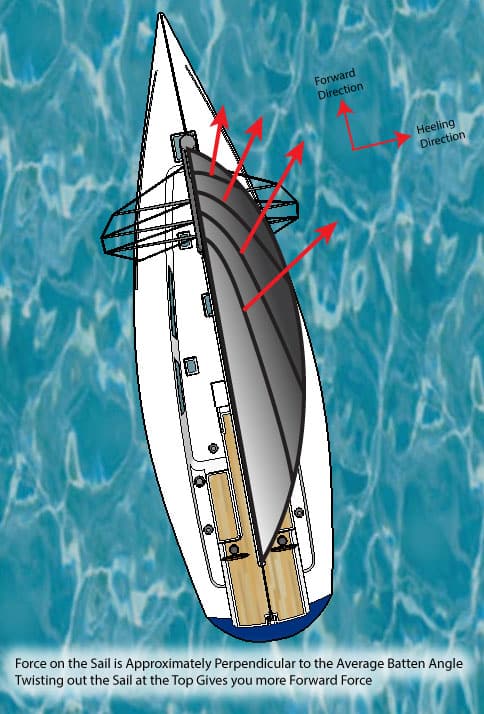
www.nauticed.org/sailing-blog/3-reasons-to-twist-your-sail-out/
Ahem....With all due respect Sailquik n Mathew. How is it that your questions n answers are more VALIDATED n CORRECT than any other poster on this topic? Others have simply put forward their ideas n yet with no evidence, for or against. You mostly fire from the hip whilst on your highhorse, a barrage of terms n quotes that you yourself cannot quantify or explain. We are all wanting n needing a solution as to why 'Twist is Necessary'. So sail development can be explained n understood n be developed to an even higher level, to drive us further n faster down the line. Towards the bigger better harder faster desire of the human spirit. Total Control of the now. In this case a windsurf sail.
Disclaimer- ive not had the experience nor ability to sail at your level. But my very inquisitive mind n thoughts are just as valid as your self righteous seemingly well schooled thoughts.
Until proven or dismissed EVERYONES posts here has a level of correctness. Although somewhat hard to explain as maybe the science just doesnt exist at this point in time.
Just because it doesnt align with your thought processes doesnt mean it is wrong. An open mind is needed to hunt for the solution. Thought this was a discussion to attain enlightenment on the TWIST topic?? Not a competition....
Yeah, sharing thoughts!
I love the drawing and text from poppydog. Is it we're being pulled or pushed, or both and does anyone know for sure?
All I know, I feel in my hands what's drawn and explained there.
Select to expand quotesailquik said..kato said..
You lot need to go for a sail
BTW I CAN beat all of you
But you got sucked in to reading all this too, hey
Hey! I can beat you when you injure yourself again, and again, and again.......
We might be due for a nice easterly on the Weekend. Put your body where your mouth is!
Done Thinking of all day at 45
Select to expand quoteolskool said..
Ahem....With all due respect Sailquik n Mathew. How is it that your questions n answers are more VALIDATED n CORRECT than any other poster on this topic? Others have simply put forward their ideas n yet with no evidence, for or against. You mostly fire from the hip whilst on your highhorse, a barrage of terms n quotes that you yourself cannot quantify or explain. We are all wanting n needing a solution as to why 'Twist is Necessary'. So sail development can be explained n understood n be developed to an even higher level, to drive us further n faster down the line. Towards the bigger better harder faster desire of the human spirit. Total Control of the now. In this case a windsurf sail.
Disclaimer- ive not had the experience nor ability to sail at your level. But my very inquisitive mind n thoughts are just as valid as your self righteous seemingly well schooled thoughts.
Until proven or dismissed EVERYONES posts here has a level of correctness. Although somewhat hard to explain as maybe the science just doesnt exist at this point in time.
Just because it doesnt align with your thought processes doesnt mean it is wrong. An open mind is needed to hunt for the solution. Thought this was a discussion to attain enlightenment on the TWIST topic?? Not a competition....
Hey mate, I dont have any answers, only questions and a few theories. That is my whole point. I love that others have all these other theories as well. I am certainly not saying I know more than anyone else. No high horses here. 
I do know how to spot unsubstantiated marketing jargon though......
I respect everyone that is willing to join the dicussion.
I would reverse your statement and say, until proven with evidence, NO-ONES posted theories are correct, definitly including mine. That are just theories, and I am not saying they might not have some validity, just that they are not backed up with science - YET.
Mathew thinks that humans 'know' all about aerodynamics. I dont agree. For sure, there are some specialist areas that have been studied in great detail with the very best science that are understood very well by those very smart people in those fields. Or at least we have very good working theories that hold up in specific situations. I am just disappointed that no one has put the vast amounts of time and money into the proper research of the windsurfing sail so that we have some hard data on that as well. And why would they? There is not millions of $$ at stake, or to be made in this area.
I would love to run a windsurfing sail experiment in the Monash wind tunnel, but that stuff does not come free or even cheap. Who would stump up the large amount of $$ to facilitate that??
Maybe we can find some other ways to find out something though. 
Select to expand quoteTGale said..
Yes agree, not trying to impress anyone, no need to give me the benefit of the doubt it is probably mostly crap . Don't be too hard on me, I'm mainly just revealing my personal thoughts and na?ve theories to be in the conversation, while toying with the idea of doing some testing. Would normally prefer to keep thoughts to myself, but would like to throw some ideas around to potentially narrow down what best to focus on with twist testing and what to measure.
Objective evidence is lacking at this stage and I'm in no way convinced by my theories, it is mainly pure supposition (though informed by nearly 50 years of looking at the top of sails in practice with the odd throwing around of ideas with some interesting people).
'the flow on the upper sail is horrible' and with 'streamlines are way too long for the small camber on this part of the sail',
This really refers to (my) observations of the difficulty of ensuring nice cross-flow of air over the upper sail if it doesn't twist, especially in real-world dynamic conditions. Rake potentially exacerbates this by encouraging more flow from foot to head of the sail (and hence longer streamlines), effectively making the sail wider but there is so little camber in the relatively flat upper part of the sail that this flow is unlikely to be efficient, especially as airflow relative to the sail can also be fairly unsteady up there due to rig motion. It is likely 'very draggy' due to 1) the component of flow up the sail being not very useful to generate forward thrust so basically is likely just contributing to drag in an untwisted raked sail, and 2) without twist the orientation of the upper sail will likely not be at the optimum angle of attack due to the effect of the lower sail on the upper airflow.
Explian why the twist would line the streamlines up more acrosss the chord of the sail?
Explain what is'exhaust'and why it'corrects the airflow'
Pure conjecture here that the opening up of the mid-sail region due to twist allows air coming up from the lower sail to exit more freely and so reduce the proportion moving up the sail.
Explain why tight leech is 'old school' when it is designed into many modern sails - even windsurfing sails which win course races.
It seems that the tight leech does not result in the best orientation of the upper sail for race-sails. My guess is that is due to the influence of the lower sail.
So is the twist up top correct, or is it 'over twist'. If it is 'over twist', what is it doing and why is it correct?
Not sure if the amount of top twist is optimal, it is obviously hard to set this, but better to over-twist and loose a little thrust than under-twist and add a little more drag.
In summary, I don't really like trying to defend these ideas. My preference is to do some testing and find out what is really happening, otherwise it can certainly all just be "marketing crap". However, in order to do good testing it would be nice to have some well-defined questions and a good knowledge of what to measure and what to look for, otherwise the results of testing are likely to be somewhat unclear and inconclusive. Some good smoke videos? Measurements of sail forces? What sails and setups to test? Real-world or wind-tunnel? Full-size or scaled-down? What to look for? Hence my throwing around of some ideas relating to what might be happening.
Thanks TGale. I really do appreciate your posts, and making the effort to explain what your ideas are.
As you say, the first thing one needs, to do some real experiments, are some good hypothesis. Yours are obviously very well thought out.


Select to expand quotesailquik said..
I would love to run a windsurfing sail experiment in the Monash wind tunnel, but that stuff does not come free or even cheap. Who would stump up the large amount of $$ to facilitate that??
Simple, it's a university, find a PhD student that wants to do it as a thesis. Can also look at the Australian Maritime College in Launceston. They have one of the only naval architecture courses in Australia, and usually they have some keen dinghy sailors, windsurfers and kitesurfers amongst their students.
Other place to look would be the University of Auckland, they have a strong yacht design group in their naval architecture course, and they have a twisted flow wind tunnel (i.e. they can deflect the air to different angles at different heights to simulate wind shear). This is only 3.5 m but may be enough to fit a small or scaled down windsurfer rig heeled over and raked back.
Edit, just saw Ian K's comment, Auckland also has a boundary layer wind tunnel, but only 2.5 metres high, so would need to use a scale model of a windsurfer rig
Select to expand quoteIan K said..sailquik said..
I would love to run a windsurfing sail experiment in the Monash wind tunnel, but that stuff does not come free or even cheap. Who would stump up the large amount of $$ to facilitate that??
It would be interesting but not conclusive. Monash uni has an aeronautical wind tunnel. It is used to investigate cars and things going fast through still air. We need a boundary layer wind tunnel. Boundary layers build up in aerodynamic tunnels of course but over the length of the tunnel it won't get to a useful ( for us ) thickness. But even the biggest and best boundary layer tunnels won't take a full-sized windsurfing rig, so you'd have to scale down. That won't be easy. I tend to think even our best science is going to have trouble with this one. Windsurfing does have the advantage of rapid evolution. The best sailmakers can quickly tweak prototypes.and the best testers can give accurate feedback just on the feel of the rig without the hours of match racing needed by those sailing larger boats controlled through cogs and pulleys.
Yes. there will be a difference.
In the heyday of Sandy Point speed from 1988-to early 90's and especially from 2004-09, one of the outstanding advantages we had was very smooth wind over the spit. Sure, there must have been boundary layer turbulence, but it was low on the scale. This was very noticeable from the sand moving over the spit to the very steady nature of the wind and its effect right down low in the sail to water level. We were using smaller sails than many would believe. The wind was very effective. Fast forward 10 years and we now have far more turbulent wind caused by the build up of some sand dunes. Even in the gaps between them, the wind is noticeably less smooth than it used to be. To get the same sort of speeds now we need a much stronger storm and larger sails. And control in the turbulence is trickier. It is very noticeable.
When I went to Luderitz in 2013, I was shocked at how turbulent the wind was, and how poorly the bottom of the sail worked in it.
Lake George, SA is another very good example of smooth wind down to very close to the water. In the classic summer Sou'Easter, the wind down near Cockies and the spit is very smooth. I vividly remember standing on the shore at Cockies on 26-01-2012, measuring the wind with my Anemo anemometer. I was amazed at how little the needle was varying. It was a very steady 30 knots, only varying by hardly more than a knot either side for long periods. That was the day that all the best Australian NM PB's were done, and still stand very close to the top internationally, and still my Ihr and NM PB day.
In later years we have tended to sail further SE on the lake due to varying water levels and weed growth. The wind up there comes over the low dunes between us and Beachport, and it is much more turbulent. The thing is though, I have done some of my best LG 2 second peaks up there in the inevitable gusts, which, if you catch onto them, are a bit stronger than the smoother flow on the other side of the lake.
Likewise a year later on 01-03-2013, Brad Anderson shattered the 1Hr world record and also did a 47.95 Knots 2 Sec in almost idential wind conditions. Again, I doubt if the wind was much over a true 30 knots, (it wasnt when I was measuring it) but the nature of it, and some outstanding windsurfing talent, produced amazingly efficient speeds for the wind strength.
I live for the day when the weed returns to the surface for the full width between the 5-mile and Cockies. Watch the records and PB's drop then! 
Select to expand quotePacey said..sailquik said..
I would love to run a windsurfing sail experiment in the Monash wind tunnel, but that stuff does not come free or even cheap. Who would stump up the large amount of $$ to facilitate that??
Simple, it's a university, find a PhD student that wants to do it as a thesis. Can also look at the Australian Maritime College in Launceston. They have one of the only naval architecture courses in Australia, and usually they have some keen dinghy sailors, windsurfers and kitesurfers amongst their students.
Other place to look would be the University of Auckland, they have a strong yacht design group in their naval architecture course, and they have a twisted flow wind tunnel (i.e. they can deflect the air to different angles at different heights to simulate wind shear). This is only 3.5 m but may be enough to fit a small or scaled down windsurfer rig heeled over and raked back.
Edit, just saw Ian K's comment, Auckland also has a boundary layer wind tunnel, but only 2.5 metres high, so would need to use a scale model of a windsurfer rig
LOL! I am a bit too old to start another Degree, let alone a PhD! But you are right I recon. Finding an interested student would probably be the only way it will happen.
I recon I could fit a 4.2m Koncept on it 340cm mast in that 3.5m wind tunnel. (I have a few laying around if any students are interested.)
Select to expand quotesailquik said..
LOL! I am a bit too old to start another Degree, let alone a PhD! But you are right I recon. Finding an interested student would probably be the only way it will happen.
I recon I could fit a 4.2m Koncept on it 340cm mast in that 3.5m wind tunnel. (I have a few laying around if any students are interested.)
Come on Andrew, you are never too old for a PhD. Think of it, you have the background knowledge, the equipment, the motivation, you are in the right state for Monash, and at the end people will call you Doctor Daff!
And you would get the unquestioning respect of everyone on this forum!
What could be better?
^^ Cmon Sailquik;-) So heres a how i percieve our scenario. Maybe right maybe wrong. A windsurfer is a quite unique sailing vessel. We have a largish waterline length n surface area when sub planing. But once planing, surface area n waterline length are drastically reduced. The force required Hydronamically harnessed by the rear mounted fin. To achieve this we firstly need a reasonably large sail area to provide the power needed to achieve planing. Once planing with massively reduced friction, we then require much less power to stay planing. Twist is therefore needed to depower n control the sail n cope with the increased apparent wind generated n lessened surface friction.
Compared to conventional sailing craft we use a very soft mast which is designed to flex off the wind when powered fully. It also needs to be raked back to align the power closer to the fin. This is where we become very different to conventional sails n theory. We dont have a vang or cunningham to alter sail shape. Hence the TWIST must be built in to the sail.
I notice most sail makers have recently all moved closer to the Constant Curve style mast. Must be for some reason??
We also have a less sciencey parallel thread running in the general forum. 'Who made the first loose leech sail.' By Nubie. Basher gives a pretty good explanation which seems to make sense.
How about this , Maybe the top outside part is just flapping about and sometimes supporting the part below . But has anyone thought that the mast and the six inches behind it before it twists off is making power . So we got two uses , a thin blade type of sail up top + a support for the sail below when needed . When its not needed it just bends out of the way doing nothing .
When you are going fast it seems to flap in tune with the bouncing over water . Seems to flex out of the way when hitting a bump , (depowering ) , and going tight ( making more power with a tighter leech ) , when getting light . This is a good sequence rather than the other way around , ( catapult city here we come ) . Thats why the more carbon , quicker responding masts have less lag in trying to keep up with the flapping sail ???
I think it boils down to this...a Holy Grail so to speak....sail designers should design leach twist into the shaping of the sail so that it sufficient to spill excess wind and provide some forward drive but maintains enough skin tension in smooth or lighter wind to twist less and develop more lift.
I have seen many sails over the years that sit with permanent radical leech twist or floppy leech when rigged on the beach. This is a no-no. Often these sails are by companies who claim to be at the forefront of sail design but as Sailquick points out trade on marketing bull with regularity. This is happening less now than in the past which is a good thing, as all major sail brands make sails that are almost identical in concept.....
There...and not a sciency word in it.
Select to expand quotePacey said..sailquik said..
LOL! I am a bit too old to start another Degree, let alone a PhD! But you are right I recon. Finding an interested student would probably be the only way it will happen.
I recon I could fit a 4.2m Koncept on it 340cm mast in that 3.5m wind tunnel. (I have a few laying around if any students are interested.)
Come on Andrew, you are never too old for a PhD. Think of it, you have the background knowledge, the equipment, the motivation, you are in the right state for Monash, and at the end people will call you Doctor Daff!
And you would get the unquestioning respect of everyone on this forum!
What could be better?
Just using what time I have left to go sailing and surfing? I've got too used to have no commitments or schedules to keep.
Select to expand quotejuicyfruit said..
I think it boils down to this...a Holy Grail so to speak....sail designers should design leach twist into the shaping of the sail so that it sufficient to spill excess wind and provide some forward drive but maintains enough skin tension in smooth or lighter wind to twist less and develop more lift.
I have seen many sails over the years that sit with permanent radical leech twist or floppy leech when rigged on the beach. This is a no-no. Often these sails are by companies who claim to be at the forefront of sail design but as Sailquick points out trade on marketing bull with regularity. This is happening less now than in the past which is a good thing, as all major sail brands make sails that are almost identical in concept.....
There...and not a sciency word in it.
I tend to agree that the Holey Grail is dynamic Twist. Not many race or speed sails seem to have it these days. Just massive, floppy head static twist.
Select to expand quotejuicyfruit said..
I have seen many sails over the years that sit with permanent radical leech twist or floppy leech when rigged on the beach. This is a no-no. Often these sails are by companies who claim to be at the forefront of sail design but as Sailquick points out trade on marketing bull with regularity. This is happening less now than in the past which is a good thing, as all major sail brands make sails that are almost identical in concept.....
That's fine, except some of the fastest sails in the world have that super floppy leech design. I don't understand it, but you can't argue with the evidence. Although my larger sails are 2018 KA Koncepts, I actually bought a 5.5m Severne Mach 2 to try for myself, and when I set it up the first time I couldn't believe how loose the leech was. I still haven't had a chance to sail with it due to lack of wind, but I'm very keen to try it out and see how it feels to sail with such an open leech.
Although I don't understand why this style of sail should work well, I'm keeping an open mind, rather than blindly rejecting a foreign concept because it clashed with my worldview.
When I pump a sail onshore I can feel in my hands what works. A sail, when pumping feels either as if it holds a lot of forward thrust or sideway pressure. When on the water I feel the same in the gust. Similar for sail handling. On one sail you need to close the gap in order to be fast. On another you can open the sail.
The best sail for lightweigths is the sail that requires the least amount of force at the maximum amount of forward thrust.
Twist is more than a friend in achieving that goal, but only if that twist supports. Hence I need to rig my sail in a way the twist is still functional and indeed does not feel draggy during accelleration as mentioned by someone earlier. At a fixed speedbank or when rigging smaller I can get away with less downhaul and thus twist. At an open course and when forced to sail larger I need massive twist.
This is also where the advantage of the taller and mostly heavier riders comes in as for these large sails that need massive downhaul to properly work, you need large boards and large fins. They all are in favour of the taller rider.
So, what if I turn things around and I want to have an advantage set against the tall and heavy. This is what struck and strikes me still and I can feel the answers in my hands while pumping a sail on the shore. I can tell from the numbers on my GPS dial what I think is correct. Thus enabling me to hand back info the the sailmaker with whom I am working closely together.
The main goal being more power per size at enough release and overall breathing capacity in order to be able to progress from large, draggy and heavy sails to small, high efficient sails with a theoretical way higher endspeed. As because of the PWA, the focus is on designing the big sails, this aspect in sail development is mostly forgotten. To me that's a shame as all would benifit. As...a tall, strong rider would still be a tall strong rider. He could choose to go for 7.7 and a 115 litre board while I am on the 5.0 and be truly competitive on an open water speedboard.
On a speedcourse he would be on a 5.7 and I would be on a 4.3. Weight shouldn't and wouldn't have to be a factor but in the now it mostly is. As soon as sailmakers are opening up to this line of thinking we also draw in the youth as they stand a chance based on pure talent.
In order to get answers in that work for all we need to think about all and all options at hand.
From what I've seen so far within this topic, I am most impressed by those who come from a "gut feeling" and/or organic theory, as many guys focussing on physics only are able to show our shortcomings in the now. Things could and would change when we get in lots of sensor information but then still I would be convinced it's the rider giving feedback on what he or she feels will be the most important factor as we ourselves are the best sensor available on the market. Physics is a help to solve the equation to find the optimum twist, but it will not be the sole solution, no matter how many sensors you put onto the rig, board and fin.
A very valid approach. All well and good if you have acces to continuous development sails to try.
Or trust the sailmaker for doing his job based on the information presented. In person I don't mind I have to wait, as long as our comments as small riderteam are being taken seriously. Like waiting for wind, that's also part of the equation.
Select to expand quotePacey said..That's fine, except some of the fastest sails in the world have that super floppy leech design. juicyfruit said..
I have seen many sails over the years that sit with permanent radical leech twist or floppy leech when rigged on the beach. This is a no-no. Often these sails are by companies who claim to be at the forefront of sail design but as Sailquick points out trade on marketing bull with regularity. This is happening less now than in the past which is a good thing, as all major sail brands make sails that are almost identical in concept.....
Fastest sails, or fastest sailors using them? How can we really say unless it's tested?
I suspect if you put Antoine Albeau on any dynamic twisting sail he'll go faster than 99% of sailors on super twisting sails.
I think NP's EVO sails and KA sails use what one could call dynamic twist, whereas Severne uses more radical permanent twist built into the seam shaping.
I have just been reminded by the other' loose leech' thread in 'General', that Gaastra made the ADTR back in 1986 and used load sensors and computers to record data.
That has to be about the most concrete scientific testing ever done on a windsurfing sail.
Quote from Roo:
"What we found was, the more you offloaded the head of the sail, the less the healing moment was, that's what you could see and was recorded in the numbers when the tip of the sail was pushed up and the angle of incidence changed. We had lots of data collected over a few years testing. Twist was a way to make the sail easier to handle rather than reduce drag."
Thats exactly what one of our main theories was. (Lower CoE/easier hadling) And there is data to confirm it.
Hmmm, maybe a reincarnation of the ADTR would be doable? Might actually be better for some things than a wind tunnel?
Pictures by Roo:


So I want a sail that's light in feel, Sets nicely sheeted in and closed the gap.
where I can relax back into harness with lots of forward drive so I'm not overloading fin. That takes full advantage of apparent wind to cruise through lulls. Is balanced as I roll over into a lay down gybe and light as I flick it around.
If it is loose leach or tight or octagonal, it doesn't matter.
although price does matter and longevity.
Select to expand quoteRAL INN said..
So I want a sail that's light in feel, Sets nicely sheeted in and closed the gap.
where I can relax back into harness with lots of forward drive so I'm not overloading fin. That takes full advantage of apparent wind to cruise through lulls. Is balanced as I roll over into a lay down gybe and light as I flick it around.
If it is loose leach or tight or octagonal, it doesn't matter.
although price does matter and longevity.
Dont we all!
But you claim the design doesn't matter as long as it works the way you want: An ugly sail? Does that matter? The graphics designers and marketing poeple will be having fits!