So much fun to argue about what we believe (or not), especially if we can bash marketing departments in the process!
For sail boats, there are a number of studies that looked at actual pressure measurements and CFD simulations, for example a master's thesis "Derivation of Forces on a Sail using Pressure and Shape Measurements at Full-Scale" at
publications.lib.chalmers.se/records/fulltext/147899.pdf and another one at
hal.archives-ouvertes.fr/hal-01071323/documentThat's a bit different from the question Andrew was asking, though. I bet there have been some big studies for the America's Cup boats, but those are probably closely guarded.
Part of the problem might be the computational complexity. Good CFD simulations for fins are hard enough, but at least there, the speed is constant over the length of the fin, and the fin shape is (relatively) stable. For sails, the wind speed changes from bottom to top, and one of the most important performance aspects is how the sail reacts to gusts. Part of that reaction is a change in mast bend and therefore sail shape, which in turn changes the flow. Besides having a lot more variable in the simulation, they are closely coupled rather than independent, which creates a bit of a computational nightmare (and strongly limits the usefulness of "simple" CFD simulations). Reminds me a bit of my masters thesis, which was about calculating the result of interactions between coupled complex electronic oscillators in one dimension. A much easier problem

.
In comparison, gathering empirical data about forces on the sail should be easier. What is the
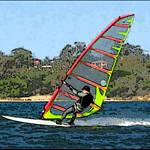
actual distribution of forces in a windsurf sail? How much does the loose top section contribute? How do things change in gusts? All we need is an aerodynamics professor and a windsurfing grad student in search of a thesis theme...



 . Measured numbers might shed some light on whether the loose top of the sail works primarily as a "drag reducer" like a winglet, or adds lots of extra forward momentum, or whatever else your favorite hypothesis is. Although it probably will be more a "how much" rather than a "yes or no" thing.