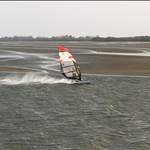
Going FAST:
To go fast one has to be in the right place, at the right time, on the right gear.
And then of course, one has to have the level of skill, fitness, motivation and confidence to do the deed.

Breaking it down:
The 'right place' is some where with flat water at the ideal angle to a very strong wind.
We are very much at Natures behest on this one. Venues and conditions change over the years. Arguably, the fastest place in the world from 1988 until about 2010 was the speed strip at Sandy Point. GPS speed results from 2004 to 2010 from this venue dominated the GPS world speed results. This venue is no longer consistently anywhere near as fast due to the physical changes evolving. A couple of specially built canals have dominated record speeds in that time and to the present, but they are accessible by only a very small number of windsurfers at sporadic intervals, so you won't really see much influence of them on GPSTC speeds.
New venues were discovered and exploited in Europe, particularly in the Netherlands and France since then and the fastest speeds now regularly come from those places. Weather patterns go in cycles so the ideal strong winds do as well. It can be many years between weather patterns (and water conditions) that favour a particular venue. Lake George is an example of that, where the best speeds were done in 2012-2013 when conditions, both wind and water, were exceptional, and have not been quite that good since. Budgiewoi, Primbee, Albany, Wellinton Point, Barrun Heads etc, have had exceptional conditions at different times over the years.
The 'right time' is the day hour and minute where the very strongest or best wind comes through at that 'right place', and all the other factors are at the optimum. The more often that happens, and the more often one can be at just the right place when it happens, the more often you will be able to go fast and the more likely you will be to achieve a PB.
The 'right gear' is the best combination of fin, board and sail for the conditions and you ability and size. This is highly variable according to all the other conditions and can take a lot of experience and analysis to optimise. Subtle differences can make a big difference. The 'combination' is far more important than any one element. As conditions and venues change, and of course the size and skills of the sailor, so do the ideal combinations.
Equipment: Much of the development of equipment over the last 15 years had been optimisation for a variety of particular conditions. eg: There is a greater variety of different sized speed boards and small slalom boards available. They is certainly a huge variety of speed fins available now to suit a huge variety of conditions, from open ocean to speed canals and the huge variety of weedy flat lakes. My current small slalom boards are demonstrably 2-3 knots faster across the wind and far easier to gybe than those I have from 10 years ago. My current fins are noticeably more secure from those I was using 10 years ago and that makes them faster for me most of the time, even if their ultimate theoretical top speed potential is no better. Likewise, my current sails are noticeably easier to sail on the limit than those from 10 years ago (and yes, I have kept some of the best of those and sailed them regularly for reference).
Human factors: The windsurfing population in general is ageing. Many of the same sailors who were in the top 50 speeds have not changed. Speaking for myself, I know I am not as fit and strong as I was 15 years ago, and I don't have the same disregard or my personal safety as I did then. I tend to sail a little more conservatively and take fewer risks when things get really wild and when there is the highest potential for exceptional speeds. I am guessing that I am not the only one.


Physics: It's pretty clear that we have got very close to the speed limitations of our current windsurfing 'platform' without some big breakthrough. The saying that "insanity is doing the same thing over and over and expecting a different result" seems to be appropriate here. Sure, there are still small gains to be had around the margins, but we won't ever see the massive progress we saw between 1980 to the early 2000's
Meanwhile, I dream of the day when conditions are such that I can again try for a 40 knot Nautical Mile PB, straight down the middle of Lake George.