This might be interesting to follow. I thought I'd the share the Black Art of composite and epoxy snapped board repair. I'm still on a steep learning curve.
I got inspired to take on a challenge after following Rider1"s thread. Mike has been very generous in passing on some specific information learned from experience.
Thanks to Appleman for donating the patient.
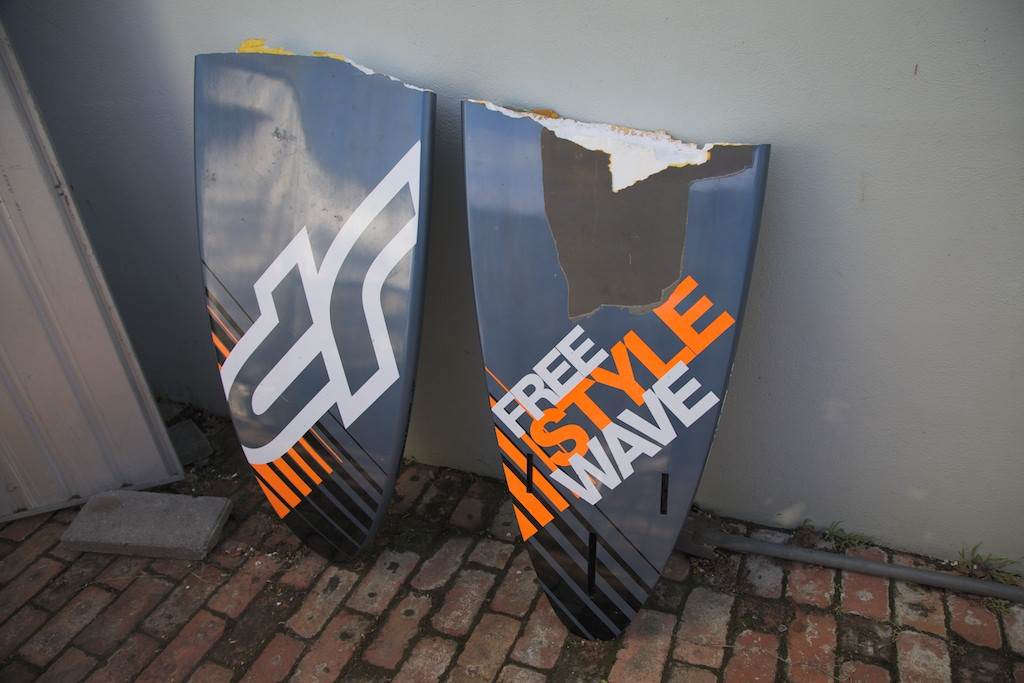
The snap was pretty clean with minimal buckling and delamination.
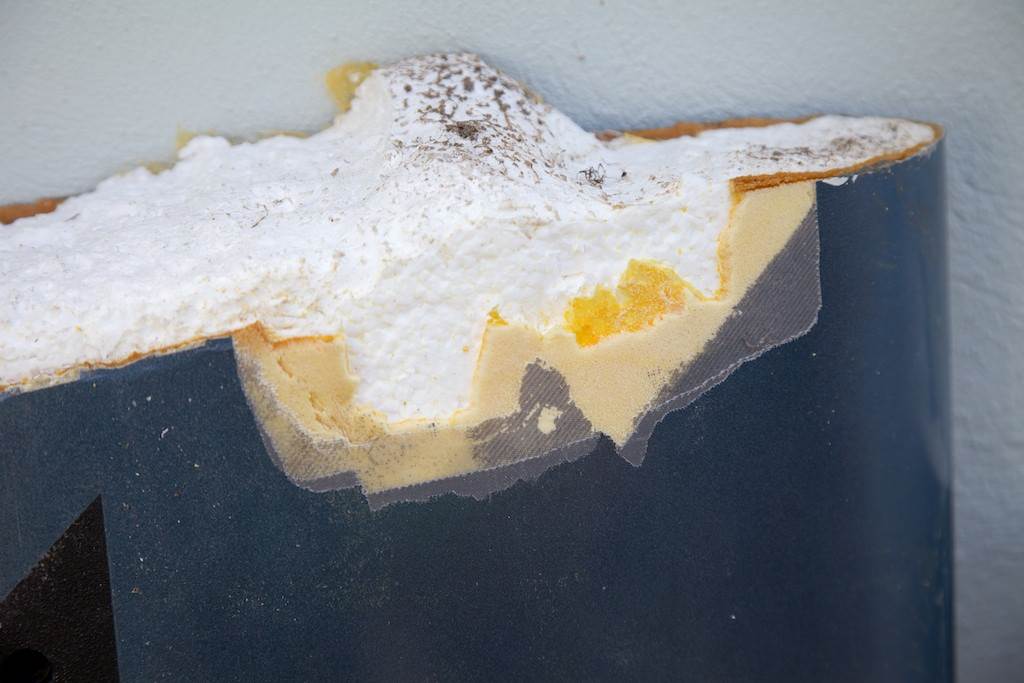
Both sides of the EPS core hollowed out to give the bonding agent a key.
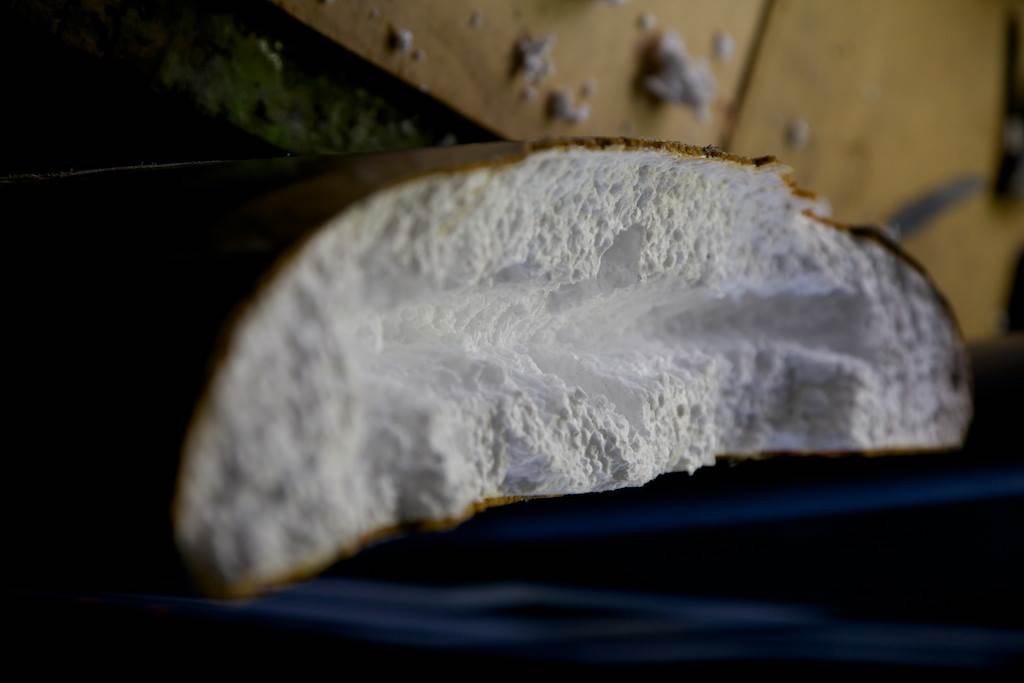
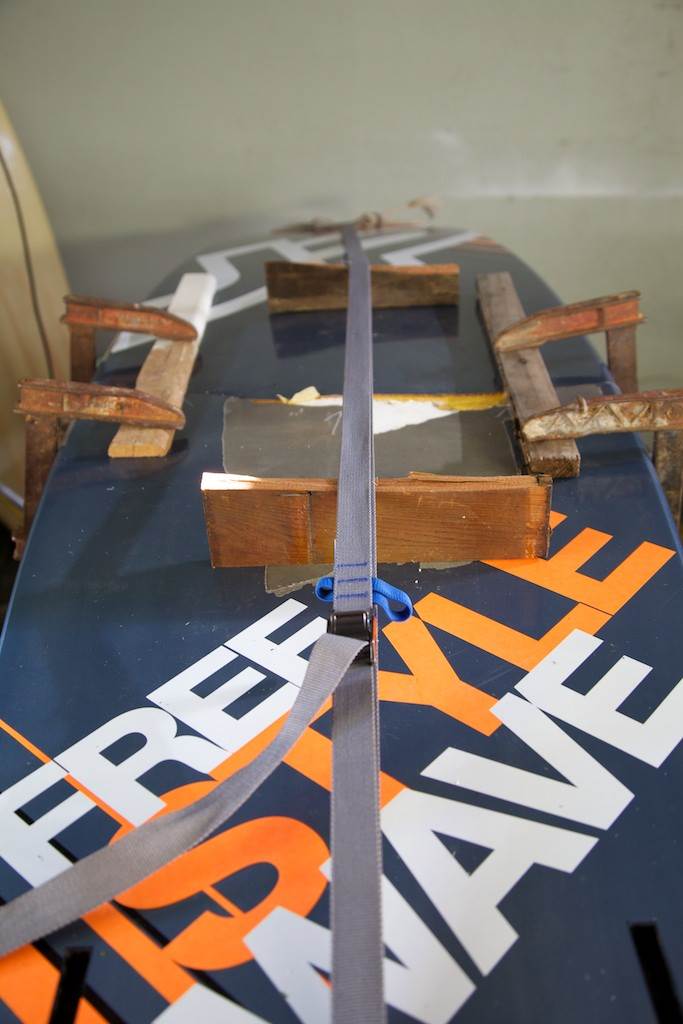
Two halves mated, clamped, aligned and placed under tension ready for Polyurethane foaming resin injection. Stringers are not a good idea. The EPS foam is basically only a mould. Inserting stuff only adds weight. The core has no strength to hold rigid additions. The Polyurethane foam has excellent bonding properties. The majority of strength, or lack of it in modern epoxy water toys is in the shell.
Holes drilled for injection. Note arrows marking hollowed EPS. 100ml of foaming resin injected. Polyurethane foaming resin will expand 5X at least. The chemical reaction will generate heat too so the foam should be allowed to vent. Not too much... It needs to force into every crevice. Sorry no pics of foaming I had to be fast. The stuff has a mind of it's own once it kicks off. It's like a shaken punctured bottle of Coke with the consistency of whipped cream spewing allover the pace only 100 X stickier. I leave the syringes inserted with the plungers out, pour mixed resin in to each and pump it in. Previous disasters have taught me more than three syringes at a time results in an uncontrollable volcano and bulging laminate.
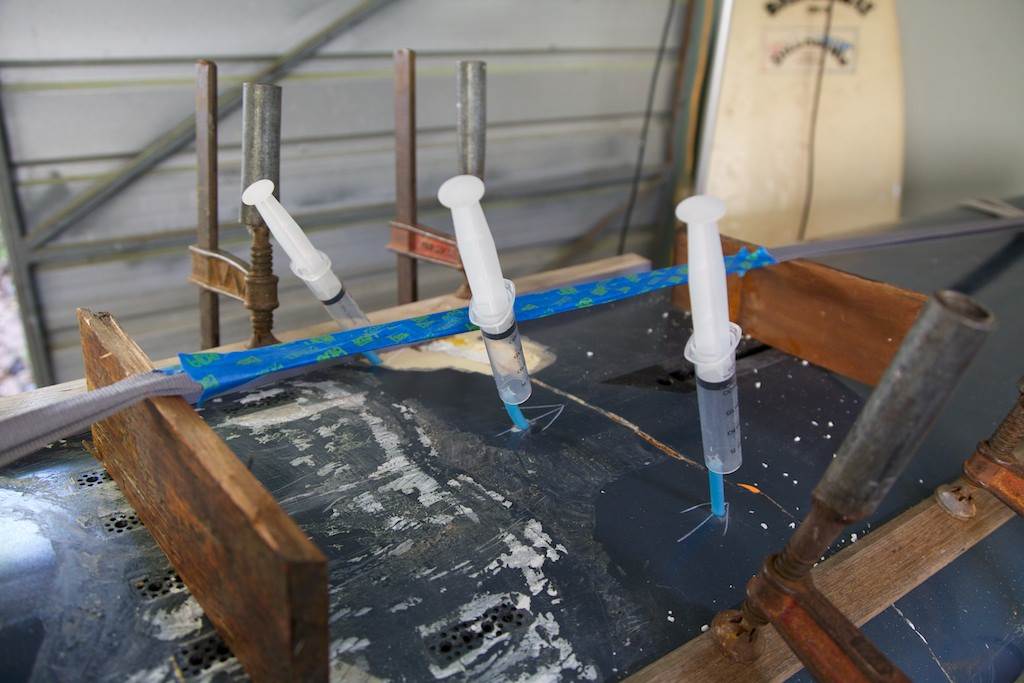
United! Ready for the tricky part; Reproducing the composite skin around the fracture. The challenge is to replicate the original construction to maintain flex and keep weight to a minimum at the same time as adding strength.
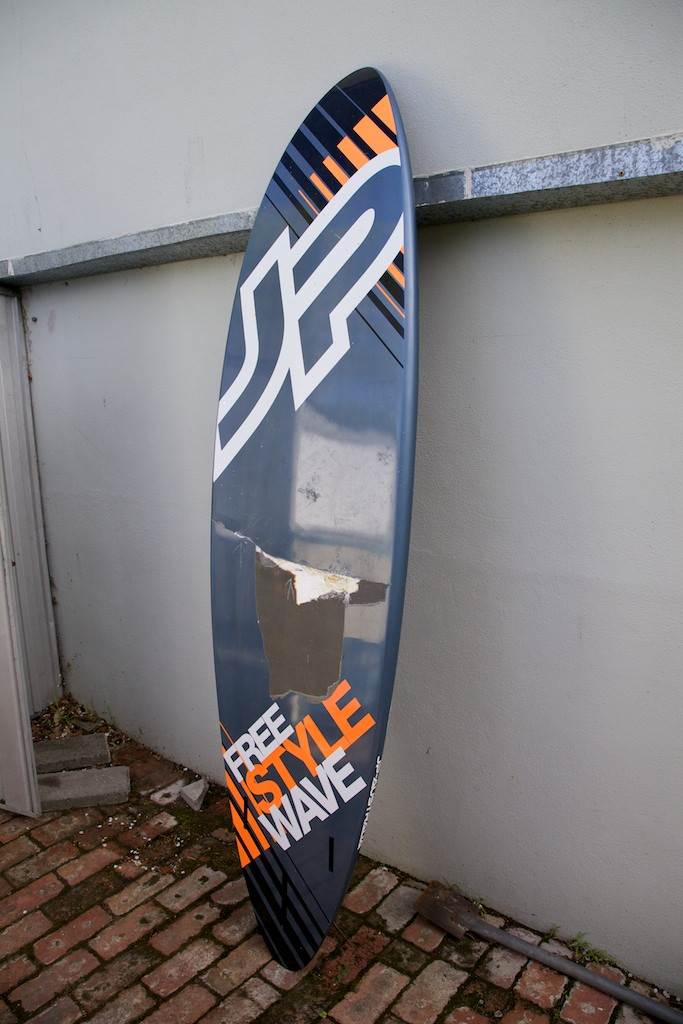
Good research Paul and the results look excellent so far. Should have given you my delaminated Simmer instead of attempting the half assed job I did. Live and learn.
Very inspiring!
- Where are you buying your divinicel from ?
- Does the expanding foam breathe.... i.e. allow air movement, so you aren't creating a compartment which isn't vented?
- Have you got a vacuum bag setup?
I used to scoff at people who had Dremmell tools. I have one that has an adjustable foot to control cut depth accurately and avoid hacking the EPS core.

There is minimal damage to the EPS. I'll fill it with Q-Cell before applying the new skin

I gave the Rider1 designed home made vacum bagging system a test run. I used hydraulic fittings into which the hose pushes without tools, creating a perfect seal. The coupler is a boat skin fitting with neoprene washers sandwiched between steel and nylon washers. A 1/4 $ of the purpose made vac coupler. No leaks!

I couldn't understand why there was no vacum at first....The vent plug was missing on the deck! The air was being sucked through the EPS core.

After the plug was screwed in it vacced down fine.

I added a check valve rather than a vacum chamber to stop loss of vacum if the fridge compressor sucking the air out fails.
I'm going to have a spare standing by in case the fridge compressor chucks it.

not better....different. Enjoy bringing junk back to life  .
.
Might make a whole board next 
Select to expand quoterobdddd said..
Very inspiring!
- Where are you buying your divinicel from ?
- Does the expanding foam breathe.... i.e. allow air movement, so you aren't creating a compartment which isn't vented?
- Have you got a vacuum bag setup?
Divinycell is available at The Fibreglass Shop in Argyle St. There are other suppliers In Moonah and Kingston.
I think the Polyerethane foam join will breathe because the areas of EPS around the hollowed out ares were under compression when the foam was injected and would have excluded the new foam. When vacuum was applied it seemed to suck down evenly which may suggest even breathing.
In any case the project is an experiment to see if it's possible to get a board run over by a truck strong and sailing again as well as not gaining significant weight.
I built a vacuum bagging system based on Rider1's set up. He has a thread on Wavesailing; "What's Mike Up to now"
mine cost just over $100. I was extravagant; using hydraulic fittings rather than hose clamps etc. The pump is an old fridge compressor, which cost a six pack.
Select to expand quoteRelic said..
I used to scoff at people who had Dremmell tools. I have one that has an adjustable foot to control cut depth accurately and avoid hacking the EPS core.
How come the skin come away from the core so cleanly? you only dremmeled around the perimeter?
Select to expand quoteRelic said..
This might be interesting to follow. I thought I'd the share the Black Art of composite and epoxy snapped board repair. I'm still on a steep learning curve.
I got inspired to take on a challenge after following Rider1"s thread. Mike has been very generous in passing on some specific information learned from experience.
Thanks to Appleman for donating the patient.

The snap was pretty clean with minimal buckling and delamination.

Both sides of the EPS core hollowed out to give the bonding agent a key.

Two halves mated, clamped, aligned and placed under tension ready for Polyurethane foaming resin injection. Stringers are not a good idea. The EPS foam is basically only a mould. Inserting stuff only adds weight. The core has no strength to hold rigid additions. The Polyurethane foam has excellent bonding properties. The majority of strength, or lack of it in modern epoxy water toys is in the shell.

Holes drilled for injection. Note arrows marking hollowed EPS. 100ml of foaming resin injected. Polyurethane foaming resin will expand 5X at least. The chemical reaction will generate heat too so the foam should be allowed to vent. Not too much... It needs to force into every crevice. Sorry no pics of foaming I had to be fast. The stuff has a mind of it's own once it kicks off. It's like a shaken punctured bottle of Coke with the consistency of whipped cream spewing allover the pace only 100 X stickier. I leave the syringes inserted with the plungers out, pour mixed resin in to each and pump it in. Previous disasters have taught me more than three syringes at a time results in an uncontrollable volcano and bulging laminate.

United! Ready for the tricky part; Reproducing the composite skin around the fracture. The challenge is to replicate the original construction to maintain flex and keep weight to a minimum at the same time as adding strength.

How'd you break it in the first place?
Nice job at breaking & fixing!
My learner driver daughter reversed over the board in the driveway paracticing clutch controll in my Land Rover. She popped the clutch and the two tonne monster lurched into the board which was minding it's own business leaning up against a fence. Lucky though the airbags didn't go off. It looked like something out of one of those AMMI car commercials.
Remains to be seen if the repair works. It's not easy joining Ito the original composite.
Azzzza a lot of care was taken getting the bottom off. I've butcherd cores removing laminates in the past. I sett the cutting depth of the Dremmell so it only cut throug to the top of the bottom layer. Then cut small areas out one by one, carefully removing the top layers then sliding a home made tool made from thin flat tool steel under the bottom layer peeling carefully. A little heat from a heat gun helps but extreme care is needed to avoid a meltdown!!
Might be a fair few more of these repairs during the "summer of loop" inspired by an apple beating gravity
Select to expand quoteFlouro1 said..
Might be a fair few more of these repairs during the "summer of loop" inspired by an apple beating gravity
Get your health insurance for orthopaedic surgery paid up too!
Waiting for the rain to stop, so I took out a bit extra along centreline. I'll lay a single bias carbon fibre strip down the centreline layed up between the 3.5 Oz glass & Corecell the aim to restore some longitudinal strength.
I've used single bias for fractures before with success.

Skin layers roughly feathered out. A bit of sanding to be done.

3.5Oz glass, single bias carbon and Corecell. Then a laer of Carbon fibre over the Corecell.

Single bias has stiff strands running in one direction. It provides rigidity.

Divinycell fitted, 3.5Oz & single bias strip laid up. Into vacum bag for the vac pump's first use.
It took ages to suck air out. The fridge compressor doesn't move a lot of volume. I'll get more air out before I seal it next time


I reckon you should try replacing fin boxes - that would be a really worthwhile skill / knowledge / talent to have. Fin boxes are so exposed to damage, especially on our new sand-free north coast, and with those big Budha rocks lying in wait. I am surprised that no one has torn their boxes out yet. Yep, replacing fin boxes should really be your next task I reckon Mr Fanatic Frankenstein...
...besides, I want to turn my 66 litre single / quad into a twin. Evil - Pfffff...it would be downright SATANIC!
Order US Boxes from Chinook, Mark where, Hack holes, Bung em in. US boxes are the only ones i've done. Better IMO put long ones in for tunability.
Have a look at "What's Mike UpTo Now" on Wavesailing thread. He did full box installation. Interesting to see how.
Next step...
Carbon fibre cloth ready for resin. "Wetted out"on table before laminating onto Dyvinicell


Much better suction on the second try because I was careful putting the bag on . Note peel cloth and breather fabric over laminate

There have been some distractions slowing down the project. One being a crunched rail which happened at one of our favourite rocky points. It's my most used ride immediate attention needed.
I'm aiming for water tightness and maintaining strength, although a small hole can't be too much of a concern. Matching the finish would be a Picasso like task.
After a wash to get salt out and few days of sun baking in the living room she's all dried out ready for treatment.


Blue tint from the fibreglass shop works a treat for keeping that rail colour. Only need a tiny bit in the mix.
Select to expand quotebuzzy said..
Blue tint from the fibreglass shop works a treat for keeping that rail colour. Only need a tiny bit in the mix.
Thanks Buzzy.I need a kg considering how often this board gets crunched!
3 major repairs and it becomes a Buxton point board in my book ,my kode 88 will hopefully never be sailed there.
I looked up after a wipeout to see my 106 sitting on those two inside rocks completely dry. A wave beat me to the rig and launched the whole lot up and over those rocks without a scratch .( Now known as the miracle of Buxton point ) 
Now I'm thinking I'm glad I missed the 2 sessions there, I don't like crunched gear 
Sanded


Hardly worth galssing but...

Glass & Carbon wet out on table. Much easier and no mess on job

Peel ply & wrapped instead of vac bag


Resin set, peel ply off

Rail pretty straight Repairs can leave indentation needing lots of flller

Pigmented Q-cell on. It'll never match...like a car duco repair

I might spray a green blob if I can be buggad. Its watertight ready to be smashed again

Afte sanding Q-Cell filler it had pin holes in it... as usual..and a low spot..as usual. So iI had a flash of creativity: The (Useless) Dremmel came in handy. I've engraved the surface to mimmic the original exposed weave and filled with white Q-Cell. Let's see if it's any good after a sand???

Done. With a bit more faffing around A repair like this could be nearly concealed....Interesting result?


Back to the main game; The deck isn't delaminated. So i don't think it's necessary to take a big piece off like the bottom. I figure it's not under tension when under load. I'm using "Finger Joins. With a layer of carbon fibre over the top. The process and lay up is the same as the bottom.