Select to expand quote
Chris 249 said..
The aerodynamic and hydrodynamic guys who design the America's Cup boats say that the problem with having multiple foils is that their span is too narrow compared to the area. It's the same reason why gliders have one long skinny pair of wings instead of having three pairs of stubby wings. So while your top speed may be OK on the small bottom foil, you may have big issues getting going.
It's interesting to look at America's Cup boats, and foiling sailboats in general. Many foiling sailboats, including the former record holder Hydroptere, have foil shapes that
reduce the wetted area of the foil as the boat gets faster. There are many shapes used here: V-shapes as in the Hydroptere, L-shapes, J-shapes, S-shapes, and more. Speed is not the only objective here, though - some of the curve shapes are designed to give better upwind ability, a very important issue in racing.
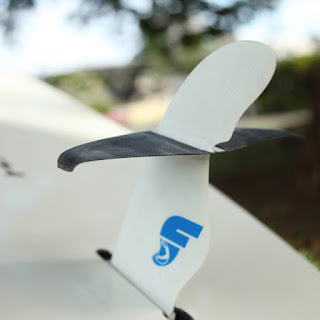
America's Cup boats have an L-shaped rudder in front, and two T-shaped foils (which are similar to windsurf foils) in back. Reducing the wetter area does not seem to be a big issue here - why? Well, the America's Cup catamarans are wicked fast even without the foils; we're talking about something like 30 knots without, and 50 knots with foils.
Compare that with the typical foil windsurfer. In the videos I have seen, they typically go from non-planing mode straight into foiling mode. Now that's going from about 6 knots to 20 knots. That's a much bigger difference. When you try to go a lot faster than that, the foil just has too much resistance. When windsurfing without a foil, you can get faster by reducing the wetted area by all kind of means, including switching to a speed board. With a given foil, you're basically stuck. You can switch to a smaller foil with a lower resistance, but you'll loose the low-wind foiling.
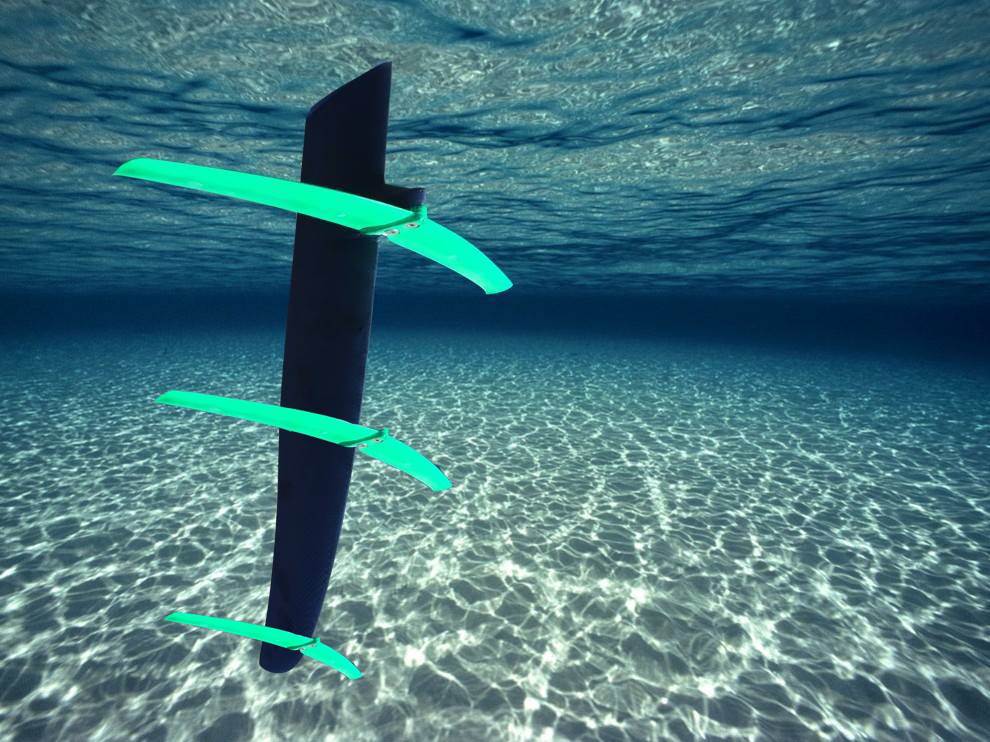
All I'm saying is that this does not have to be so if you change the foil design to multiple foils. The lowest foil would be a high-speed foil - let's call it the 40-knot foil. On it's own, it might need a takeoff speed of 20 knot to generate enough lift for foiling. Theoretically, you could put that on a slalom board, start planing to get to 20 knots, and then start foiling. But there are a few problems with that idea; for example, an abrupt transition to foiling at high speeds would be very challenging.
So let's help the high-speed foil out by adding a second foil higher on the mast, like the "Virus foil". The combined lift from both foils will get you foiling just above the water in light winds. As the wind picks up and you get faster, you reach the point where the lift from the lower foil is enough. You rise higher out of the water, and you can start going faster since your foil now has a lot less resistance. The transition is less dramatic than with just a "40-knot" foil, since you just go from "low foiling" to "high foiling". Going to more than 2 foils will give you even more gears, and smoother transitions (like a 9-gear automatic car transmission).
The "glider" argument you bring up kind of misses the point. The glider is always completely surrounded by air, so there's no reason for going to multiple lifting surfaces. But with a two-foil windsurfer, raising the first foil out of the water as wind and speed increase would cut drag resistance by 50% or more, so you'd be able to go 50% faster. But maybe nobody wants to go that fast quite yet, anyway - crashing a foiling windsurfer at 20 or 30 knots looks pretty scary already.