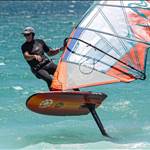
I've been watching the evolution of foiling on a windsurfer with interest for the last 9 months. WindFoiling as it has become known has taken off in more ways than one! It's an incredible sight to see and one of the most exciting, coolest advancements in the sport for a long time.
While still in its infancy it holds incredible benefits for sailing in lightwind locations and also amazing potential for pushing speed boundaries in choppy water found wherever its windy. The latter really interests me and I envisage being able to do forty knots down the middle of the Gorge in the nastiest conditions within a year or two.
Overseas in France seems to be the epicenter for WindFoil development with only two companies in the Gorge starting to explore its potential. Tony Logosz has been one of the pioneers of windsurfing in the USA before starting Slingshot kites and developing KiteFoiling. He's now come back to windsurfing and used his incredible R&D skills to get flying on a windsurfer. I've partnered with him to get me up to speed and help develop the next generation of SpeedFoiling.
Slingshot developed a graduated program of flight training for kiting and the same principles apply to windsurfing.
www.slingshotsports.com/2016-Foiling-Flight-School-mast-package#.V4USU9QrKUM Using an extruded alloy mast that has an adapter at the top to fit into deep tuttle/tuttle/powerbox fin boxes, it will plug into any windsurfing board. Ideally something in the 110 to 130 liter range is ideal so you can uphaul in light winds when waterstarting is not possible. The mast connects to an alloy fuselage at the bottom which has a larger fiberglass wing at the front and a smaller one at the rear. The length of the fuselage and positioning of the wings are crucial to get a windsurfer to fly. Different length mast are available for flight training, starting with a 15" one for taxi and getting used to getting up on the foil without going to high, an intermediate 24" touch and go one to get more confidence flying before graduating to 30" for solo mode! 35.5" is for hover mode when you've graduated flight school.
http://www.slingshotsports.com/2016-Hover-Glide-NF2#.V4UUmtQrKUM 
Once foiling not much power is needed so a small sail is all that is required. Something in the 5 to 6 meter range is perfect to get started. You don't even need a harness it's so effortless.
I've kept a flight log of my training and will keep it updated on a regular basis, feel free to ask any questions and give feedback as my adventure in WindFoiling begins.
Day 1
40" mast 5.3 Naish Force Custom 120 liter wide board
Logged time:0.5 hour
Check your ego at the door, you end up spending lots of time in the water and endure multiple crashes...you will get wet and lots of water up your nose! The first time you get up on the foil and fly will alter your perception of windsurfing for ever. It's an incredible feel but over so quickly as the foil comes up out of the water and this followed by the first of many crashes. Leaning back puts lots of angle on the wing and it climbs until it runs out of water, gets airborne, loses lift and stops flying. Lesson, get your weight forward to level out, also get your weight off you back foot onto the front foot with toes down. Forget about pumping, just let the board come up to speed, 11 knots is take off velocity for the wing, then gradually feed your weight forward to level off. You need to swing your body/shoulders forward as you rake the rig back to noramalise the forces and balance the board out. The view 3 feet above the water is incredible, a totally different perspective to normal windsurfing, so you find yourself looking down immediately in front of the board......bad move, you go where you look so it's inevitable a crash soon follows. Just like flying a plane look at the horizon or in the Gorge the other side of the river. Everything balances out and the flights last much longer each time.
Major learning points.
It's a long way up so look into the distance and not down.
You go where you look.
Don't lean back, get your weight forward.
It's all about finesse and subtle movements, brute force not required.
Day 2
15" mast 5.3 Naish Force Mistral 112 Slalom
Logged time: 0.75 hour
Taxi training to get used to flying on the foil but at a safe height so crashes aren't as bad! If anything a little bit harder than being on the full 40" mast, the board never really gets up above the water but goes into a ground effect gliding mode which lets you get used to flying level. It's better to have a little bit bigger sail so the board can come up onto the plane then lift onto the foil without pumping. Really only need a hour or so in this short mast mode to get the feel for straight and level flight.
Day 3
35" mast 5.9 Loft Oxygen Mistral 112 Slalom
Logged time: 2 hour
Boy this is addictive, 2 hours on the water went by in a flash. The sensation when flying is hard to describe, it's so quiet and effortless when everything is in balance. You start feeling the effect subtle differences make, moving the mast slightly forward to control the boards angle and keep the nose down as you feed in more power to prevent the foil rising up out of the water and stalling. Pressure through your front foot with toes down to keep the board level front to rear and rear foot toe pressure to keep it level side to side so the foils stay in a neutral position and glide better. It's all about balance of forces but in a more subtle way than normal windsurfing. One big lesson today was to stop choking the sail and move the hands forward on the boom to let it breathe more and open up the sheeting angle. You get so used to going for maximum power on a slalom/speed board to drive off the fin but there's no need to do this on a foil. Putting the rear hand between the harness straps on the boom and the front one between the front strap and boom head seems to be the optimum position for controlling the foiling height. It makes it easier to sheet out and bleed off foil load in the gusts to keep everything straight and level.
Major learning points.
Easier on the longer 35" mast once you get used to the height above the water.
Mast position and mast foot pressure are like the joystick in a plane, move mast back to rise up on the foil, forward to come back down, center to keep level.
Sheeting angle is like the throttle/power on a plane, more sheeting equals more power equals more speed and the foil lifts more. Nose down to stay level.
Hand position on the boom critical to trim, forward on boom to balance out the rig for smooth even power, don't oversheet.