Select to expand quotestehsegler said..
I am not part of the Slingshot Crew or Severne Crew or any other crew for that matter. I shot the videos in my own time while not shooting commercial jobs... eg sitting with my kids on the beach flying the drone while they run their cookie stall.
To be honest I'd love to be part of a crew. Perhaps that way I wouldn't have to drop so much money on windsurf gear.
if anyone out there wants me to part of their crew I'd love to be.
re Slingshot, they simply asked me if they could post the video on their YouTube / Instagram channels. The mindfactory logo the beginning is my company. We offer corporate consulting services as well as do media production for corporate customers.
Again this was not and never has been a commissioned video. My 5 cents ... don't like it... don't watch it.
Now can we get back to discussing foiling rather then people bickering at eat other.
It's a fricking amazing video. Period. Keep them coming, it is inspiring to see your progress. I won't get to your level, but I am for damn sure going to have fun trying. 
Select to expand quotestehsegler said..duzzi said..
including a professionally made video with it, and claiming that that wing is the best wing on the market, to me looks like a commercial in disguise. And if not it is just reflects a very biased idea about what the market offers.
Thanks for the compliment. I can assure you though that none of the footage or edits were done in a professional capacity... ie paid for.
The biased idea about what the market offers is there  and as oscardog found out the video is indeed part of a Slingshot promotion ... but .... I wish I was half, no wait, a quarter as good a foiler as you are!!!!!!!!!!!!
Select to expand quotestehsegler said..
Look mom... no payment:
Just bad ass video and sailing skills!
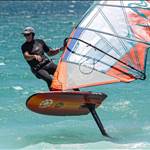
Just came back from Bonaire where I spent 3 weeks foiling every single day! I think that at this point I completed my total transition from regular windsurfing to foiling. No interest in plowing through the water on a regular board whatsoever! At this point I feel much safer and much more comfortable up in the air in any conditions. I took I76 and I84 with me and used both wings testing the limits of their use. Both wings have an amazing range. I used sails from 4.2 to 8.0 (including 4.7-5.0-5,5-6.5) in winds ranging from 8 to 29 knots. Taty tried I76 and liked it so much that I had to sell it to him?? Now I ordered I65 to complete the Infinity range. From this experience I think I could get by with 4.2-5.5-8.0 range of 3 sails, or 5.0-8.0 if pressed to choose 2 sizes. I am close to 90 kg and I do not like to pump like mad, although I can if I have to.
Another 6 months using the Infinity 76 (in <20 knots winds) and still frothing on it 
It's an awesome learner wing but also a magic wing when you've clocked up reasonable TOW and can properly control the lift/power and fully utilize its downwinding and surfing potential.
Flying at 20 knots across a wave face then cranking a big power carve and accelerating down the swell is off the charts fun
Today's speed on the 76 downwinding in 1.5m swell
SW 15-18 knots


Select to expand quoteazymuth said..
Flying at 20 knots across a wave face then cranking a big power carve and accelerating down the swell is off the charts fun
Do you have any idea how fast the waves are moving? If they are moving at 5 knots and your top speed is going down a wave, the board speed relative to the water would be 18 knots. Just curious how the speed compares to flat water.
It would also be cool if you could post a screen shot of the speed plot, or a link to the data.
Select to expand quoteDo you have any idea how fast the waves are moving? If they are moving at 5 knots and your top speed is going down a wave, the board speed relative to the water would be 18 knots. Just curious how the speed compares to flat water.
It would also be cool if you could post a screen shot of the speed plot, or a link to the data.
The water in a wave is actually moving up and down as the waves passes. It is not travelling in the direction of the wave.
If the GPS shows 23knots and the wave speed is 5 knots then the speed of the foil through the water is still 23 knots. Your speed relative to the moving crest/trough of the wave would be 18 knots.
Select to expand quotesimonp123 said..
The water in a wave is actually moving up and down as the waves passes. It is not travelling in the direction of the wave.
The water moves in a circular fashion. Near the top of the wave, the movement is forward, in travel direction of the wave. Near the through, the movement is backwards. If you think about it, there actually has to be a horizontal back-and-forth element to the motion, since a pure up-and-down movement would require water to be very compressible, which it is not.
At the surface, the water movement is roughly the same speed as the wave speed, but it's lower the further down you go, down to about 1/2 half of the wave length. "Circular" applies to deep water; near shore, the circle gets squashed into an ellipse. If you managed to keep the foil in the top half (or better top quarter) of the wave, the water that the foil is in will move towards show with non-trivial speed. The deep water speed of a wave is 3x the period, so a 5-second period wave travels at about 15 knots. Speed near shore will be slower, but you can still have close to 10 knots in 2 m water depth (according to www.soest.hawaii.edu/oceanography/courses_html/OCN201/instructors/Carter/SP2016/waves2_2016_handout.pdf)
A nice example that shows the circular motion of water molecules in a wave is this video, starting at around 4:30:
Select to expand quoteboardsurfr said..simonp123 said..
The water in a wave is actually moving up and down as the waves passes. It is not travelling in the direction of the wave.
The water moves in a circular fashion. Near the top of the wave, the movement is forward, in travel direction of the wave. Near the through, the movement is backwards. If you think about it, there actually has to be a horizontal back-and-forth element to the motion, since a pure up-and-down movement would require water to be very compressible, which it is not.
At the surface, the water movement is roughly the same speed as the wave speed, but it's lower the further down you go, down to about 1/2 half of the wave length. "Circular" applies to deep water; near shore, the circle gets squashed into an ellipse. If you managed to keep the foil in the top half (or better top quarter) of the wave, the water that the foil is in will move towards show with non-trivial speed. The deep water speed of a wave is 3x the period, so a 5-second period wave travels at about 15 knots. Speed near shore will be slower, but you can still have close to 10 knots in 2 m water depth (according to www.soest.hawaii.edu/oceanography/courses_html/OCN201/instructors/Carter/SP2016/waves2_2016_handout.pdf)
A nice example that shows the circular motion of water molecules in a wave is this video, starting at around 4:30:
Interesting - didn't know that! So, if you are carving down a wave face the water will be moving in your direction in the top half and against you in the bottom half as you approach the trough? Overall the average velocity of the water through which you foil on a wave face must be zero as you go from crest to trough.
But on a large wave you might expect to see a short peak in GPS speed as you start to carve down the face because you would have a few less knots of drag on the foil?
In this animation you can see the side ways movement is dominant at the crest and trough. The up/down movement is dominant half way up the leading or trailing edge. :
Select to expand quotesimonp123 said..
But on a large wave you might expect to see a short peak in GPS speed as you start to carve down the face because you would have a few less knots of drag on the foil?
I think a large wave should have some effect on speed, but it's hard to say exactly what effect. That depends on entry speed, angle, where you are in the wave, and so on. It also depends on the sailor's reaction. For example, if you enter the top of a wave quickly to the water suddenly moves faster under the foil, the lift of the foil should be reduced. If you keep power in the sail, the reduced drag should give you a speed boost as your foil reaches the previous speed relative to the water (and a faster GPS speed). With no power in the sail, that should not happen; instead, the reduction in lift would just have the foil go down until the sailor shifts the weight to the back to compensate. '
But at the same time, since the water changes direction, you'll also have a change in the angle of attack of the foil. I can't quite wrap my head around this. But these complex changes should have something to do with why going down a wave sometimes requires throwing weight forward, and sometimes backward. The "sometimes" here mostly refers to different foilers in different conditions, although my wife says she sees both when winging, depending on wave height.
If you could ride a wave by keeping the foil near the top of the wave, and wind and wave direction line up properly, then in theory, you should be able to get a faster GPS speed. Select to expand quotesimonp123 said..
In this animation you can see the side ways movement is dominant at the crest and trough. The up/down movement is dominant half way up the leading or trailing edge. :
Yes, I had found this animation, too. But it's a theoretical picture, so it could be wrong (some diagrams I found can easily give the wrong ideas). I think the movie has the movement right, especially in the second part. But what looks incorrect is that the distance between the individual dots changes - that seems to indicate compression and expansion, which does not happen. That's why I chose the movie that shows actual movement of beads in a wave tank. That movie also shows that the movement further down in the water is very similar to the movement on the top, just smaller. In theory, the movement below could be in opposite direction to the movement on top, but that does not seem to be the case.
One aspect that the animations do not show is that wind waves also have a forward momentum, so the the movement near the top is trochoidal rather than circular:
 I verified that this is the case last spring when my board got away from me when I was a kilometer upwind from the launch. The water was too choppy and too cold for swimming, so I mostly drifted back to shore. By the time the rescue boats found me, I had drifted back about two thirds of the way. My gear had arrived long before me (almost giving my wife a heart attack), but the wind pushed it around way more than me.
The directed forward momentum is much less than the forward speed near the top, and the backward speed in a trough, though. My speed back to shore was less than 1 knot in 20-25 knot wind, and that includes a bit of trying to swim. Tidal effects can be much larger, but there's not too much tide at this spot.
I have been calling the change in water speed caused by the waves "apparent water speed" and I have seen the light bulbs brighten particulary talking with sailors.