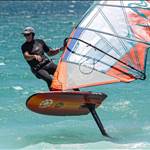
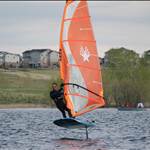
A few comments from a former (and still) beginner. I have 155 sessions on a foil, but I still feel like a beginner in this really cool sport.
1. Yes, you will get really sore from foiling. You are using muscles you never used before. They will protest until they get stronger. I finally got past that point of soreness. This is normal.
2. Yes, you should stay out of the harness. For foiling, the pressure on the arms is really light compared to finning. I still foil mostly off the harness. Just don't need it unless I am trying to race with a really big sail (8.0+). Yes, staying off the harness can mean more arm pressure and more soreness, but this is minor. Staying off the harness lets you make pitch corrections more quickly and correctly.
3. Gusty conditions are great for finning, but a bugaboo for foiling. When finning, a gust will simply propel you forward. The board is down on the water surface anyway, so a gust simply presses it down a little more. You hardly notice that. When foiling, a gust suddenly propels your speed. Since you are on a lifting airfoil an increase in speed means an increase in lift. Up goes the foil, down goes the rider when you foil out. Obviously you have to correct for the increased pitch. This takes practice and muscle memory. I can survive gusty conditions, but it is not much fun. Staying off the harness is key in gusty conditions. Up and down, up and down, pogo-sticking is what you get with gusty conditions.
This is a whole new sport. Responding to gusts and trim with the sail is a whole new action compared to finning. Fore and aft lean, and sheet-in and sheet-out, is completely different. You have learn this new action. It takes time and practice to develop this new muscle memory.
4. Use the front footstraps, but not the back footstraps at first. In fact, just leave the back footstraps on the beach. The front straps locate your feet and stance for balance--see 5. below. Your back feet can then hunt for the best position until you get things figured out. If you can, mount the front footstraps inboard for better roll control.
5. Until you can confirm that your gear is balanced, you will just fight it. If the wing is too far aft, you will have difficulty getting it to lift at all. If it is too far forward, you will have difficulty controlling the lift.
So, what you want is to get the midpoint of the front wing at the MIDPOINT between front and back foot. You do this by (a) adjusting the position of the wing relative to the foil mast, if you have something like Slingshot where you can adjust this; (b) adjusting the position of the foil mast under the board, if you are using the track-style mount or Power Plate; or (c) adjusting the footstraps fore and aft. Again, the starting point is MIDPOINT. This is key.
Then, set the sail's mast track at 43 inches in front of the leading edge of the foil mast, then fine tune from there until things are balanced.
Sailworks talks about this balancing stuff a lot.
I made a youtube a couple years ago to show this. Since my foil mast is raked forward I had to use a right-angle tool to make the measurements. Most foils have the foil mast at, or nearly at, at 90 degree angle, so you can do this without the tool.



 ).
).