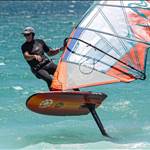
This actually means more to me than the first 30 knot run on 337 I did because the 560 is so easy to gybe. I did a 20knot alpha and a few air gybes too! Stoked.

just found this awesome thread! I am currently trying to get 25 knts with the HG2 9.0, SB foil 100 board, and SB foil with 800 front wing, 115 (black) fuselage.
I think I'm setting up the footmast not far back enough, since when I load weight to the harness lines, my nose goes down, and then I put back foot pressure, making a not so fluid ride.
Top speed so far 23.35 knts measured with the Garmin watch.
I'll take some time to read more carefully your thoughts.
Great post and amazing speed Berowne!
Select to expand quoteManilo said..
just found this awesome thread! I am currently trying to get 25 knts with the HG2 9.0, SB foil 100 board, and SB foil with 800 front wing, 115 (black) fuselage.
I think I'm setting up the footmast not far back enough, since when I load weight to the harness lines, my nose goes down, and then I put back foot pressure, making a not so fluid ride.
Top speed so far 23.35 knts measured with the Garmin watch.
I'll take some time to read more carefully your thoughts.
Great post and amazing speed Berowne!
You should be able to get 25 out of your gear with the right settings, water conditions and some practice
Sometimes one on one advice is best, I would suggest you PM Berowne and will be more than happy to give some setup tips to send you in the right direction 
Cheers TK
So while I am happy with 30kts... on small foils I see our friend Nico has posted 39.6!
There is a phantom video on another thread where they stated their design goal all along is to crack 40kts!
www.gps-foilsurfing.com/default.aspx?mnu=user&val=368803&uid=22412&spotid=18466
BoardPhantom Proto IRIS X 78 , 2021
SailPhantom IRIS RF 4.3, 2021
FinPhantom IRIS R FW350-Fuselage100-BW200 350
There is a phantom video below where they stated their design goal all along is to crack 40kts!
Jordy @ Sylt talking F4 foil setup
Select to expand quoteberowne said..
I'm seeking tuning and 'feel' tips to break the 30kt foil speed barrier. I've made the switch to F4 and feel like they definately have the potential for great speeds. After 3 months I have improved speeds from 20 knots to 27 knots as of yesterday . I'm adding my tuning tips here, and am keen for anyone to share there experience.
I typically ride with high boom, long adjustable harness lines and a seat harness (have done for 30+ years). For context, I'm 188cm and weight 80kg. My Foil board is FMX Hyperion 91cm - awesome board!. Some of you may be familiar with it...
I decided to move to F4 race foil after watching your youtube shares and got my race set-up to use with my FMX foil slalom 91 cm board. My IQfoil mast was fitting very snugly but I feel I may need to add very thin support to prevent side pressure in the tuttlebox for the F4 mast. Did you experience the same issue for fitting your mast to tuttlebox? What are the shims and rake of mast for your set-up. I also note that they have 115, 115+, 115++. What are the conditions one uses these different fuselages?
I'm not nearly that fast but when it's hairy for me I shuffle my hands back and then move the rig forward to assist in increasing mast foot pressure & gaining some control back. It even works sometimes when I'm quick enough at reading death threats. And sometimes not!
Where are the big speed coming on the tacks. Across the wind or off the wind same as when finning. About what heading in comparison to speed fin sailing. I find that I rarely head off the wind looking for speed while foiling. I probably do more up & down wind sailing compared to the guys I go out with. I think that some speed experimenting is due this summer.
Select to expand quoteSA_AL said..berowne said..
I'm seeking tuning and 'feel' tips to break the 30kt foil speed barrier. I've made the switch to F4 and feel like they definately have the potential for great speeds. After 3 months I have improved speeds from 20 knots to 27 knots as of yesterday. I'm adding my tuning tips here, and am keen for anyone to share there experience.
I typically ride with high boom, long adjustable harness lines and a seat harness (have done for 30+ years). For context, I'm 188cm and weight 80kg. My Foil board is FMX Hyperion 91cm - awesome board!. Some of you may be familiar with it...
I decided to move to F4 race foil after watching your youtube shares and got my race set-up to use with my FMX foil slalom 91 cm board. My IQfoil mast was fitting very snugly but I feel I may need to add very thin support to prevent side pressure in the tuttlebox for the F4 mast. Did you experience the same issue for fitting your mast to tuttlebox? What are the shims and rake of mast for your set-up. I also note that they have 115, 115+, 115++. What are the conditions one uses these different fuselages?
Fin boxes and tutle heads are all a little unique. I've had boxes in new boards that were either too loose or tight for different fins over the years. I've used
> aluminium cans cut to size.
> plastic icecream containeer
> sticky tape
> epoxy resin very carefully painted on the side of the box (or fin box head)
Select to expand quoteBSN101 said..
Where are the big speed coming on the tacks. Across the wind or off the wind same as when finning. About what heading in comparison to speed fin sailing. I find that I rarely head off the wind looking for speed while foiling. I probably do more up & down wind sailing compared to the guys I go out with. I think that some speed experimenting is due this summer.
GPS analysis with polar diagrams can help show you speed at different angles.
I think the air tacks are done with reaching speeds and good control turning into the wind.
What is your best save? I can't believe I survived the first moment with the foil exposed let alone the second one on the next wave! Took a lot of experience and luck to survive. Unlike the next video.


Save Of The Day at Jervis Bay
Select to expand quoteberowne said.. Not every 30k attempt is smooth!!
How to sit on your sail GS010187
Mad respect for you showing us not only the hero moments but when it goes bad, too.
btw, interesting review of the new Phantom masts on windfoilfan (requires free registration and google translate if your French is like mine) windfoilfan.glissattitude.com/devices/foil/phantom-iris-r-95-2023
Essentially some of the magic sauce to the latest versions of fast Zfin and Phantom foils are slimmer but less stiff masts. Phantom is even using shorter fuses to compensate. But it makes speed easier. Downside is these are slalom only, not stiff enough for upwind sailing.
"I insist on the fact that with these new foils, the brands agree for the first time to break the versatility they offered until now. In the past, a single mast made it possible to both practice slalom with small wings and fuselage, or race with longer fuselages. From now on, we will have a mast dedicated to slalom, and another to the race. Why ? Quite simply because the very low thickness of the profiles leads to less rigidity, which thus becomes incompatible with large fuselages and wings. These would introduce too much stress on the mast and make the foil very complex to manage.
The second consequence of adopting thinner masts (globally going from about 14mm maximum thickness at the tail to 11.5mm) is that to maintain control, brands have been forced to limit the overhang created by the offset wings well forward of the mast. On the Phantom side, we tested fuselages at -30mm compared to the current Evo version (which we take as a reference). At Z Fin, if we take the same reference, we would be around -50mm/-60mm.
These new geometries make it necessary to review the entire float / foil / rig balance... and to increase the incidence of the stabilizer so as not to sail 100% aft.
The stiffness/drag debate
Let's face it: we all know that the debate revolves around the drag / stiffness compromise. The rigidity (especially in torsion) gives control in flight and therefore efficiency in piloting. A low drag, on the other hand, makes it possible to go faster in theory."
Select to expand quotePaducah said..berowne said..Not every 30k attempt is smooth!!
How to sit on your sail GS010187
Mad respect for you showing us not only the hero moments but when it goes bad, too.
btw, interesting review of the new Phantom masts on windfoilfan (requires free registration and google translate if your French is like mine) windfoilfan.glissattitude.com/devices/foil/phantom-iris-r-95-2023
Essentially some of the magic sauce to the latest versions of fast Zfin and Phantom foils are slimmer but less stiff masts. Phantom is even using shorter fuses to compensate. But it makes speed easier. Downside is these are slalom only, not stiff enough for upwind sailing.
"I insist on the fact that with these new foils, the brands agree for the first time to break the versatility they offered until now. In the past, a single mast made it possible to both practice slalom with small wings and fuselage, or race with longer fuselages. From now on, we will have a mast dedicated to slalom, and another to the race. Why ? Quite simply because the very low thickness of the profiles leads to less rigidity, which thus becomes incompatible with large fuselages and wings. These would introduce too much stress on the mast and make the foil very complex to manage.
The second consequence of adopting thinner masts (globally going from about 14mm maximum thickness at the tail to 11.5mm) is that to maintain control, brands have been forced to limit the overhang created by the offset wings well forward of the mast. On the Phantom side, we tested fuselages at -30mm compared to the current Evo version (which we take as a reference). At Z Fin, if we take the same reference, we would be around -50mm/-60mm.
These new geometries make it necessary to review the entire float / foil / rig balance... and to increase the incidence of the stabilizer so as not to sail 100% aft.
The stiffness/drag debate
Let's face it: we all know that the debate revolves around the drag / stiffness compromise. The rigidity (especially in torsion) gives control in flight and therefore efficiency in piloting. A low drag, on the other hand, makes it possible to go faster in theory."
Seems then that a more optimized foil board would have the foil box even further forward to reduce the wing overhang, but maybe the point of diminishing returns is already there. This seems big, and indicates how new this sport is still. I'll hold off on that slalom board purchase....
Select to expand quoteaeroegnr said..
Seems then that a more optimized foil board would have the foil box even further forward to reduce the wing overhang, but maybe the point of diminishing returns is already there. This seems big, and indicates how new this sport is still. I'll hold off on that slalom board purchase....
The challenge with that is what was discovered a while back, the boards sail better with the mast further back where the fin would be all other things equal. I don't know all the reasons why that. I would speculate the way we drive upwind off the mast and the need to transition small wings from windsurfing to foiling at takeoff are just two of the reasons.
The advantage of not having to use + or even ++ style fuses suggests there are compelling reasons for having the foil box generally where it is. However, I certainly can see a case where the advantages of thinner masts and shorter fuses override the negatives of having a foil box further forward. As said more than a few times in the AC campaigns, they design stuff to go fast, not easy, and leave it up to the sailors how to deal with it.
Select to expand quotePaducah said..aeroegnr said..
Seems then that a more optimized foil board would have the foil box even further forward to reduce the wing overhang, but maybe the point of diminishing returns is already there. This seems big, and indicates how new this sport is still. I'll hold off on that slalom board purchase....
The challenge with that is what was discovered a while back, the boards sail better with the mast further back where the fin would be all other things equal. I don't know all the reasons why that. I would speculate the way we drive upwind off the mast and the need to transition small wings from windsurfing to foiling at takeoff are just two of the reasons.
The advantage of not having to use + or even ++ style fuses suggests there are compelling reasons for having the foil box generally where it is. However, I certainly can see a case where the advantages of thinner masts and shorter fuses override the negatives of having a foil box further forward. As said more than a few times in the AC campaigns, they design stuff to go fast, not easy, and leave it up to the sailors how to deal with it.
Hmm that makes sense. In buoyancy mode you need the mast back there to point upwind and having it further forward for more efficient foil flight would compromise that in marginal situations... or maybe my understanding of that is wrong.
Hmm
I'll just grab a good second hand slalom board when I decide to break into some real speed on my existing gear. My gear is definitely not holding me back at the moment, just my skills. I think the real good sailors upgrading to the latest kit will be chasing the new masts/fuses and leaving enough used gear that is capable of 30+ knots laying around.
Select to expand quoteaeroegnr said..
I'll just grab a good second hand slalom board when I decide to break into some real speed on my existing gear. My gear is definitely not holding me back at the moment, just my skills. I think the real good sailors upgrading to the latest kit will be chasing the new masts/fuses and leaving enough used gear that is capable of 30+ knots laying around.
Yeah, my number starts with a 2 and barely that. Lots of overhead left on current gear for me.
Select to expand quotePaducah said..aeroegnr said..
I'll just grab a good second hand slalom board when I decide to break into some real speed on my existing gear. My gear is definitely not holding me back at the moment, just my skills. I think the real good sailors upgrading to the latest kit will be chasing the new masts/fuses and leaving enough used gear that is capable of 30+ knots laying around.
Yeah, my number starts with a 2 and barely that. Lots of overhead left on current gear for me.
Hahaha yes I look at speeds reached on IQFoil gear getting just to 30knots on the 900cm2 wing, and I know the guy is almost the same size as me (but I'm less athletic and need to lose a little fat), so I know there's still a lot more on tap if I can just use it.
650 or 725 will make it easier as well, I just haven't been riding them lately.
About 10 foiling "useful" sessions over total 40.
Finally i'm finding the confidence to foil when i previously use to prefer the fin activity.
At the moment i'm in the stage i foil with no back foot into the strap (but just in surround area...).
With no intention i found myself foiling in more than 15 kts (close to 18 kts) using a 7 (4 cams) fin sail BUT unhooked!!
Hooking is my current biggest s...t!! Tried many different ways:
- taking off already hooked (at the moment) makes for a slow launch. As soon I unhook the kit launches super suddenly
- in flight i find the right balance only unhooked, empowering and depowering on demand (but please don't ask me how!). When i feel a good stability i get hooked but it's like the sail is far away and i can't sustain the flight. OR, sometimes, sail is too close to my face and when the gust hits, the system goes higher and higher and i crash.
Maybe my flight is not stable enough and surely i'm not good at reaching a constant speed (not always enough sail power).
During my long "manual" runs i keep asking myselt how the hell is possible (ok, squat stance!) to depower the sail if hooked!
p.s. a foil sail is needed??
Select to expand quotePaducah said..aeroegnr said..
Seems then that a more optimized foil board would have the foil box even further forward to reduce the wing overhang, but maybe the point of diminishing returns is already there. This seems big, and indicates how new this sport is still. I'll hold off on that slalom board purchase....
The challenge with that is what was discovered a while back, the boards sail better with the mast further back where the fin would be all other things equal. I don't know all the reasons why that. I would speculate the way we drive upwind off the mast and the need to transition small wings from windsurfing to foiling at takeoff are just two of the reasons.
The advantage of not having to use + or even ++ style fuses suggests there are compelling reasons for having the foil box generally where it is. However, I certainly can see a case where the advantages of thinner masts and shorter fuses override the negatives of having a foil box further forward. As said more than a few times in the AC campaigns, they design stuff to go fast, not easy, and leave it up to the sailors how to deal with it.
I would hazard a guess it has to do with the see saw effect having a foil mounted further forward creates. It would make things much sketchier (more than likely too sketchy) for the rider because suddenly moving weight around has an amplified effect. Taking a back foot out to go into a gybe would result in a nose dive.
They might ooch out another few knots of straight line speed by moving it forward, but thats all for nothing if the rider loses control and crashes out. I would think they've already refined exactly how far forward they can get away with.
When all the experimentation was going on with moth foils, initially they tried a system where the pitch trim was all done by flaps on the rudder wings, linked to a system so the sailor could adjust them by twisting the tiller extension. Problem was that it was too big a trim movement, the sailors crashed and burned pretty hard. It eventually resulted in the automated wand system that they now all have. They can still do trim adjustment with trim tabs on the rudder foils, but its a much more dampened system than the original. There is definitely a human limitation to the mechanics of going fast on a foil.
Select to expand quoteSubsonic said..Paducah said..aeroegnr said..
Seems then that a more optimized foil board would have the foil box even further forward to reduce the wing overhang, but maybe the point of diminishing returns is already there. This seems big, and indicates how new this sport is still. I'll hold off on that slalom board purchase....
The challenge with that is what was discovered a while back, the boards sail better with the mast further back where the fin would be all other things equal. I don't know all the reasons why that. I would speculate the way we drive upwind off the mast and the need to transition small wings from windsurfing to foiling at takeoff are just two of the reasons.
The advantage of not having to use + or even ++ style fuses suggests there are compelling reasons for having the foil box generally where it is. However, I certainly can see a case where the advantages of thinner masts and shorter fuses override the negatives of having a foil box further forward. As said more than a few times in the AC campaigns, they design stuff to go fast, not easy, and leave it up to the sailors how to deal with it.
I would hazard a guess it has to do with the see saw effect having a foil mounted further forward creates. It would make things much sketchier (more than likely too sketchy) for the rider because suddenly moving weight around has an amplified effect. Taking a back foot out to go into a gybe would result in a nose dive.
They might ooch out another few knots of straight line speed by moving it forward, but thats all for nothing if the rider loses control and crashes out. I would think they've already refined exactly how far forward they can get away with.
When all the experimentation was going on with moth foils, initially they tried a system where the pitch trim was all done by flaps on the rudder wings, linked to a system so the sailor could adjust them by twisting the tiller extension. Problem was that it was too big a trim movement, the sailors crashed and burned pretty hard. It eventually resulted in the automated wand system that they now all have. They can still do trim adjustment with trim tabs on the rudder foils, but its a much more dampened system than the original. There is definitely a human limitation to the mechanics of going fast on a foil.
Thought provoking but not sure I agree with the first part. Absolutely agree for the second part - there's been a lot of trial and error already. Boards with foil tracks end up putting the mast in pretty much the same place so it's not just a legacy thing.
On the first part, my reptile brain sees that if the fuse length, wing placement and stab angles remain the same, moving the mast shouldn't make things more pitch sensitive as those forces are all on the same plane, horizontal, and we, as I understand it, haven't moved anything. The mast affects things on the vertical plane - more opposing the sail force. Moving the mast forward would seem to affect sail trim (ie rake) and the sailor (foot strap/harness pressures). What am I missing?Select to expand quotew100 said..
About 10 foiling "useful" sessions over total 40.
Finally i'm finding the confidence to foil when i previously use to prefer the fin activity.
At the moment i'm in the stage i foil with no back foot into the strap (but just in surround area...).
With no intention i found myself foiling in more than 15 kts (close to 18 kts) using a 7 (4 cams) fin sail BUT unhooked!!
Hooking is my current biggest s...t!! Tried many different ways:
- taking off already hooked (at the moment) makes for a slow launch. As soon I unhook the kit launches super suddenly
- in flight i find the right balance only unhooked, empowering and depowering on demand (but please don't ask me how!). When i feel a good stability i get hooked but it's like the sail is far away and i can't sustain the flight. OR, sometimes, sail is too close to my face and when the gust hits, the system goes higher and higher and i crash.
Maybe my flight is not stable enough and surely i'm not good at reaching a constant speed (not always enough sail power).
During my long "manual" runs i keep asking myselt how the hell is possible (ok, squat stance!) to depower the sail if hooked!
p.s. a foil sail is needed??
I try to rarely be "that" guy but those issues are best addressed in a separate thread as your question will absolutely get buried here and you won't get the attention you deserve. There are a lot of things going it sounds like and we'd love to help you. (Two second answer - you are probably well overpowered for your stage of the process. Try a smaller sail about 2m less than you would normally use. Looking forward to your new thread  )
)
Select to expand quotePaducah said..Subsonic said..Paducah said..aeroegnr said..
Seems then that a more optimized foil board would have the foil box even further forward to reduce the wing overhang, but maybe the point of diminishing returns is already there. This seems big, and indicates how new this sport is still. I'll hold off on that slalom board purchase....
The challenge with that is what was discovered a while back, the boards sail better with the mast further back where the fin would be all other things equal. I don't know all the reasons why that. I would speculate the way we drive upwind off the mast and the need to transition small wings from windsurfing to foiling at takeoff are just two of the reasons.
The advantage of not having to use + or even ++ style fuses suggests there are compelling reasons for having the foil box generally where it is. However, I certainly can see a case where the advantages of thinner masts and shorter fuses override the negatives of having a foil box further forward. As said more than a few times in the AC campaigns, they design stuff to go fast, not easy, and leave it up to the sailors how to deal with it.
I would hazard a guess it has to do with the see saw effect having a foil mounted further forward creates. It would make things much sketchier (more than likely too sketchy) for the rider because suddenly moving weight around has an amplified effect. Taking a back foot out to go into a gybe would result in a nose dive.
They might ooch out another few knots of straight line speed by moving it forward, but thats all for nothing if the rider loses control and crashes out. I would think they've already refined exactly how far forward they can get away with.
When all the experimentation was going on with moth foils, initially they tried a system where the pitch trim was all done by flaps on the rudder wings, linked to a system so the sailor could adjust them by twisting the tiller extension. Problem was that it was too big a trim movement, the sailors crashed and burned pretty hard. It eventually resulted in the automated wand system that they now all have. They can still do trim adjustment with trim tabs on the rudder foils, but its a much more dampened system than the original. There is definitely a human limitation to the mechanics of going fast on a foil.
Thought provoking but not sure I agree with the first part. Absolutely agree for the second part - there's been a lot of trial and error already. Boards with foil tracks end up putting the mast in pretty much the same place so it's not just a legacy thing.
On the first part, my reptile brain sees that if the fuse length, wing placement and stab angles remain the same, moving the mast shouldn't make things more pitch sensitive as those forces are all on the same plane, horizontal, and we, as I understand it, haven't moved anything. The mast affects things on the vertical plane - more opposing the sail force. Moving the mast forward would seem to affect sail trim (ie rake) and the sailor (foot strap/harness pressures). What am I missing?
my apologies, I thought we were talking about moving the mast position forward to, in part reduce the requirement for a longer fuse. My pigeon brain transposed that from other comments about not needing +/++ fuses and being able to use shorter fuses, to mean maintaining the position fore and aft of the main wing, and shortening up the fuse to match the new mast position. Not moving the same size fuse set up to the forward position.
so what you say is correct.
Regardless of the method used (+ and ++ fuses, movable plate mounts, moving the finbox, moving footstraps, etc.) the goal is to get the front wing at about the midpoint between your feet (or footstraps).
In 2017 all you could get were freeride foils with short(er) fuses, and mostly deep tuttle fittings. In order to get the front wing between my feet on a formula board with only one footstrap location, I had to move the DT finbox 3 inches further forward. It then balanced perfectly. I still use that board for testing.
Select to expand quotePaducah said
Phantom is even using shorter fuses to compensate.
No, it's still 100cm but its moved 3cm further back compared to the 100 EVO fuse.
Select to expand quoteSubsonic said..
my apologies, I thought we were talking about moving the mast position forward to, in part reduce the requirement for a longer fuse. My pigeon brain transposed that from other comments about not needing +/++ fuses and being able to use shorter fuses, to mean maintaining the position fore and aft of the main wing, and shortening up the fuse to match the new mast position. Not moving the same size fuse set up to the forward position.
so what you say is correct.
Apologies never necessary. I appreciate the exchange of ideas with others and I've always learned a lot from your comments. It's all confusing and I've had to reread both your and my comments a dozen times. From what I read on the windfoilfan page, they tested a number of 100cm fuses with different setbacks
"To compensate for the inevitable loss of rigidity, and the loss of control that goes with it, Phantom will equip this mast with a new fuselage limiting the forward offset of the wings, and thus the torsional stresses. This new fuselage will shift the position of the wings by 30mm rearward....
During this test, I successively tested
- Config 1 > Mat R Gen3 100 / Fuselage 100 Evo Std (to start on a known reference)
- Config 2 > Mat PWA 95 / Fuselage 100 Evo Std / Shim 1.2mm
- Config 3 > Mast PWA 95 / Fuselage 100 -30 / Shim 0.6mm
- Config 4 > Mast PWA 95 / Fuselage 100 -15 prototype / Shim 0.7mm
- Config 5 > Mast PWA 95 / Fuselage 100 -15 protoype / Stab R175 / Shim 0.7mm"
Hope that helps.Select to expand quotebel29 said..Paducah said
Phantom is even using shorter fuses to compensate.
No, it's still 100cm but its moved 3cm further back compared to the 100 EVO fuse.
Yes, thanks for the correction. I think reading that they suggested not using the 110 was the source of that mistake. I may have inadvertently caused both Subsonic and aeroegnr unnecessary stress. 
I'm learning a lot from the pigeon and reptile brains
I can see why foil centre of lift should be roughly between your feet, but why is the foil mast so far to the rear of the board?
The foil would be stiffer if the front wing was closer to the mast.
Armstrong wing boards have a forward geometry that seems to work?
Select to expand quoteazymuth said..
I'm learning a lot from the pigeon and reptile brains
I can see why foil centre of lift should be roughly between your feet, but why is the foil mast so far to the rear of the board?
The foil would be stiffer if the front wing was closer to the mast.
Armstrong wing boards have a forward geometry that seems to work?
Yep that's the thought. More forward tuttle box with shorter wing to mast distance with the same fuse length.