" These short boards are a real revolution, but as usual, they won't be mainstream till one of the global companies gets on board and starts claiming them with advertising dollars."
Before that, need to convince surfers to hold paddle and then to catch wave with something under 7', so hopefully our research and creativity will last some more time , i think 
Select to expand quoteboardbumps said..
I have been watching and occasionally commenting on your posts Colas, thinking is this real? My mistake, just wish I had started on Sub7 last year.
Actually, it was hard also for me to be familliar mentally with the concept of ShotSUPs
For a long time, I kind of was shy of them, and would take them out only in small and clean conditions, not daring to try them out in some size or chop.
One have to kind of overcome his own preconceptions to "force" oneself to get out with ShortSUps is conditions apparently not made for them to discover that, after some technique adaptations, they actually work in a lot of conditions.
The last post of Casso taking out his Minion in double overhead waves for instance is very mind-opening on www.seabreeze.com.au/forums/Stand-Up-Paddle/Review/DEEP-Oceanboards-72-Minion-Review/?page=4
Basically you are forced to do late drops, but late drops are much easier to survive with the shorter length...
I have already caught a few overhead waves on my 6'10. it was the first surf on it. I stayed inside for a few waves to get the feel of the SunFish then paddled out to the first bombie.
The 6'10 handled the drop and made the wave but it was and I was just along for the ride, climbing and dropping and zooming along.
With my narrower pod 8'2 pintail I could have really hooked in and jammed off the bottom, but I never made this board for bigger surf.
I just wanted to try a sub7 SUP board and I am now a convert!!!
I have already planned the next board a 6'7 narrower with less volume so that you can really get control and have that levitation feeling of no board under foot when surfing. Paddling is just part of surfing and the shorter you go the harder it gets and that goes for prone boards too. At least I'm standing up at the takeoff.
I was reconciled to not riding/surfing a 6foot plus surfboard again, but not now, Hooting.
Could be some really nice swell on the weekend if it does not have too much west in it and bypass most of the coast.
Bl00dy hell! How many boards do you expect me to have? Now I gotta get one of these too!
Didn't go aut this morning clean but tides was too low and no walls about 2 meters on the sets and no bombs.
The wind is in now so I'm home for brekky.
Rod My 8'2 is 800mm wide (31.5") which is 20mm narrower than my 6'10.
With another 1.5 hours of tide we might have some surfable waves, there was frost on the way to the surf this morning.
innovative and forward thinking as usual,now how small can annie go on the sunfish,sub 6ft and 60 ltrs?
Select to expand quotefirstpoint said..
innovative and forward thinking as usual,now how small can annie go on the sunfish,sub 6ft and 60 ltrs?
we can always try a 5'10, I reckon that would be OK.
Back from surfing this arvo really windy and just about to go out for the evening. The waves weren't as big as I thought they would be but the ind was howling 27+kts offshore with sets with just overhead faces and lumpy backwash conditions.
This type of board is super stable, once again this design surprised me. Greg Beersup Has a new shorty or should I say long board at 7'6", he's 100 kegs.
Greg was commenting on how stable by comparrison his new board is compared to his older board which is 7'10.
What we reckon is happening is that the shorter boards length actually adds to stability and end dipping recovery times because there is less board to be moved around by the ocean and waves. Sure the motion is quicker but not by much.
Shorter now equals better stability, Thats what we reckon.
The early should be pumping!!

Heres my new longboard as Rod calls it all 7'6 of her! Handled stormy six foot plus surf Saturday stable as a table loved the late drops and not run down once. My new all rounder from 1ft to way over head and bumpy as f@:; it loves it all sweet

This short video of the 6'10 SunFish SUP is from todays surf in Bumpy Windy conditions.
The video shows just how stable wide Sub7 boards really are in the worst conditions with winds gusting over 25kts from the SSW.
Mats catching reform waves on the inside reef.
I forgot to ad that the surfer Mat has only been surfing the SunFish for around two hours. He is 85 kg around 180 tall and in his mid 40's.
nice rides
Shwoing the benefit of a short board: turning just in time before the wave arrives - in bumpy conditions i don't like to wait parallel to the waves as i have too much likelihood to fall of the board. With the board nose pointing to the waves I cab withstand much more bumpy sea surface and still turn on time to catch the wave.
Rod, your new board definitely looks like a good board for throwing around. How would it rate for straight lines on fast waves? Whilst traditionally - a (longer or narrow) board with straighter rails works for fast breaks, I'd be interested to hear how these shorter boards with very curvy rails go for speed and holding direction. Most vids show them getting thrown around in smallish, slow waves.
Select to expand quoteSailhack said..
Rod, your new board definitely looks like a good board for throwing around. How would it rate for straight lines on fast waves? Whilst traditionally - a (longer or narrow) board with straighter rails works for fast breaks, I'd be interested to hear how these shorter boards with very curvy rails go for speed and holding direction. Most vids show them getting thrown around in smallish, slow waves.
If you look at the planshape closely, you will see that the rail thru the tail does not have a great deal of curve in it. The planshape is very drivey and so is the bottom rocker because it only has 50mm tail lift.
This is one of the fatest boards that I have made in a long time.
The maneuverabilty of this design is because of its short length, the fin positioning and the flex pod.
All SUP boards can be improved by adding a flexible pod of only 100mm in length. This allows the tail to gain extra bottom curve right at the very tip of the pod nad this extra curve allows for tighter radius turns.
I dont use the flex for driving you thru turns, I use it to increase the boards maneuverabilty.
Select to expand quoteJohn4F said..
nice rides
Shwoing the benefit of a short board: turning just in time before the wave arrives - in bumpy conditions i don't like to wait parallel to the waves as i have too much likelihood to fall of the board. With the board nose pointing to the waves I cab withstand much more bumpy sea surface and still turn on time to catch the wave.
These ultra short boards spin around very quickly, you can wait till the last second and pop it around just under the lip or earlier if you need to.
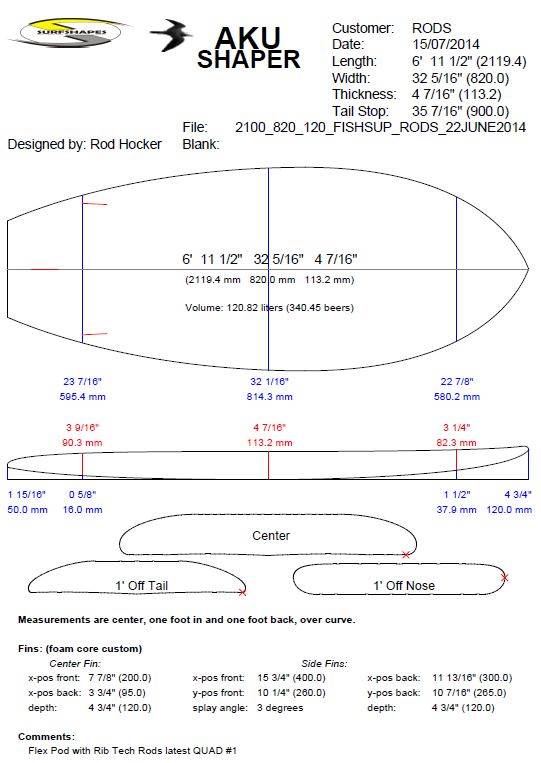
This is the pdf from AKU gives you all the data and really shows how straight the tail rail is and how long the rail is with the wide point forward. All measurements are along the stringer line.
This screen shot shows my new 205 x 75 TwinTip style SUP overlayed with the 2100 SunFish SUP

The surface area of the 2100 SunFish is 1.383 m2
The new 2050 TwinTip is 1.366 m2 slightly less area overall but wider at the ends with a much narrower waist. Rocker will be the same and the tail will be a swallow.
It has taken a while to get the TwinTip to look this good, I'm not sure about the tail width but I'll find out shortly.
I dug out a Vanguard shape from Swaylocks, one of the guys kindly posted the width numbers up so I didn't have to borrow garths board and measure it.
Some interesting numbers as percentages are
Swaylocks board 5'1
width as a % of length = 27.5%
Nose tip as a % of width = 70%
1 foot nose as a % of width = 86.8%
1 foot tail as a % of width = 85.9%
Pod width as a % of width =64.5%
My new 205 TwinTip SUP
width as a % of length = 36.6%
Nose tip as a % of width = 72%
1 foot nose as a % of width = 87.2%
1 foot tail as a % of width = 83.7%
Pod width as a % of width =64%
Hi , boarbump. what's your idea about rocker? are you going to lift up the tail as you've done on your others board.
I see you put some toe in as well . i reckon on my board a bit similar to yours , i put no lift tail as i can and fins paralel to the stringer. Those wide tail are so loose 
Select to expand quoteKami said..
Hi , boarbump. what's your idea about rocker? are you going to lift up the tail as you've done on your others board.
I see you put some toe in as well . i reckon on my board a bit similar to yours , i put no lift tail as i can and fins paralel to the stringer. Those wide tail are so loose
No, I'm using the same rocker profile as the 6'10.
I'm going to start the planshape at the start of the nose rocker.
When I ghost the 6'10 over the 6'8 there is a small difference at the 1foot mark from the tail and about 10mm less tail kick.
I'm going to cut the extra tail rocker into the blank by hand at the shaping stage.
So there will be a bit of extra tail kick due to the shorter length.
Flex pod on this one also.
The fin measurement means nothing, but I like 5mm of toe in on my front fins over 100mm and half that on the backs for a bit more drive.
I'm going to make this board ultra light and not worry about deck dents or rail cuts from the paddle.
Why don't you post up your width percentages so we can compare?
Select to expand quoteboardbumps said..Kami said..
Hi , boarbump. what's your idea about rocker? are you going to lift up the tail as you've done on your others board.
I see you put some toe in as well . i reckon on my board a bit similar to yours , i put no lift tail as i can and fins paralel to the stringer. Those wide tail are so loose
No, I'm using the same rocker profile as the 6'10.
I'm going to start the planshape at the start of the nose rocker.
When I ghost the 6'10 over the 6'8 there is a small difference at the 1foot mark from the tail and about 10mm less tail kick.
I'm going to cut the extra tail rocker into the blank by hand at the shaping stage.
So there will be a bit of extra tail kick due to the shorter length.
Flex pod on this one also.
The fin measurement means nothing, but I like 5mm of toe in on my front fins over 100mm and half that on the backs for a bit more drive.
I'm going to make this board ultra light and not worry about deck dents or rail cuts from the paddle.
Why don't you post up your width percentages so we can compare?
Sorry , I don't understand the % relations and i don't use relations numbers, i better like graphics.
If i use numbers better use it for area repartition , flotation centers.
The % of numbers describe the relation of the width to the length of a board for when you want to scale that board up. This is similar to what the CAD programs do for you automatically. I do this by hand to see what is going on.
For example:
The Tomo surfboard design that I got from Swaylocks, was to get the basic plashape of a Tomo board. I have not seen one up close or held one in my hands nor have I measured one up, just spotted one occasionally in the surf.
I want to see if it can be done in a 6foot SUP board. The basic difference between an SUP board and a prone board is the ...Width!.. SUP are wider.
So I divided the width by the length, and then multiplied by 100, to give a percentage value of the width to length of a board.
As you can see from my earlier post the Tomo board has a width value of 27.5% and my SUP width of 29.5" x 6'8" has a width value of 36.6%.
I then divived the nose tip width by the boards actual width width to give me a % value of the nose tip width to the boards actual width, so that I could check on how parallel the planshape was for scaling up to a SUP size.
I hope that is clear enough.
I have very firm Ideas on where I want the centre of ballance/gravity/flotation of all my boards.
A graph of area is all very fine but after 40+ years of board building I can see area distribution with out a graph. Thats what a planshape is.
Everyone talks about volume as a measure of float and stability, I find that the actual surface area is a great help in this department.
I find that a comfortable surface area for me is between 1.5m2 and 1.4m2 for perfomance surfing SUP boards with a traditional planshape.
What has surprised me about the 1.383m2 surface area of the SunFish, is that even tho it is lower than I like, it is just as stable as my 8'2" 1.5m2 area board.
I think this is because of the wider ends.
So that is why I am now building a6'8"x 29.5" x 120 ltr Mutant style TwinTip. This new board is called a "Mutant".
Select to expand quoteboardbumps said..
The % of numbers describe the relation of the width to the length of a board for when you want to scale that board up. This is similar to what the CAD programs do for you automatically. I do this by hand to see what is going on.
For example:
The Tomo surfboard design that I got from Swaylocks, was to get the basic plashape of a Tomo board. I have not seen one up close or held one in my hands nor have I measured one up, just spotted one occasionally in the surf.
I want to see if it can be done in a 6foot SUP board. The basic difference between an SUP board and a prone board is the ...Width!.. SUP are wider.
So I divided the width by the length, and then multiplied by 100, to give a percentage value of the width to length of a board.
As you can see from my earlier post the Tomo board has a width value of 27.5% and my SUP width of 29.5" x 6'8" has a width value of 36.6%.
I then divived the nose tip width by the boards actual width width to give me a % value of the nose tip width to the boards actual width, so that I could check on how parallel the planshape was for scaling up to a SUP size.
I hope that is clear enough.
I have very firm Ideas on where I want the centre of ballance/gravity/flotation of all my boards.
A graph of area is all very fine but after 40+ years of board building I can see area distribution with out a graph. Thats what a planshape is.
Everyone talks about volume as a measure of float and stability, I find that the actual surface area is a great help in this department.
I find that a comfortable surface area for me is between 1.5m2 and 1.4m2 for perfomance surfing SUP boards with a traditional planshape.
What has surprised me about the 1.383m2 surface area of the SunFish, is that even tho it is lower than I like, it is just as stable as my 8'2" 1.5m2 area board.
I think this is because of the wider ends.
So that is why I am now building a6'8"x 29.5" x 120 ltr Mutant style TwinTip. This new board is called a "Mutant".
Really interesting and informative.
Thanks, Rod
I love the idea of "surface area" as a spec.... I agree, volume is simply a "float" number....
when you combine length, volume AND surface area, you can get a REAL gauge of stability...
Nicely said!!!!!
Select to expand quoteboardbumps said..
What has surprised me about the 1.383m2 surface area of the SunFish, is that even tho it is lower than I like, it is just as stable as my 8'2" 1.5m2 area board.
I think this is because of the wider ends.
Maybe a better measure would be to combine (multiply) volume and distance from the stringer.
I mean, a cube of 0.1 liter of foam 20" from the stringer will have the same "floatation torque" (force to counter roll) than 0.2 liter 10" away.
A simple way to calculate this would be to have the computer program compute the center of gravity of a half-board (cut at stringer), and multiply the volume of the half-board by its distance from the stringer, to get the "floatation torque". This would be a good indication of the"static" stability of a shape.
I don't know the various shaping softwares. Does one offer a way to compute the center of gravity (or center of volume) of a half-board?
OK i got you Boardbump, ratio width /length in a percentage is a good way to schedule shaping right
up to me to better like ratio surface/ aera and surfer weight as i've done to draw the first board of my son when he was a kid.
Back on the difference between pointed nose SUP and Tomo style SUP as Colas said up here:
"A simple way to calculate this would be to have the computer program compute the center of gravity of a half-board (cut at stringer), and multiply the volume of the half-board by its distance from the stringer, to get the "floatation torque". This would be a good indication of the"static" stability of a shape."
Just look those 2 diagrams from a pointed nose 6'4" and a kind of tomo 6'4" . You will notice that surfaces's areas are spread along the stringer in Tomo (EBB6'4") with a reinforced length stability due to the torque ( area multiplied by distance from center flottation)
Notice that center of gravity is better centered to volume distribution in the Tomo style( EBB6'4") due to the larger tail of that kind of shape


Colas its just a surfboard design program.
Rail volume and flat decks have a lot of influence over the static stability and roll stability of a SUP board.
High volume/thick rails are hard to sink into the waters surface and offer the best static stability, just look at the rails of a race board. The trick is to get the right volume for a SUP surfing board, not so thick that the rails resist sinking and not too fine so that that sink easily and cause instability.
A flat deck offers the best defence against high roll instability. All boards roll, even when the water is perfectly flat and glassy. What the flat deck does is put the maximun thickness closer to the boards outline and that resists the roll instability. A board with a rolled or domed deck has the maximum thickness at the centre line and has very little roll resistance.
I hate to disappoint you Kami, but I can move the centre of gravity/volume/flotation just by adjusting the thickness distribution.
You can get the same movent of area by using a full round nose as well as a square nose. The Tomo affect is more about the planshape angle.
It gets back to graphs and damned graphs.
It is a much better policy to understand how the centre of gravity/volume/flotation affects a board and then control it and place it where you want it, depending on the design requirements of a clients wishes.
Select to expand quoteboardbumps said..
I hate to disappoint you Kami, but I can move the centre of gravity/volume/flotation just by adjusting the thickness distribution.
You can get the same movent of area by using a full round nose as well as a square nose. The Tomo affect is more about the planshape angle.
It gets back to graphs and damned graphs.
It is a much better policy to understand how the centre of gravity/volume/flotation affects a board and then control it and place it where you want it, depending on the design requirements of a clients wishes.
I'm not disappointed and i reckon you're right to talk about moving the centre of gravity/volume/flotation just by adjusting the thickness distribution.
As well you know that thickness distribution is rule by rocker curve. So if you draw a Tomo outline, you can't put the same rocker curve as you did on the pointed one.
Now , i wonder about the rocker curve on your project you are going to do, up to your feeling and waves around your place. 
Well I'll find out about the rocker curve Kami, as I have used the SunFish profile template for my hot wired blank for the 205 Mutant.
All I have done is a bit of freehand adjustment to the longer blank that is now shorter for the Mutant.
The planshape has been started at the nose in the same place as the SunFish, I have had to add 10mm of late tail lift to the pod to get the correct rocker in the tail.
I lightly hand sanded in about 5mm into the diamond tips on the Mutants nose , I had to do this because the diamonds are set back 40mm. When I place my rocker curve template over the centreline you can just see a small gap in the nose where the rocker was adjusted.
A bit of overtime last night shaping the new shooter.