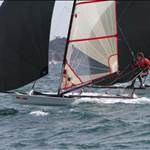
I don't think these "results" are any surprise, except maybe that the FX looks more stable than I anticipated. But really, paddling these two boards in those conditions is pretty meaningless. It would be like testing an off- road vehicle on a racetrack. If you want to test an offroad vehicle take it offroad. If you want to test all-conditions boards then take them out in lively conditions. They are designed to shine in choppy stuff and to be good all-rounders in mixed conditions, so that's where the real tests lie.
But I'm sure that this company wanted to be the first to compare these two boards and so get plenty of hits. And that might mean some compromise on the depth and breadth of the testing.
As for the stuff on the All Star flex... Umm.. The All Star Trampoline is arriving in the next consignment, with free bouncing Connor toy.
But it's lovely to finally see someone paddling the 25" wide version of the FX. Looks great.
Two shops have done head to head testing with the Allstar and the FX now, with different results on the flats. The other test was with 12'6" models though. Regardless, 101 surf sports had the FX being slightly faster on flat water, so if we can conclude anything, it's that testing is extremely subjective. I don't think it's really possible to have completely conclusive results testing boards like this given the variables involved. You can come close, but testing on the water is just too subjective to provide absolutes imo. Given the information that's available now, it's probably splitting hairs in deciding which is the better overall board.
While 101 surfsports didn't provide video, they did a much more comprehensive test ranging from flat water and some wind around 20mph, both upwind and down. No, not true blistering downwind conditions, but enough texture on the water to provide some bumps, waves and chop for which these boards were designed to be used in. It will be nice when big winds gets both boards on the water when DW season starts there.
The flex comments coming up in two different tests is interesting, but I buy into the 101 surfsports test more, stating the flex in the bumps helping out, but once again we have two very subjective tests, and it's probably largely opinion based more than anything else. Both shops read the Allstar brochure anyways. 101surf sports specifically mention the stiffness of the FX following the test on the flats, and the flex in the Allstar helping in the bumps, while Bigwinds mention the flex helping on the flats with Allstar. Subjective.
Going back to previous comments, the FX does look to be a bit thicker than I originally thought and hopefully it's stable, with enough float for the 200+ pounders out there. Hopefully boards like the SIC FX and Bark Vapor become popular and more widths will be added.
www.101surfsports.com/index.php/about-us/blog/295-which-is-faster-the-sic-fx-or-starboard-all-star
How do these boards compare in price from the retailers who made the video? The last comparison had a 800 dollar difference in favour of the SIC, which is pretty substantial.
I do wonder sometimes how much the "has it got enough volume to float a big guy?" question is a red herring. There seems to me to be a very imperfect relationship between a board's volume and the weight range of the people who can find good trim on it. I've paddled several fairly high volume boards where even at my average weight I've struggled to achieve trim. And some lower volume boards where my bigger friends can dance all over the place without sinking the nose or tail. Certainly, the SIC with 290L, thick rails, and plenty of rocker, should "float" big units fine. Whether or not they can achieve good trim is the question. And of course in reality the issue isn't about "flotation" at all, it's often whether bigger guys can balance narrow boards. Heavier guys tend either to be taller (therefore needing a wider board) or if they are not, are likely to be less fit (also needn't a wider board). That's not really much to do with volume per se, although in the real world there is likely to be a modest correlation between volume and width.
So, in short, I wonder if a board's suitability for bigger paddlers is more to do with design and stability than volume.
Both of these comparison tests are in the United States, so the price difference is going to be very similar for both shops. It's not if the board will have enough volume to float a bigger guy, but how well it float you in comparison to it's width among other design parameters. A 290 litre board can float 300 pounds, but at 25" wide, it will paddle like **** and won't be stable. The heavier you are, the lower a board sinks in the water, the more friction it has, and it also becomes less stable. You can also float more weight with less volume if you add more width. If skills are equal, and we are the same height, your Bark Vapor at 26" is probably going to be a bit more stable for you at 165 pounds at 271 litres, than for me at 215 pounds regardless of trim specifics. Height and fitness doesn't always equate with weight either. I'm very lean at 200 pounds, but for my height, a BMI index registers me as obese. There is a fine balance between trim, volume, width, and how much a board sinks with a paddler on it.
to me it looks like the sic has that standard high centre of gravity twitchy look to it going by what the video shows, i really can't see the need for so much volume,increasing volume above water line does pretty much zero for stability except giving you a slightly higher rail, my guess is next year they will do the same board with a small recess.
when you do the math the weight of the rider actually only makes a very small difference in where the water line sits however there are other effects as to how the board will feel.
Select to expand quoterobon said...
Both of these comparison tests are in the United States, so the price difference is going to be very similar for both shops. It's not if the board will have enough volume to float a bigger guy, but how well it float you in comparison to it's width among other design parameters. A 290 litre board can float 300 pounds, but at 25" wide, it will paddle like **** and won't be stable. The heavier you are, the lower a board sinks in the water, the more friction it has, and it also becomes less stable. You can also float more weight with less volume if you add more width. If skills are equal, and we are the same height, your Bark Vapor at 26" is probably going to be a bit more stable for you at 165 pounds at 271 litres, than for me at 215 pounds regardless of trim specifics. Height and fitness doesn't always equate with weight either. I'm very lean at 200 pounds, but for my height, a BMI index registers me as obese. There is a fine balance between trim, volume, width, and how much a board sinks with a paddler on it.
Yes, I am aware of the arguments Robon, it's just that I'm not sure they are correct. For instance, the idea that you can float more weight with the same volume if you have more width. You don't displace less because the object you are standing on is thinner and wider.
And 271 L (of air) will float 271 kgs, not 271lbs. 271 kgs is nearly 600lbs! Now, clearly at 600lbs the board would be submerged. And at 0lbs very little of the board is below the waterline. So the optimal weight for the board lies somewhere between those two ranges. But where that weight actually is likely I think to rest on various design parameters. And at that point the volume of the board doesn't I suspect help you much at all in determining which will be the best board for the heavier paddler (assuming that the board is not at crazy design extremes).
So, I appreciate that what you have outlined is the position that keeps getting said on these forums. But just because people say it a lot doesn't necessarily make it right.
Another issue for you to consider is that for a given volume and design, a wider board will be necessarily thinner. Thin rails could be a distinct problem for the heavier paddler because they will be able to sink them more easily with weight shifts, thereby leading to rails catching, water on the deck, and rail steer. The heavier paddler might actually be better off on a narrower thicker board, assuming they can balance it. A 100kg person will displace 100 Litres of water (roughly), which will mean that with the wide board you are now pushing a wide submerged object through the water rather than a narrow one. Which do you think would be faster? Submarines aren't square-shaped, that's for sure.
So, this all broadly coalesces to return to my previous point about the issue with a heavier paddller being - in the real world - perhaps usually more about their ability to balance, rather than a matter of litres of flotation.
Oh, and btw, I'm not sure it's valid to compare the flat water speeds of two boards using the same paddle when the boards differ greatly in the height above the water than you are standing. If your paddle length is optimised for, say, the sunken-deck All Star, it's probably gonna feel way too short when you jump on the flat deck, thick SIC. These differences in paddle length might be enough to make the 0.1mph kind of differences they were talking about in the video review. But maybe they were using adjustables, or had two paddles of differing lengths, set to the perfect length for each paddler on each board?
Select to expand quotecharlieuk said...
to me it looks like the sic has that standard high centre of gravity twitchy look to it going by what the video shows, i really can't see the need for so much volume,increasing volume above water line does pretty much zero for stability except giving you a slightly higher rail, my guess is next year they will do the same board with a small recess.
when you do the math the weight of the rider actually only makes a very small difference in where the water line sits however there are other effects as to how the board will feel.
Yeah the thickness puzzles me as well. But MR must have gone with a narrower thicker board than the prototype for a reason, because on the face of it, standing far above the waterline brings a lot of disadvantages. I'm wondering if it might be to do with DW performance in long period conditions. Or perhaps it is to do with the displacement profile of the submerged mass, especially with heavier riders. Or maybe it's to do with reducing flex. Or reducing pitching under stroke power. Or increasing buoy turning ability. Or increasing the sweet spot so you can eg. go forward when quartering wind and waves without scrubbing off too much speed. Certainly, a flat deck is easier for beach starts and transitions. So many possible reasons, I guess, and I'm not too sure how valid any of them are. Without looking into the mind of Mark Raaphorst and seeing what feedback he's been getting from his team riders, it's all guesswork. But it is a striking and interesting design aspect of this board for sure.
Personally, I think I generally prefer a thinner board. But I paddle for enjoyment rather than wins, I'm not heavy, paddle in **e conditions, and my skill sets are modest at best. So I might not be who MR had in mind when he designed the board. No-one is going to mistake me for Georges Cronsteadt's brother.
What I take from that vid is that the boards are pretty evenly matched but the true test will be in DW conditions.
The bottom line is that there are many variables to consider and the point stands with volume and width making a difference. Once again, Skills being the same, I can pretty much guarantee a board like the Vapor with 271L, will float someone who is 30-40 pounds under 200 pounds better, than someone who is 15-20 pounds over 200 pounds.I cited multiple variables in my last post. People who are 165-175 pounds are in an entirely different category for size and can get away with much narrower boards with less volume as a result. There is a reason why paddlers over 200 pounds frequently opt for slightly wider boards with more volume, and once again, it's not always height as the primary factor in combination with weight. Narrower boards become twitchier with more weight on them.
The boards don't become twitchier. It will take a huge amount of extra weight of paddler to create even half an inch of extra 14ft board below the waterline. And if you do, the board will actually be more stable because you are standing closer to the waterline. What is actually happening is that heavier people make bigger weight shifts when they move around. This isn't a problem of flotation, its a problem of balance. The heavier you are the more careful you need to be with your weight distributions, i.e. have better balance and footwork for a given volume. Most typical 14ft boards, like the 271L Vapor, will float a heavy person just fine. Whether or not they are going to feel comfortable on it is going to be down to their skills set.
So, what I think is misleading is people saying that "a big guy needs 300L (or whatever) to float him". This is not true. He can float just fine on MUCH less volume. But he'll have to have better balance. It's a small point, but an important one, because I suspect that shapers listen to customers saying things like this and so add in massive volume for marketing purposes which have the paradoxical effect of actually making the boards to be LESS stable in chop and sidewinds because for most people they become corky.
So, we could just ask Mark Raaphorst what the design objectives he was targeting in adding so much volume and thickness, when reducing the width of the board from 26 to 25 inches. I will write to him and see if we can get a response to this burning question.
Select to expand quoteRideordie said..
So, we could just ask Mark Raaphorst what the design objectives he was targeting in adding so much volume and thickness, when reducing the width of the board from 26 to 25 inches. I will write to him and see if we can get a response to this burning question.
Great idea. I was just going to suggest the same. Mind you, he's not going to give any secrets away...
It is striking in the Big Winds video how much nose rocker (in particular) the FX seems to have. But I'm not sure if the guy is standing quite as far forward as he might. These guys both look pretty light. There seems on occasion to be more wash coming from the back of the Starboard, but maybe that's just again the paddler position or the way it is filmed. And in terms of volume, the FX doesn't look particularly unusual in this respect. Sure, the rails are fullish, but you don't look at it and think "wow lots of volume there", do you?
It is interesting if the Starboard is much faster upwind than the FX, as the previous review claimed, because on pure looks alone you'd think that maybe the FX might even have it. You are pushing a big fat nose on the All Star.
Well, I have already received a response from Mark. Here was my question and his response:
"Mark, I have a new FX 14 x 25 on order. There is much debate going on in our paddle forums about your design change from pre-production 26 wide and 266 liters volume to 25 wide and 290 liters. Can you tell me what your design objectives were in making these changes? That is a pretty big change in volume, when reducing width!! Thanks!!"
"After racing the FX at the Carolina cup, team riders requested these changes. I manage to implement them prior to start of production. And although narrower, I maintained the bttm stabilizing platform under your feet. Hope you get to like the board. Aloha. Mark"
Area, you are living in an alternate dimension if you don't think volume and weight aren't important variables when it comes to larger paddlers. For starters, you aren't even close to being 200 pounds yourself. Weight does make a difference. Big time. I have been on a Variety of Boards of various widths, lengths and volume distributions. A board is going to behave differently with a much heavier person on it. It's inevitable. I'm not saying a 220 pounder needs a 300 litre board, but volume is a consideration. I have owned a board that was around 300 litres and it wasn't corky for my weight in the least and I had a good go on a board with 304 litres of volume in chop and it wasn't corky at all. Sometimes it just seems you want to argue for the sake of arguing on these forums.
Interesting...I weight about 165 right now and two weeks ago I had my grandson sitting on my 26" X 14' board in front of me (he's 37 lbs) for a total weight about 210 allowing for camelback and other gear.... and the board felt more stable not less. In fact I could have sworn it was faster in glassy conditions...going upwind was a different matter.
R
egardless of the shape, the board is going to displays the same amount of water per unit of weight on it. Archimedes principal "an object immersed in a liquid wholly or in part is equal to the weight of the liquid it displaces".
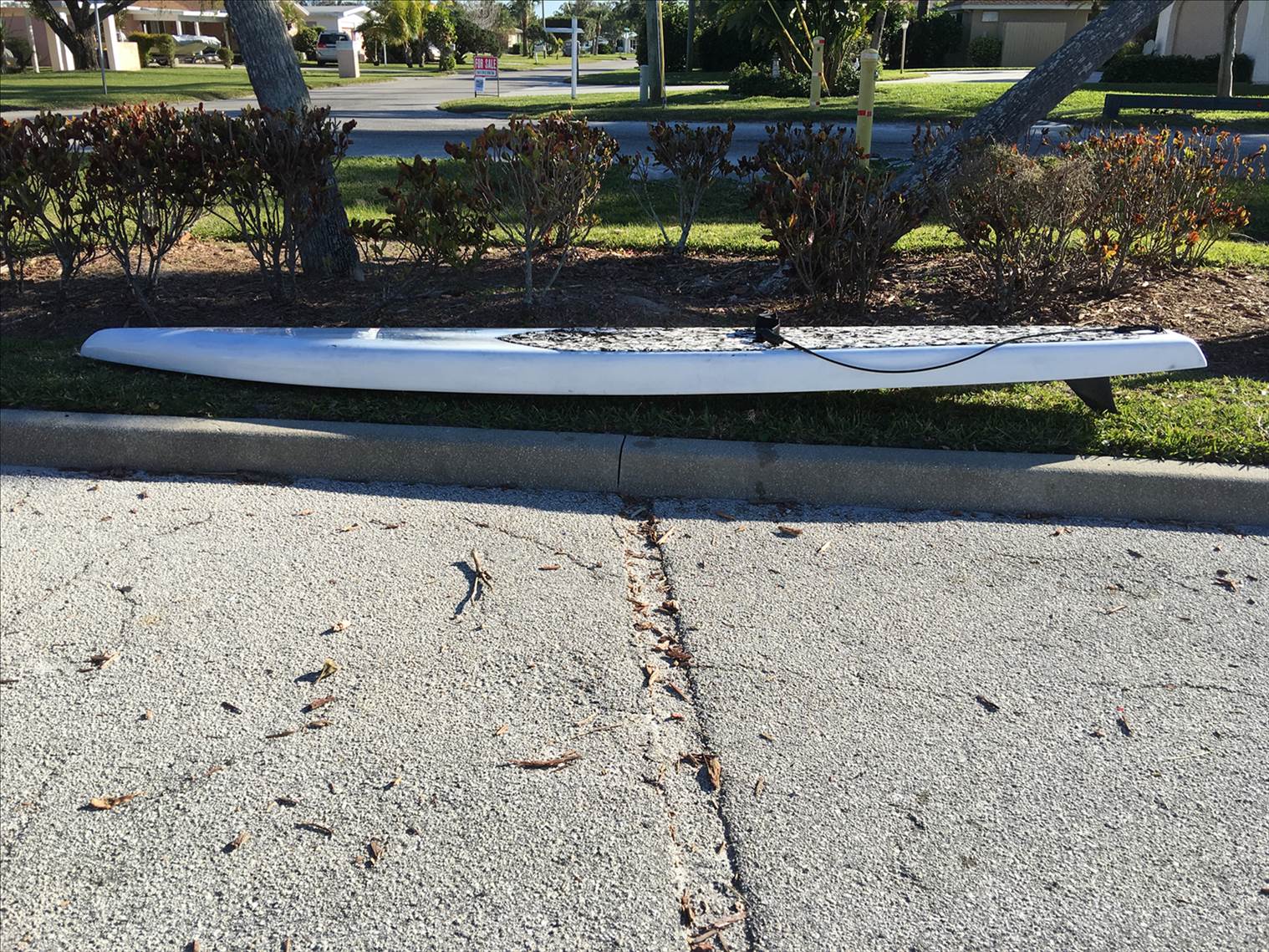
Hi, how much volume is the board in the pic? Can't tell from my phone. In calm conditions it could be more stable with more weight if you are light enough that the rails are quite a bit higher above the water.
Select to expand quoterobon said..
Area, you are living in an alternate dimension if you don't think volume and weight aren't important variables when it comes to larger paddlers. For starters, you aren't even close to being 200 pounds yourself. Weight does make a difference. Big time. I have been on a Variety of Boards of various widths, lengths and volume distributions. A board is going to behave differently with a much heavier person on it. It's inevitable. I'm not saying a 220 pounder needs a 300 litre board, but volume is a consideration. I have owned a board that was around 300 litres and it wasn't corky for my weight in the least and I had a good go on a board with 304 litres of volume in chop and it wasn't corky at all. Sometimes it just seems you want to argue for the sake of arguing on these forums.
robon, I'm not arguing with you, I'm trying to explain my point because you don't seem to be following it. So I'm trying different ways to get the point across.
My point is illustrated nicely by rghdc's post. A board probably actually gets more stable under *static* load, not less. I've paddled my wife on my Angulo Shaka 14 (I'm guessing about 270L) sitting on a deck chair. As long as she sat on the deck chair we were perfectly stable and we made good speed (as long as not into the wind). It was possibly more stable than usual, even. But as soon as she stood up, her weight was not evenly distributed, and started to shift from foot to foot, then the board felt much less stable.
Now, the Angulo is not a high volume board. But it floated both of us fine (and my wife is 6ft tall). I can get my wife, myself and my two teenage kids on my 400L inflatable, as long as they are all sitting down there's no issue of stability, and the board is nowhere near sinking. So, as I say, the issue of flotation is a red herring. There's plenty of volume in the average 14fter to float a big person.
But of course heavier people will find bigger boards more stable. EVERYONE finds bigger boards more stable. This isn't a phenomenon that people experience uniquely if they are over 200 lbs. So just take it easy mate, forums are for the exchange of ideas.
Select to expand quoteRideordie said..
Well, I have already received a response from Mark. Here was my question and his response:
"Mark, I have a new FX 14 x 25 on order. There is much debate going on in our paddle forums about your design change from pre-production 26 wide and 266 liters volume to 25 wide and 290 liters. Can you tell me what your design objectives were in making these changes? That is a pretty big change in volume, when reducing width!! Thanks!!"
"After racing the FX at the Carolina cup, team riders requested these changes. I manage to implement them prior to start of production. And although narrower, I maintained the bttm stabilizing platform under your feet. Hope you get to like the board. Aloha. Mark"
Very impressive that you got a reply so quickly. But, predictably, he's playing his cards close to his chest. After all, why should he give away for free his hard-earned knowledge gathered over thousands of hours of work? I don't blame him.
So, we'll just have to try to work it out for ourselves. What we need is someone who has both the pre-production and the production versions of the board, and who can compare them in a variety of conditions. Maybe then we'll get to know why he went to so much trouble to effect this change.
I stated how well a board floats you, not if it could and volume is a consideration for heavier paddlers, and yes boards do behave differently with heavier paddlers. I had close to 400 pounds on my starboard touring that has 276 litres of volume so being able to actually float a lot weight is something else, and I addressed it already. It's not a static variable across weights with boards behaving the exact same way. This can go in circles forever. I will change my terminology next time.
I can understand why the Team riders would want the board to be more more narrow, but why would they want that much more volume? Possibly helps to prevent the swamping/slowing effect in cross chop and buoy turns? Just a guess. Thoughts?
I'm not sure. Marks comments are interesting. If the paddlers in the video say it's relatively stable, then hopefully it will be for you. it looks the goods for rough water paddling and once you get out a few times, I'm sure you will have your balance figured out. Based on your weight, it likely won't be as corky for you as it would for lighter riders. Beauty of a board.
What if the extra thickness is mostly there to add 'stiffness' and 'strength' and it would also help the board recover from what Mark calls the 'poke' (pearl) .. It also reduces the amount of water flowing over the rails and tail.. and lastly makes the board available to a bigger weight range of paddlers.. We're only talking about a few mills of extra thickness over the whole length of the board.. Not enough to effect paddle length or tippyness by much.. It's all win,win,win IMO.. 
I like that answer DJ, but that sure flies in the face of the Starboard trampoline multi-flex bouncy turbo thing. I guess if the the Team asked for it, they must think it will make them faster overall. I find it interesting that the width and volume of both boards is the same. I think maybe that "springy" thing is just attributable to their top team rider (below). Can't wait to try out my new board!!

Select to expand quoteDavidJohn said..
What if the extra thickness is mostly there to add 'stiffness' and 'strength' and it would also help the board recover from what Mark calls the 'poke' (pearl) .. It also reduces the amount of water flowing over the rails and tail.. and lastly makes the board available to a bigger weight range of paddlers.. We're only talking about a few mills of extra thickness over the whole length of the board.. Not enough to effect paddle length or tippyness by much.. It's all win,win,win IMO..
I agree, to keep the drag down, minimize the water flowing over the deck and rails. Drag/friction is the enemy. The whole issue of corkyness is moot considering for whom and what the board is designed for.
Re: Starboard. I'm not sure how flex will help with downwinding. Perhaps they are going to argue that it will allow the board to "fit in the trough better" ;)
Select to expand quoteArea10 said..
Re: Starboard. I'm not sure how flex will help with downwinding. Perhaps they are going to argue that it will allow the board to "fit in the trough better" ;)
especially if it's in two bits...

The topic of flex in the bumps goes back to subjectivity and opinion. Several paddlers chimed in on this on the standupzone forum with the FX and Allstar saying that they prefer flex when downwinding, and some said it helps for upwind too. Hard to prove either way, but obviously some paddlers like it, so I can't completely discount it.
Going upwind I'll keep an open mind, but how would flex help going downwind?
I'm not trying to pick an argument with you, I genuinely want to know what aspect of this flex is apparently advantageous and how. I had always thought that flex was the enemy of early planing. This is principally why inflatables don't tend to DW well, I suspect. So why would it be a good thing in an All Star? Can someone explain that to me?
Select to expand quote
Robon...can't tell you the volume...I designed & built it...and I am not using software to design...I could figure it out with Simpsons Rule calculations if needed. Next build will be a bit thinner in the standing area as I want to drop the width another 1" to 2". It's quite stable at 26".
Rideordie... Based on some comments I have heard from Mark on You-tube I think the golden nugget in his comment has to do with....
"And although narrower, I maintained the bttm stabilizing platform under your feet."
I remember in one of his videos Mark talked about this as being a key factor in board stability...not overall width, width at the bottom...from chine to chine under the standing area.
it would be interesting to see the pre-production rail compared to the production one. The bottom might have remains the same width with only 1/2" of curve taken out of each rail when viewed from a slice across the board. Or to put another way a 25" board with a Boxier, more vertical rail could have the same stability as a 26" board with a slightly more egg shaped rail.
Select to expand quoteArea10 said...
Going upwind I'll keep an open mind, but how would flex help going downwind?
I'm not trying to pick an argument with you, I genuinely want to know what aspect of this flex is apparently advantageous and how. I had always thought that flex was the enemy of early planing. This is principally why inflatables don't tend to DW well, I suspect. So why would it be a good thing in an All Star? Can someone explain that to me?
I really don't know. Just going by several comments others have made that goes back to the allstar vs fx thread on the zone. Several did say they liked flex in bumps going up wind or down wind. One fx owner even got his board made custom because he wanted more flex. It's obviously something some paddlers value. I just don't know how it can be quantified realistically.