Select to expand quote
mcrt said..frenchfoiler said..Cedrus with art999 :
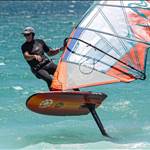
www.instagram.com/p/CcLdht_IsCr/Check the water flow behind the mast, i don't know what to think about this ? good, bad ? Any idea, theorie ?
You mean the water climbing up the mast and trailing behind?.
All masts do this to some degree, maybe with the Cedrus it is more noticeable.
Reason could be the thicker section,or the joints between the leadin&trailing edge and the carbon central part,or both.
IMHO it is drag ,lifting water takes energy,my guess is it is the result of a more turbulent vs linear flow over the mast.
Turbulent is draggier but has more energy,it might even be desirable to prevent flow separation and ventilation.But i really have not read much at all about surface piercing foils.
It is not the seams of the non-structural leading/trailing edges. Check out the website, ask any owner, you can't even feel the transition from rubber to carbon with your eyes closed.
The point at which a foil (mast) pierces the water contributes a significant amount to the total drag in the system. Yes lifting water takes energy. As you mention, all masts have spray off the trailing edge but you may notice it more with Project Cedrus due to the thicker profile. The math again supports ~5% drag increase of the system for a 19mm thick mast vs. 16. Plenty of clients don't notice a difference, but then there are some who claim they notice it. Could be confirmation bias, could be extreme sensitivity, and could also be their setup. Please note that heavier riders have much more lift-induced drag (at the wing) and will be far less sensitive to mast parasitic drag. Heavy riders also benefit most from a stiffer mast. This all being said, there are quite a few very happy lightweight female riders who appreciate a light/stiff mast and again don't notice or mind a slight impact to speed.
Turbulent flow does create more drag along the surface of which it is attached to. But a turbulent boundary layer is thicker, and will stay attached to the surface longer, reducing pressure drag and the likelihood of ventilation or stalling. It's why airplanes have vortex generators on the leading edge. It's why golfballs have dimples. But the top 3' of the surface of the ocean is about the most difficult set of boundary conditions for fluid flow analysis or CFD, and by difficult I mean impossible. I worked with some of the best America's Cup foil designers on Project Cedrus and even they can't predict the characteristics of the boundary layer between water and the foil. It's a combination of laminar flow transitioning to turbulent at all times, and also depends on temperature, salinity, wind/wave conditions, speed, currents, and more.

 foilstate
> 9 months ago, 18 Dec 2021
foilstate
> 9 months ago, 18 Dec 2021