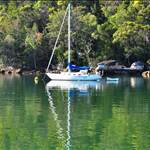
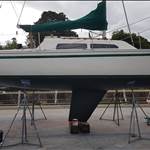
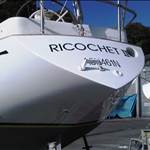
MB, couldn't find a way(read have no idea) to add pics when I PM'd you, so I've posted a few here. hope that's s ok.


ps, refastened your tiller, had worked its way loose and was flogging 6inches or so.
Select to expand quoteAzureF305 said..
MB, couldn't find a way(read have no idea) to add pics when I PM'd you, so I've posted a few here. hope that's s ok.
ps, refastened your tiller, had worked its way loose and was flogging 6inches or so.
I think the topping lift may have sagged a bit as the boom is much closer to the dodger than normal. That may explain the slop in the tiller as I use the same line to secure the boom and the tiller. It has worked for 14 years but not this time.
I sent you a PM with my number so I can thank you personally when I get home.
Hi Morningbird
Good top see that you boat is pretty much unscathed
Just a question
What are the 2 horizontal channels on either side of the cockpit (Just above the winch handle pocket) in the photo below used for
Regards Don

I noticed when i was aboard they were pretty much level with the bottom of the companionway. Id say either a seat or a step would slot into it, that's what it looked like to me anyway
Select to expand quoteAzureF305 said..
I noticed when i was aboard they were pretty much level with the bottom of the companionway. Id say either a seat or a step would slot into it, that's what it looked like to me anyway
Hi Azure
I was wondering if a piece of timber to use as table top slots in there
I have been locking a doing something similar on mine as the cockpit seats slope and even at anchor if you put a cup on them is slides backwards
Either that or put a piece of ply across the seats with a couple of pieces of timber fixed to the lower face the same width as between the seats to lock it in position
Regards Don
Select to expand quoteDonk107 said..AzureF305 said..
I noticed when i was aboard they were pretty much level with the bottom of the companionway. Id say either a seat or a step would slot into it, that's what it looked like to me anyway
Hi Azure
I was wondering if a piece of timber to use as table top slots in there
I have been locking a doing something similar on mine as the cockpit seats slope and even at anchor if you put a cup on them is slides backwards
Either that or put a piece of ply across the seats with a couple of pieces of timber fixed to the lower face the same width as between the seats to lock it in position
Regards Don
Something for a table looks like it would work there too, never thought about that, good call Don.
I have the same problem with sloping seats and nothing flat to use. I found this roll-up aluminium table fits neatly on the cockpit floor between the seats (from memory the legs fold out to about 55cm x 55cm and top is 70cm x 70cm), it rolls and folds away into a small bag for easy stowage. not expensive either. maybe this could help.
Regards, Mick.
Select to expand quoteAzureF305 said..Donk107 said..AzureF305 said..
I noticed when i was aboard they were pretty much level with the bottom of the companionway. Id say either a seat or a step would slot into it, that's what it looked like to me anyway
Hi Azure
I was wondering if a piece of timber to use as table top slots in there
I have been locking a doing something similar on mine as the cockpit seats slope and even at anchor if you put a cup on them is slides backwards
Either that or put a piece of ply across the seats with a couple of pieces of timber fixed to the lower face the same width as between the seats to lock it in position
Regards Don
Something for a table looks like it would work there too, never thought about that, good call Don.
I have the same problem with sloping seats and nothing flat to use. I found this roll-up aluminium tablefits neatly on the cockpit floor between the seats (from memory the legs fold out to about 55cm x 55cm and top is 70cm x 70cm), it rolls and folds away into a small bag for easy stowage. not expensive either. maybe this could help.
Regards, Mick.
Hi Mick
Thanks for the idea
Regards Don
Select to expand quoteSectorsteve said..sydchris said..
What's the issue with moorings in Callala Bay - is it lack of maintenance, poor holding, lack of swinging room preventing a decent scope, or a combination?
Went for a look today. The beneteaus bolt on keel has ripped through the hull. Keel is sitting on the sand. 1 dismasted. Fibreglass washing ashore in the surf. Construction on the beneteau doesn't look good actually.
The keel on the dismayed yacht is completely submerged in the sand
The third boat fared the best. There's at least one small yacht dismasted in the bay with the mast onboard.
Must have been bad there. My boats in the creek and fine. Thought I'd lost a winch cover but it only got blown into the bucket on deck.


Did a claim survey on a benny that went ashore at Vincentia a few years ago. Same thing. Keel came of on the second bump on the beach. Laminate very thin, no floors and washers under the nuts. Average glass thickness in that area 5mm!!
Lived at Callala for 20 years and saw this many times. Easy fixed by building a breakwater but it will never happen now it's a Marine Park. And that's another discussion for another day
Select to expand quoteDonk107 said..AzureF305 said..
I noticed when i was aboard they were pretty much level with the bottom of the companionway. Id say either a seat or a step would slot into it, that's what it looked like to me anyway
Hi Azure
I was wondering if a piece of timber to use as table top slots in there
I have been locking a doing something similar on mine as the cockpit seats slope and even at anchor if you put a cup on them is slides backwards
Either that or put a piece of ply across the seats with a couple of pieces of timber fixed to the lower face the same width as between the seats to lock it in position
Regards Don
1st prize Don. There is a timber piece that slides in that holds a lovely gimbal compass and holes for drinks to be placed in. It is absolutely useless and is a hindrance for going below so I have never used it.
Maybe a new owner will make use of it.
The poor boat has been sitting there unloved for a month or more and is showing it. I get onboard every week or two to clean her up and run all the systems and the cockpit usually looks more loved. I can see an afternoon of minor repairs and scrubbing is in order when I get home.
I should say that people on this site have been marvelous. I didn't ask for any assistance but yet again someone responded to a need without being asked. Thank you AzureF305.
I have had the opportunity to help out a few Seabreezers, it is a great way to meet other sailors. I hope the culture continues.
Make no mistake considering how crappy the internet can be,
there are some incredibly good and giving people on this site.
The spirit of Haydn (HG 02) is alive and well.
Are they the moorings that were trialled a few years ago that screwed into the seabed?
There was talk of it before I left the area in 2014. There was also talk of 3 point stingray anchor moorings at cb
Select to expand quotetroubadour said..
Are they the moorings that were trialled a few years ago that screwed into the seabed?
There was talk of it before I left the area in 2014. There was also talk of 3 point stingray anchor moorings at cb
That's them I think. Look ****ty have seen them before. You need something proper, like some bit of metal. People put Concrete on the end of moorings but they loose half their weight in water so they arnt effective either. My dad used to have a massive ships anchor on the end of their that Bundaberg Slipways gave us for $300. Worked a treat for "Shanty" only weighed 15 ton though.
Select to expand quoteAzureF305 said..
MB, couldn't find a way(read have no idea) to add pics when I PM'd you, so I've posted a few here. hope that's s ok.
ps, refastened your tiller, had worked its way loose and was flogging 6inches or so.
Morning Bird is definitely a beautiful boat.
A mate who had the only private mooring at Green Is. off Cairns holding only a 32 ft Pearson was told he had to have an "environmental" mooring of the screw in type.
So G.B.R.M.P.A. duly installed their screw in mooring and Joe hooked up to it but not letting the line go on his block mooring but leaving a respectable amount of slack in the tackle.
After the first 25 knot blow came through he rang G.B.R.M.P.A. and said come out and have a look at how good your screw in is, obviously designed by some university graduate using a theoretical formula and with no experience of the real world. Complete failure.
Take heed to this story because these are the kind of bearuocrats that are running ruining our country today.
With the screw in mooring system that is designed to protect the sea bed i assume it relies on stretch in the rope (or what ever is used) to absorb shock loads where as with a traditional mooring with a heavy bottom chain laying on the sea bed the heavy chain being lifted and would absorb some of the shock loads
It would be interesting to know at what point (wind strength, sea conditions ) the bottom chain of the mooring is stretched tight
Regards Don
Select to expand quoteDonk107 said..
With the screw in mooring system that is designed to protect the sea bed i assume it relies on stretch in the rope (or what ever is used) to absorb shock loads where as with a traditional mooring with a heavy bottom chain laying on the sea bed the heavy chain being lifted and would absorb some of the shock loads
It would be interesting to know at what point (wind strength, sea conditions ) the bottom chain of the mooring is stretched tight
Regards Don
On "Normal" Moorings with chain you would have some bit of chain that is really heavy say 1 inch chain. 2-3 metres of chain ( Same depth of water you are in) that connected to a massive piece of old metal machinery ( or in my case a 500 pound cqr or plough anchor). Then some chain that can be replaced (10-15mm depending on boat size) at the surface of the water that would naturally go up and down with the tide and pull of the boat. This chain should not be to heavy otherwise you can't replace it. That is my idea of a mooring I can trust on a boat up to about 40 ton.
This works on Motor Boats (or stink boats if you yachties are like that). Don't know about you guys but that alwayd worked for me and my mates and family.
PS Cisco read into any commercial fishing "regulation adjustments" the bureaucrats have made. Look at the Torres Strait Prawn industry. They totally destroyed it, what was had going worked perfectly my dads mate showed evidence to the government of a steady industry for over 10 years. Even a slight increase in catch. All evidence was totally ignored, I would not pay attention to the moorings. All they are going to do is make boat break off and sink making a real environmental problem.
PPS sorry for the book
Select to expand quoteShanty1 said..AzureF305 said..
MB, couldn't find a way(read have no idea) to add pics when I PM'd you, so I've posted a few here. hope that's s ok.
ps, refastened your tiller, had worked its way loose and was flogging 6inches or so.
Morning Bird is definitely a beautiful boat.
Not looking her best there I'm afraid. But the S&S lines are excellent. As is said of planes, if it looks like it will fly well it will, if a boat looks like it will sail well it will.
Select to expand quoteDonk107 said..
With the screw in mooring system that is designed to protect the sea bed i assume it relies on stretch in the rope (or what ever is used) to absorb shock loads where as with a traditional mooring with a heavy bottom chain laying on the sea bed the heavy chain being lifted and would absorb some of the shock loads
It would be interesting to know at what point (wind strength, sea conditions ) the bottom chain of the mooring is stretched tight
Regards Don
That stainless steel bit is the shock absorber. I'm not sure what is inside the tube, probably a spring. This rotates on top of the screw in bit which is supposed to be down in the sand with the ring just clear. The shock absorber is supposed to rotate just above the ribbon weed and the Seagreen riser floats so it keeps everthing clear of the ribbon weed. I have not seen the broken bit but looking at the photo I presume it is a failure with the bolt. I think these moorings would need annual visual inspections just like normal moorings. I think there maybe the usual problem of dissimilar metals and either the bolt has failed or the top of the ring.
It is going to be real hard to find the top of that screw!
This is at least the second environmental mooring in CB that has failed in the last 2 years. Both resulting in wash ups.
Select to expand quotekeensailor said..
This is at least the second environmental mooring in CB that has failed in the last 2 years. Both resulting in wash ups.
What are the courtesy moorings on the other side of the bay? They are part of the park.
not very environmental moorings are they ..........spewing yachts all over the beach !!!
Select to expand quoteSandS said..
not very environmental moorings are they ..........spewing yachts all over the beach !!!
That's what i think. Maybe for you guys down in Sydney seaweed damage is an issue. Up here in Queensland we don't really have that problem with the seaweed, but we do have the environmental mooring problem. Putting yachts on the beach surely isn't good for the environment, especially if one gets smashed up and fuel ends up in the water.
I am a bit surprised that they use that type of mooring. In the Whitsundays they have a good type of mooring where a big concrete block has a really thick rope leading to a large fender. The fender floats above the block but still way below the surface. A second line leads from the fender.
So you get good shock absorbing from the floating fender and no problems with the bottom - in most cases coral. Seems pretty dumb not to use that method here - but I do remember someone had invented the screw mooring and so they may have pushed it to get the business.
cheers
Phil
Select to expand quoteKankama said..
I am a bit surprised that they use that type of mooring. In the Whitsundays they have a good type of mooring where a big concrete block has a really thick rope leading to a large fender. The fender floats above the block but still way below the surface. A second line leads from the fender.
So you get good shock absorbing from the floating fender and no problems with the bottom - in most cases coral. Seems pretty dumb not to use that method here - but I do remember someone had invented the screw mooring and so they may have pushed it to get the business.
cheers
Phil
yes, exactly what should be used.
Select to expand quoteRamona said..keensailor said..
This is at least the second environmental mooring in CB that has failed in the last 2 years. Both resulting in wash ups.
What are the courtesy moorings on the other side of the bay? They are part of the park.
yes, "hole in the wall" courtesy mooring is sheltered from southerly too
Select to expand quotekeensailor said..Ramona said..keensailor said..
This is at least the second environmental mooring in CB that has failed in the last 2 years. Both resulting in wash ups.
What are the courtesy moorings on the other side of the bay? They are part of the park.
yes, "hole in the wall" courtesy mooring is sheltered from southerly too
even at anchor youd be better off over there but i dare say there would have been swell coming through - even there.
One of the courtesy moorings on the Eastern side failed a few years ago and the yacht ended up on the rocks. There was a hell of a stink about it and the owner appeared on TV. He was a Vietnam veteran and a cranky old bugger and made plenty of noise and the Parks and Wildlife coughed up and paid for all his repairs. I think that was one of the early environmental moorings.