The mixture of the two suggested systems, Jolene's and Cisco's is the one l worked out years ago by trial and error to keep the number of reefing lines down to one.
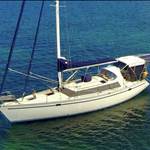
I am talking about a 28 footer, not a big yacht.
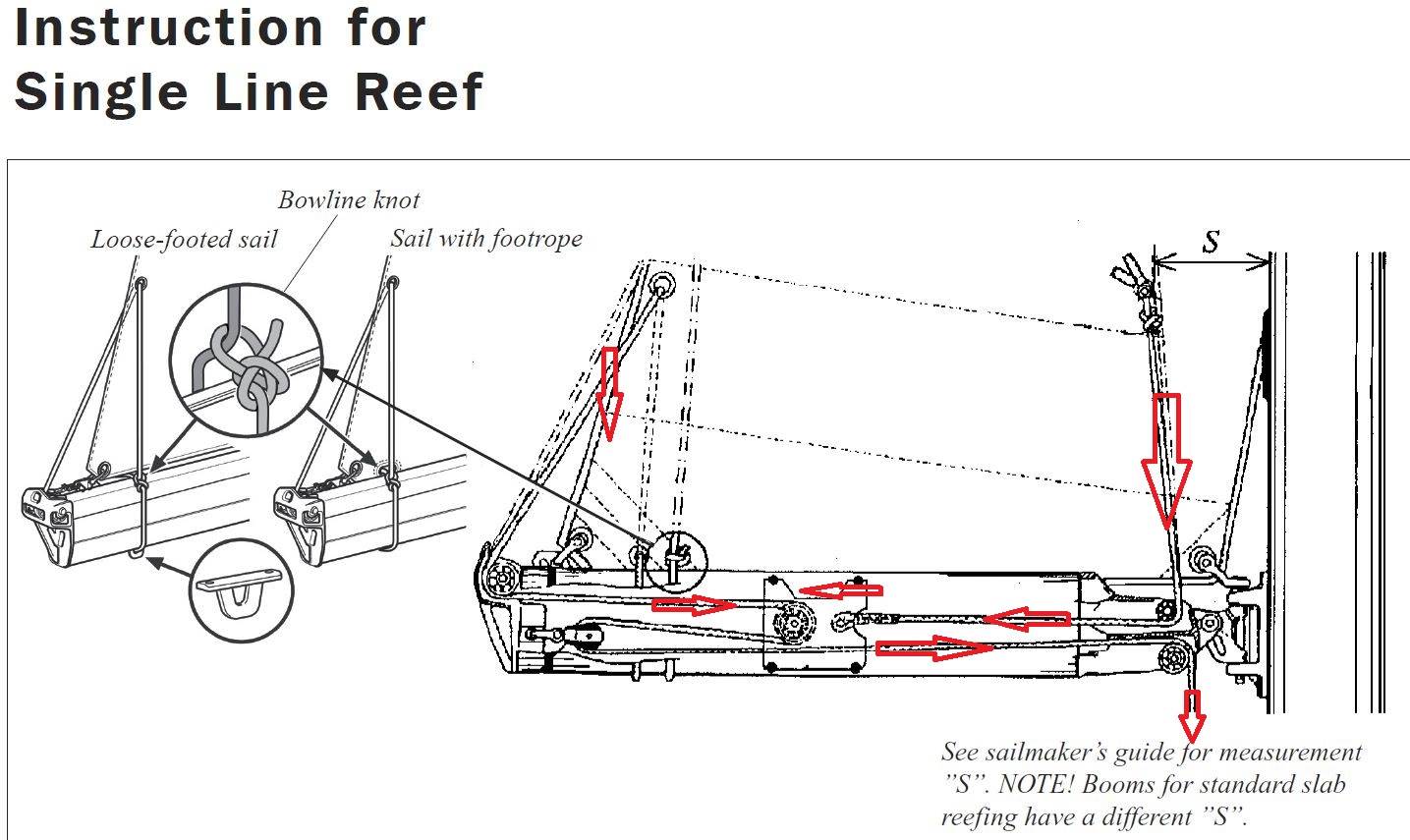
A single reefing line, inside the boom cuts down on the clutter, created by 3 reefing lines l would otherwise have.
I don't mind going to the mast to put the tack cringle onto the horn. When the weather is coming a cutter sail is used which is a hanked sail, with Wichard hanks, so l gotta go forward, anyway.
It gives a good opportunity to check everything on and around the mast before the blow.
The tack cringles are fitted with strops and rings.
Main is a 3 reef, fully battened lose footed Dacron cruising sail running on sliders.
The clew is like Jolene's system, running on a sliding boom car except it is held in position by a sliding stopper which is slid to the appropriate, 1,2 or 3 reef position on the boom track, in a second.
When no reefing is required the car is controlled by the main outhaul line.
The single reefing line (6mm spectra) is running inside the boom with a hook attached to it!
This hook is hooked into the appropriate reef cringle in accordance with the boom position and the line put on the boom winch.
The main outhaul, attached to the boom-car, is the second line inside the mast (6mm spectra) and this line with the reefing line gives enough leverage via the boom winch to make the sail flat as a board even in 35-40 knot puffs in third reef.
If necessary, instead of the horn, the Cunningham can be used as an extra adjustment as it has a hook at the end and it can be moved to any tack cringle position in a second. Its fourfold purchase and the line to the winch allowing it plenty of power to do it's job.
The size of the yacht and my 6 feet height allows me to work all the above from the cockpit but the working of the tack cringles and the cutter sail.