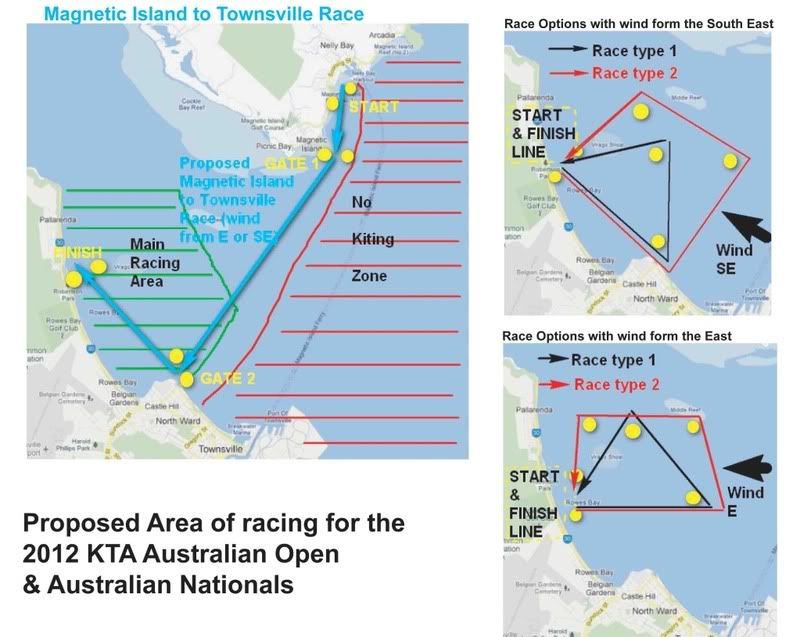
The two bottom marks are not far apart, (maybe 100 meters, sometimes closer) as long as competitors go between them at the end of the downwind leg they can round either mark to head back up to the top mark, it adds a bit of variety and brings some tactics into play as you need to decide what mark to go around or should you cover the other guy and follow him or try and make a break for it out the other side of the course ;)
The race committee decides on the day how many laps to do and is usually indicated by a particular flag on the start boat. it is usually the same for the whole day unless the wind drops off and less laps are needed to complete the course in a timely mater, but this is with normal sailboats when you can sometimes be becalmed if the wind starts to die between races.
I would think with kites though and to save confusion it maybe better to just have a briefing at the beginning of each day and state how many laps will be used. if the wind dropped off that much our kites dont fly anyway :(
This type of course would be easy for the race officials to set up as it is just in line with the wind and the start line is at 90deg to the wind.
If the wind changes that much they just gota move the top mark and let a bit more rope out on the start boat to keep the start line square to the wind direction.
All they need to worry about is how far apart to put the top and bottom marks.
The start finish line would usually be a couple of hundred meters downwind of the bottom mark to make sure there is no confusion with other boats being laped.
Occasionally as you can see in the hobie cat courses they sometimes might stick an offset mark near the top mark, this might be 100 or 200 meters offset to give a small reach just to mix it up a bit, but the course is still mainly upwind/downwind.


And here are some typical sailing instructions with course layouts listed at the bottom
http://hobiecatnationals.com.au/si/