recos for a parawing board

1 month ago
Reply
Register to post, see what you've read, and subscribe to topics.
Hubie
Hubie
13 posts
13 posts
14 Apr 2026 9:50am
I currently have a 100L Cabrinha Swift ML board (I weight 80 kg). It's fine but I find it unstable in bigger waves.
I've been thinking of getting a more stable ML board so why not get one that will also help with parawinging.

I heard that for parawinging, the board should have more weight on the front? Any other specific characteristics?

What board would you recommend in the 100L to 120L that is "parawing proof?
Pasquales
Pasquales
210 posts
210 posts
14 Apr 2026 12:20pm
I'm 90 kg and picked up a used a 95 L Sunova Carver. It's plenty stable for a 6'2" x 20" narrow profile. The nose area has enough width/volume to keep it from sinking when getting to your feet. This has helped for learning in lite winds.
hilly
hilly
WA
8120 posts
WA, 8120 posts
14 Apr 2026 2:42pm
Smik "The Jack" is very stable pumps up onto foil really well. Highly recommended

www.smiksup.com/parawing
Grantmac
Grantmac
2383 posts
2383 posts
15 Apr 2026 1:34am
I would look less at volume and more at thickness, as in you want less thickness under your feet. If anything a thinner board with the same or less volume will offer more stability.
BWalnut
BWalnut
WA
1160 posts
WA, 1160 posts
15 Apr 2026 1:55am
Hubie said..
I currently have a 100L Cabrinha Swift ML board (I weight 80 kg). It's fine but I find it unstable in bigger waves.
I've been thinking of getting a more stable ML board so why not get one that will also help with parawinging.

I heard that for parawinging, the board should have more weight on the front? Any other specific characteristics?

What board would you recommend in the 100L to 120L that is "parawing proof?


I think the chubby nose thing is a bit more for shorter designs unless you are going full gator! I'd look for something that is a touch longer and a few less liters but the same width if you can find it.
windwaterfoil
windwaterfoil
23 posts
23 posts
15 Apr 2026 3:17am
Grantmac said..
I would look less at volume and more at thickness, as in you want less thickness under your feet. If anything a thinner board with the same or less volume will offer more stability.


Grantmac, what dimensions (length, width, thickness, volume) does your current board have? and how much do you weigh?
Pasquales
Pasquales
210 posts
210 posts
15 Apr 2026 11:33am
Instability is also influenced by ML shape. Pintails have greater tendency to roll. Check the shapes with more area - diamond, square, etc.
robbo1111
robbo1111
NSW
654 posts
NSW, 654 posts
15 Apr 2026 2:10pm
hilly said..
Smik "The Jack" is very stable pumps up onto foil really well. Highly recommended

www.smiksup.com/parawing


I second this, just got a 65L version and took it straight to Maui, both PW and wing goes great
Hubie
Hubie
13 posts
13 posts
15 Apr 2026 10:06pm
Thanks guys. I do think thickness and bottom profile has a lot to do with it. My 100L swift is 6'3x20x5.4 (190x51x14 cm) so it's deep in the water and just rolls.

Just looked at smik, their 6'0x22@106L doesn't provide thickness and tried searching but couldn't find anything.
@hilly and @robbo1111 do you know their thickness?

@Pasquales the sunova 95L is 5 3/8" (and rest of dimensions are similar to swift) but the bottom profile is more flat.Maybe it's the rider that is a problem?
airsail
airsail
QLD
1598 posts
QLD, 1598 posts
16 Apr 2026 5:16am
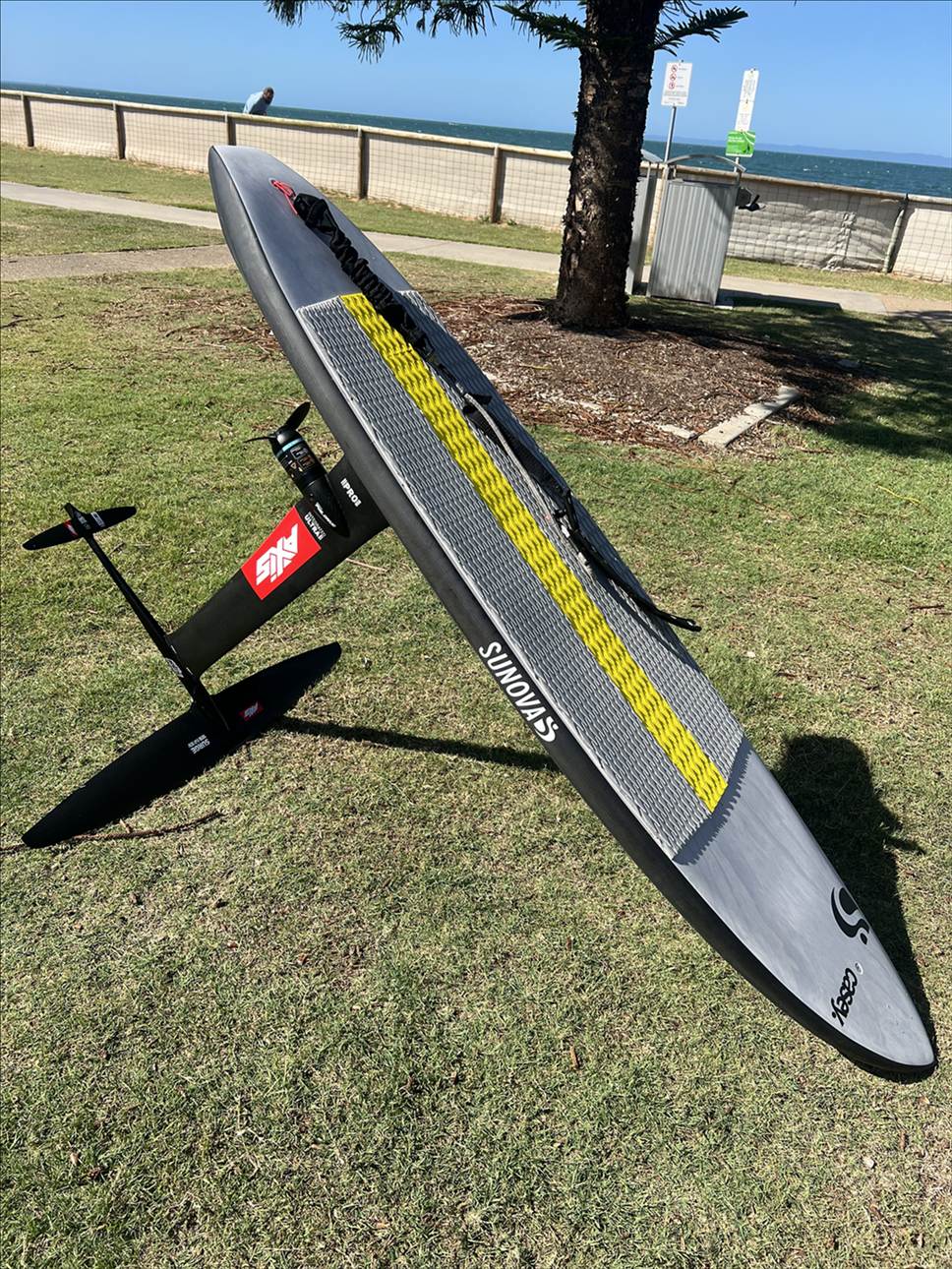
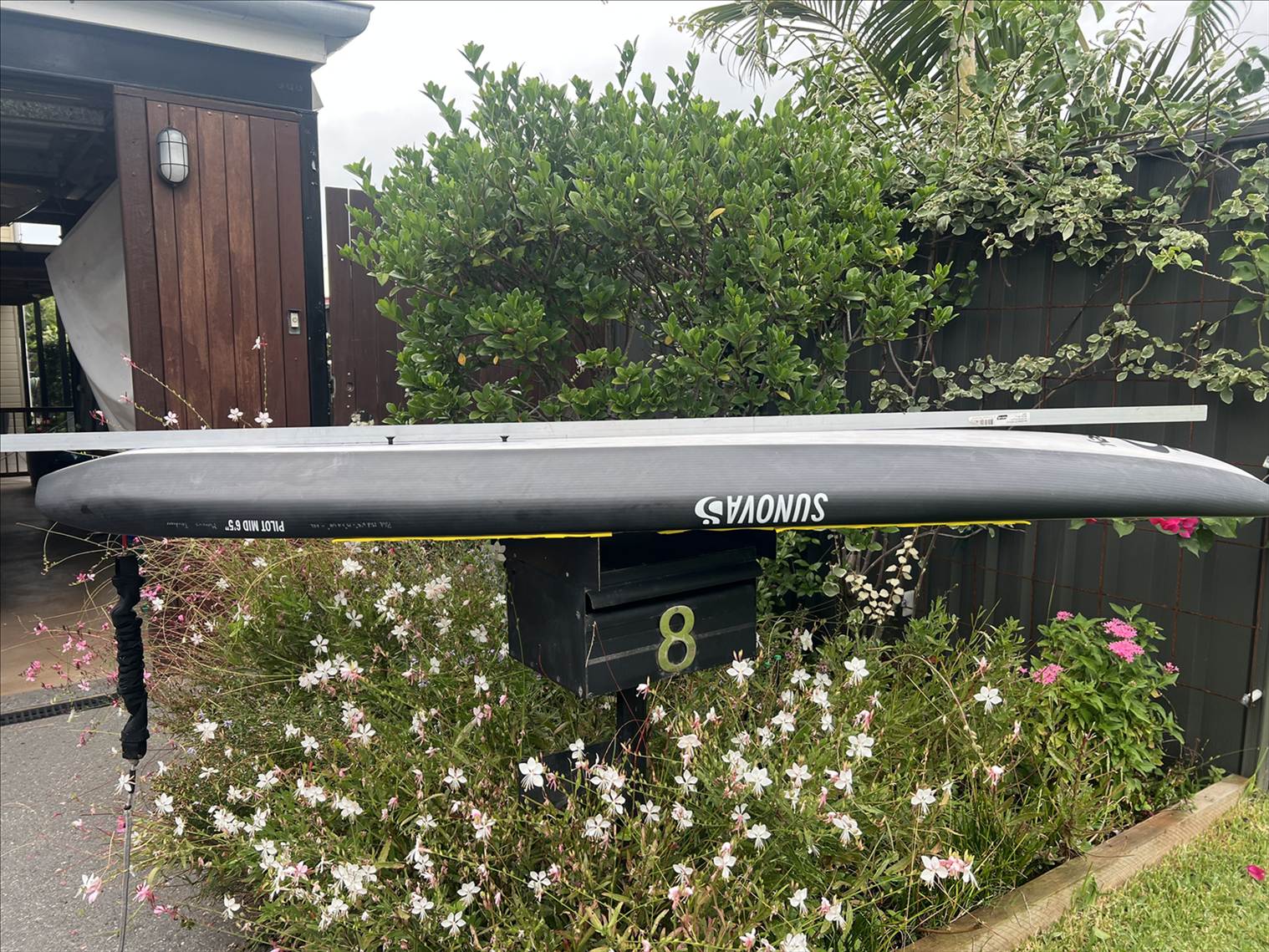
I’ve just changed to the Sunova Mid Pilot 6’5x19x68lts, I’m 81kgs. These are actually a prone board, not a shrunken DW board so have a very flat rocker. No need to rock these to get on foil, they just accelerate quickly to foiling speed. Even though they are narrow they sit low in the water and are quite stable. If the wind dies you will sink, but super easy to prone paddle back in. At 6’5 any gust gets you up on top of the water and the low volume is amazing on a swell.
Tried mine with FD the other day, works great but better with a para.
Note, you need to fit your own deck pad.
i predict we will see a lot more boards similar to this or the Omen Emessary for para in the future, length without the volume.




Hubie
Hubie
13 posts
13 posts
17 Apr 2026 12:30am
airsail said..
I've just changed to the Sunova Mid Pilot 6'5x19x68lts, I'm 81kgs. These are actually a prone board, not a shrunken DW board so have a very flat rocker. No need to rock these to get on foil, they just accelerate quickly to foiling speed. Even though they are narrow they sit low in the water and are quite stable. If the wind dies you will sink, but super easy to prone paddle back in. At 6'5 any gust gets you up on top of the water and the low volume is amazing on a swell.
Tried mine with FD the other day, works great but better with a para.
Note, you need to fit your own deck pad.
i predict we will see a lot more boards similar to this or the Omen Emessary for para in the future, length without the volume.


Gav did speak very well about Emissary. The nose on your sunova seems very straight.
airsail
airsail
QLD
1598 posts
QLD, 1598 posts
17 Apr 2026 5:45am
Hubie said..

airsail said..
I've just changed to the Sunova Mid Pilot 6'5x19x68lts, I'm 81kgs. These are actually a prone board, not a shrunken DW board so have a very flat rocker. No need to rock these to get on foil, they just accelerate quickly to foiling speed. Even though they are narrow they sit low in the water and are quite stable. If the wind dies you will sink, but super easy to prone paddle back in. At 6'5 any gust gets you up on top of the water and the low volume is amazing on a swell.
Tried mine with FD the other day, works great but better with a para.
Note, you need to fit your own deck pad.
i predict we will see a lot more boards similar to this or the Omen Emessary for para in the future, length without the volume.


Gav did speak very well about Emissary. The nose on your sunova seems very straight.


Here is the rocker line with a straight edge on it.


Hubie
Hubie
13 posts
13 posts
17 Apr 2026 9:22pm
airsail said..

Hubie said..


airsail said..
I've just changed to the Sunova Mid Pilot 6'5x19x68lts, I'm 81kgs. These are actually a prone board, not a shrunken DW board so have a very flat rocker. No need to rock these to get on foil, they just accelerate quickly to foiling speed. Even though they are narrow they sit low in the water and are quite stable. If the wind dies you will sink, but super easy to prone paddle back in. At 6'5 any gust gets you up on top of the water and the low volume is amazing on a swell.
Tried mine with FD the other day, works great but better with a para.
Note, you need to fit your own deck pad.
i predict we will see a lot more boards similar to this or the Omen Emessary for para in the future, length without the volume.


Gav did speak very well about Emissary. The nose on your sunova seems very straight.


Here is the rocker line with a straight edge on it.


Oh, that looks really good. Thank you for taking the time to do this.
BWalnut
BWalnut
WA
1160 posts
WA, 1160 posts
19 Apr 2026 1:12am
If you're open to things like that I'd totally second the Pilot Mid. That's my all time favorite right now. I have some notes on it in my blog as well as in my little youtube clip on parawing board progression.
Hubie
Hubie
13 posts
13 posts
19 Apr 2026 8:23am
Reading your blog now.
Is your yt channel @maretasurf5406 ?
pitbulldoug
pitbulldoug
198 posts
198 posts
19 Apr 2026 8:57am
OP you might consider the Axis mini dart 70 or 80L at your weight can't say enough about the MD even though I'm in another weight class 100 kgs+ as you,but just got the 100L MD and it pretty much exceeded my expectations performance wise the way Frank designed the board for PWing really works with the extra vol in the nose really helps when getting on to foil especially for a heavier rider the nose resists pearling on takeoff and just so unsticky getting board speed going and lifting off Im like minus 5 for me with 100L and when I unpacked the MD at first glance was whoa don't think its gonna be a good fit at 6'4"X20.5X100L but it surpassed my first few tests in 18 to 25 kts+ performance wise,construction seems pretty stout for stock production board and weight is respectable for a 100L board.The MD should definitely be on your radar for a parawing board
Hubie
Hubie
13 posts
13 posts
19 Apr 2026 9:13am
Thanks Doug and others but one thing I am seeing: you guys are recommending around 80L board and I was thinking 100L.
I an winging on lakes, light wind between 10 and 20 knots. My weight is 80kg, never been on a parawing but can do foot switches, started to do tacks.

I do enjoy the extra float as it's cold where i am and again, lighter winds and I am not a pro like you guys. What say you?
BWalnut
BWalnut
WA
1160 posts
WA, 1160 posts
19 Apr 2026 9:48am
Hubie said..
Thanks Doug and others but one thing I am seeing: you guys are recommending around 80L board and I was thinking 100L.
I an winging on lakes, light wind between 10 and 20 knots. My weight is 80kg, never been on a parawing but can do foot switches, started to do tacks.

I do enjoy the extra float as it's cold where i am and again, lighter winds and I am not a pro like you guys. What say you?


Mareta Surf is my buddy Omar. My youtube is @BryanWouzel

IMO you're right to stay high on volume. The 68l isn't going to necessarily be helpful for learning or light winds. Honestly I'd give your current board a try with the parawing. What about it is unstable in bigger waves and what are bigger waves for you on the lake?
Hubie
Hubie
13 posts
13 posts
19 Apr 2026 10:03am
Cool. Few months ago I actually watched your stowing and redeploying the ozone pocket rocket video. Do you still use this technique?
Talking about 2-3 ft waves, I know for you guys this isn't much but ours aren't as clean and all over the place. I use the technique of getting half of my body to lie on the board, wing over my head holding with one hand, and crawl onto the board using the second hand, and quickly grabbing the wing handle. Once on my knees and holding a wing with both hands, I am good. It seems like I might need to go back to the conventional way of just getting on my knees as that's how most people get up using a parawing.
BWalnut
BWalnut
WA
1160 posts
WA, 1160 posts
19 Apr 2026 12:07pm
Yep! Still using the same technique for stow.

Here's a clip of me breaking down my water start with a wing. Maybe give this a try and see if it's more stable?
www.instagram.com/reel/DEanJd9yzdP/?utm_source=ig_web_copy_link&igsh=MzRlODBiNWFlZA==
Hubie
Hubie
13 posts
13 posts
20 Apr 2026 7:54pm
Thanks
FranP
FranP
158 posts
158 posts
21 Apr 2026 8:26pm
Interesting to see how rocker and width are evolving lately - I think we're starting to see two clear directions:


A. Wing-driven boards
Wingfoiling still favors relatively narrow boards with flatter rockers, since most of the pumping power comes from the wing rather than the board pump-oscillation. That keeps things efficient and fast to release.

Typical "mid-length" shapes still dominate here (roughly 5'8-6'5 length ? 18-21 width), relatively flat bottom, low kick tail.


B. Parawing focused boards.
Lots of discussions about "more volume in the nose", but it looks like there are other relevant trends.With parawing (or more foot-driven pumping), stability becomes more critical - you don't want to be constantly fighting balance. The pumping energy comes more from the rider (foil up/down oscillations), so boards tend to have more rocker in both nose and tail (like a banana).

Dimensions are similar in volume vs wing boards but shift slightly: around 5'6-6'2 length ? 19-22 wide, with a more "banana" rocker - similar to the kind of shapes Ken Adgate has been popularizing, and the new KT Arc.


Curious where this converges. do we end up with two distinct board categories, or a hybrid that does both reasonably well?
What do you guys think ?
airsail
airsail
QLD
1598 posts
QLD, 1598 posts
22 Apr 2026 5:15am
FranP said..
Interesting to see how rocker and width are evolving lately - I think we're starting to see two clear directions:


A. Wing-driven boards
Wingfoiling still favors relatively narrow boards with flatter rockers, since most of the pumping power comes from the wing rather than the board pump-oscillation. That keeps things efficient and fast to release.

Typical "mid-length" shapes still dominate here (roughly 5'8-6'5 length ? 18-21 width), relatively flat bottom, low kick tail.


B. Parawing focused boards.
Lots of discussions about "more volume in the nose", but it looks like there are other relevant trends.With parawing (or more foot-driven pumping), stability becomes more critical - you don't want to be constantly fighting balance. The pumping energy comes more from the rider (foil up/down oscillations), so boards tend to have more rocker in both nose and tail (like a banana).

Dimensions are similar in volume vs wing boards but shift slightly: around 5'6-6'2 length ? 19-22 wide, with a more "banana" rocker - similar to the kind of shapes Ken Adgate has been popularizing, and the new KT Arc.


Curious where this converges. do we end up with two distinct board categories, or a hybrid that does both reasonably well?
What do you guys think ?


After replacing my banana rocker board with a flat rocker board I'd never go back. This allowed me to to go from a same volume as weight board to 14lts under my weight but with earlier takeoff.
As for the idea of more volume in the nose it's just not needed if you add 5-6" of length, I've gone from a 6' to a 6'5 board and get absolutely zero pearling when getting going. Plus the slight extra length really makes getting going easy with no extra swing weight.
FranP
FranP
158 posts
158 posts
22 Apr 2026 5:07am
airsail said..


FranP said..
Interesting to see how rocker and width are evolving lately - I think we're starting to see two clear directions:


A. Wing-driven boards
Wingfoiling still favors relatively narrow boards with flatter rockers, since most of the pumping power comes from the wing rather than the board pump-oscillation. That keeps things efficient and fast to release.

Typical "mid-length" shapes still dominate here (roughly 5'8-6'5 length ? 18-21 width), relatively flat bottom, low kick tail.


B. Parawing focused boards.
Lots of discussions about "more volume in the nose", but it looks like there are other relevant trends.With parawing (or more foot-driven pumping), stability becomes more critical - you don't want to be constantly fighting balance. The pumping energy comes more from the rider (foil up/down oscillations), so boards tend to have more rocker in both nose and tail (like a banana).

Dimensions are similar in volume vs wing boards but shift slightly: around 5'6-6'2 length ? 19-22 wide, with a more "banana" rocker - similar to the kind of shapes Ken Adgate has been popularizing, and the new KT Arc.


Curious where this converges. do we end up with two distinct board categories, or a hybrid that does both reasonably well?
What do you guys think ?


After replacing my banana rocker board with a flat rocker board I'd never go back. This allowed me to to go from a same volume as weight board to 14lts under my weight but with earlier takeoff.
As for the idea of more volume in the nose it's just not needed if you add 5-6" of length, I've gone from a 6' to a 6'5 board and get absolutely zero pearling when getting going. Plus the slight extra length really makes getting going easy with no extra swing weight.


I agree with the "more volume in the nose" hype. At the end it's a matter of food placement during the initial pump phase.Do you notice board performance difference when winging VS parawing ?

Here's another "banana style" example:
, a DW board range where the smallers are PW-ready

PS: My main board is a 6'4 x19'' custom from HAV foilboards, model Pegaso. A super efficient board.
AnyBoard
AnyBoard
NSW
425 posts
NSW, 425 posts
22 Apr 2026 7:38am
FranP said..
Interesting to see how rocker and width are evolving lately - I think we're starting to see two clear directions:


A. Wing-driven boards
Wingfoiling still favors relatively narrow boards with flatter rockers, since most of the pumping power comes from the wing rather than the board pump-oscillation. That keeps things efficient and fast to release.

Typical "mid-length" shapes still dominate here (roughly 5'8-6'5 length ? 18-21 width), relatively flat bottom, low kick tail.


B. Parawing focused boards.
Lots of discussions about "more volume in the nose", but it looks like there are other relevant trends.With parawing (or more foot-driven pumping), stability becomes more critical - you don't want to be constantly fighting balance. The pumping energy comes more from the rider (foil up/down oscillations), so boards tend to have more rocker in both nose and tail (like a banana).

Dimensions are similar in volume vs wing boards but shift slightly: around 5'6-6'2 length ? 19-22 wide, with a more "banana" rocker - similar to the kind of shapes Ken Adgate has been popularizing, and the new KT Arc.


Curious where this converges. do we end up with two distinct board categories, or a hybrid that does both reasonably well?
What do you guys think ?


Ken's pw boards are mostly around 5'10" and 19 wide with very even foam distribution and certainly not what I would call more volume in the nose.

I think the more volume in the nose has come from pw foilers trying to go too short. My experience is that for a one board quiver we will be best served by a board around 6' minimum and probably up to 5" longer for those that are heavier or need more stability.

just make them light so the slight length isn't a factor
flowstate
flowstate
147 posts
147 posts
22 Apr 2026 8:35am
***warning parawing board design ramble

Great discussion!
Keeping width around 20" provides decent stability off foil whilst keeping the board comfortable for paddling prone - not jettisoning that one-board quiver parawing/wing/prone/tow/and at-a-pinch-SUPsurf magic, which is key for those of us unable to drop $$ on a foiling quiver.
And in that multi-discipline suitability paradigm - bottom-shape notwithstanding - a bit of extra length is def a worthwhile tradeoff for a little bit of swing weight.

For me at 80kg that means a 65L daily driver with a min length of 6'0, and quite possibly a couple inches longer. The extra length smooths out the corkiness by bridging the chop, slop & reverb better on PW and SUP allowing me to pump like a madman, it slso paddles in earlier with smoother lift-off proning. Reduced foam btwn feet and foil is also a big plus right?

Would love to try a 65L Pilot Mid, see how much that 19" width impacts off-foil stability parawinging out in rough stuff. A scaled 20" x 85L custom Pilot Mid might be a sick light wind multi- discipline beast too?! Uber flexibility at half the price of the big names. Thanks for the straight-edge pic Airsail!

interested too in better quantifying the impact of what FranP refers to as 'kick tail' - which most brands have jumped on the bandwagon with- on takeoff parawinging specifically.
Sunova Coaster and Carver a useful comparison, JC's added a few progressive tweaks and reduced width, but 'kick tail' vs flat all the way thru is a key diff bottom shape. Not curious enough to take the handsaw to the tail of my Carver tho ;)
Board dims/design for that savagely-challenging 10-12 knot rough water PW takeoff is the real pointy-end, where round-hull displacement vs flat vee bottom shape, length & angle of kick tail, and other more subtle chine tuning debates really kick in. Lots to learn from the downwind SUP designers on that front, which is where having ripper-designers like Kane, Ewan, Dave K out there doing off-season marginal Maliko runs on PW exciting.

Incidentally the Gator Compact takes the straight tail (vs kick tail) to the extreme, how does that compare for lightwind PW takeoff vs say, a Super K 2, or Dart Mini?
flowstate
flowstate
147 posts
147 posts
22 Apr 2026 9:29am
I dont understand the French audio, but certainly LOOKS as though KT's new Arc board is flat thru the tail. No 'tail kick' transom a la Super K, Dart, etc. Thats a solid vote for the flat-rocker-for early-takeoff camp. And for extra width. Too much width for my prone paddling crossover.And somewhere north of A$4K landed Oz. Jaysus!!
www.instagram.com/reel/DXKZlekDQOn/
hilly
hilly
WA
8120 posts
WA, 8120 posts
22 Apr 2026 11:09am
flowstate said..And somewhere north of A$4K landed Oz. Jaysus!!
www.instagram.com/reel/DXKZlekDQOn/


Smik custom is way less than that
BWalnut
BWalnut
WA
1160 posts
WA, 1160 posts
22 Apr 2026 10:43pm
This conversation makes me generally wonder about matching your board to your foil a little more. Banana rocker for pumping up early on something like KT foils with crazy low end. Flat bottomed for board speed to play well with foils like AFS that focus on top end.
Hubie
Hubie
13 posts
13 posts
23 Apr 2026 12:52am
I really like that explanation Bryan.
So if I am about speed, aggressive and advanced parawinging, flat bottom.
If my location doesn't have strong wind, i am just learning, or just cruising, then a rocker to get me up as quickly as possible.
airsail
airsail
QLD
1598 posts
QLD, 1598 posts
23 Apr 2026 5:09am
Hubie said..
I really like that explanation Bryan.
So if I am about speed, aggressive and advanced parawinging, flat bottom.
If my location doesn't have strong wind, i am just learning, or just cruising, then a rocker to get me up as quickly as possible.

I found the opposite, the flat rocker gets going faster. I think the banana boards are a carry over from paddle DW where the banana helped with stability. But this isn't required with a para board as the para above your head gives you all the stability required even in the roughest conditions.


Para was adopted by the DW crew so naturally they used their DW boards, but we have moved on now, closer to winging and you don't see banana boards used for winging.
Please Register, or first...
Topics Subscribe Reply

Return To Classic site 😭
Or... let us know if a problem, so we can tweak! 😅