Select to expand quote
sailquik said..As I understand it, that is what Mal Wright called the "Drag Bucket". He did some calculations which showed that at top speed the AoA of his fins was around 1 degree.
The issued we found was that the fins that turned super fast and slippery at high speed,(great L/D) were the hardest to get to 'drop in' to the 'drag bucket'. In everything, there are compromises.....
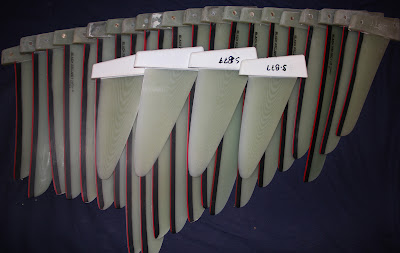
While I was chatting with Mal about fins the other day I realised that I have not used any of the TM fins since I was at Luderitz in 2013.

The reason is that pretty much everywhere I speed sail these days requires at least 25 degrees of rake to shed weed, (even Sandy Point!) and the most of the best spots need 40-50+ degrees. Those fins are nothing even remotely like the TM fins @ 12 degrees..
And yes, using the smallest fin I can get going, and maybe back upwind on, seems to really work for me, especially if it is asymmetrical, which decreases the AoA even more.
I think I larger fin will have a lower angle of attack at any given speed. But it is combination of L/D that we are seeking. Mal was the master at doing insane speeds on his insanely stiff TM V8 assy 23 cm fins at tight wind angles that none of the rest of us could get anywhere near, except on broader angles in more wind.

The drag bucket is typically not very wide, so if you reduce the area of your fin you will increase the angle of attack and lift coefficient needed to produce the required amount of lift and make it harder to get into the drag bucket. If you are reducing area by reducing chord while keeping span the same, you will also increase the amount of induced drag at about the same rate that you reduce profile drag due to the reduction in area for a given amount of lift.
Similarly, having an asymmetrical fin doesn't really reduce the angle of attack of the fin to the water, as the asymmetry makes the angle of zero lift go negative. The actual angle between this negative angle of zero lift and the angle needed to produce the lift required is about the same as for a symmetrical fin, the difference is that the water flow is better aligned with the centreline of the board and the drag bucket of the fin is hopefully centralised around the angles of attack most commonly used during sailing.
The best way to get good L/D is increasing span (i.e. fin length) as much as possible, not by reducing area to a minimum. Unfortunately that increases the overturning moment generated by the fin and conflicts with the amount of righting moment that can be provided by the feet on a narrow board. Deep fins are also not compatible with the the shallow water depths available on many of the best speed runs.
In aircraft design where high L/D was crucial (large airliners trying to increase fuel efficiency, sailplanes), wingspan used to be crucial. These days, winglets have changed the situation, allowing shorter wingspans to generate higher L/D ratios, without increasing the bending moment at the wing root. Maybe there is a case in speed sailing for a small winglet on the windward side of the fin for the favoured run direction to increase the effective span of the fin, reduce the induced drag, and increase the overall L/D ratio of the fin.
This is similar in a lot of ways to what Neil Scheltema has been doing with adding winglets to conventional fins. While some people have interpreted these as being mini-hydrofoils, in my view they work primarily to increase the L/D ratio of the fin while providing damping of pitch and heave motions. Neil's winglets have been symmetricalport and starboard,so the fin works equally on both tacks, but this isn't necessary for a speed fin. There is no reason not to have a winglet just on one side, particularly on an asymmetrical fin.
Maybe it's time I built one and tried it out.