Back to top

tunnel hull

Created by pirrad pirrad  > 9 months ago, 28 May 2009
Register to post, see what you've read, and subscribe to topics.
pirrad
pirrad

SA

850 posts

28 May 2009 3:27pm
www.boatdesign.net/articles/tunnel-hull-design/index.htm en.wikipedia.org/wiki/Tunnel_hull .hypersonic was close ..what else has been done in this area in windsurfing in the past?could it have merrits?
latedropeddy
latedropeddy

VIC

417 posts

28 May 2009 10:58pm
Gday Pirrad

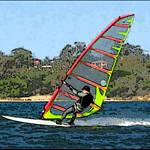
My mate Dougy had a go at making a extreme tunnel windsurfer, it is the board on the left (my mate Mick is board caddy). Dougy modififies everything - he's an eternal tinkerer and not scared of giving a perfectly good board or yacht the chop just to get a bit more speed. He is also artificially enhanced with a pacemaker to give him a boost when his heart beat goes funky - he has flatlined a few times before. An inspirational bloke that got me into windsurfing in which I am stoked for!

The board was an old NZ carbon slalom board purchased for a few bucks then had a bit of plastic/carbon surgery done. The tunnel was around 70mm deep, the rails were square also an extra fin was added as can be seen.

Dougy tested the board in some of the most ideal speed sailing conditions (6am 25kt sandy point - kato was already sailing for half an hour!, + willy speed track to 35kts).
Going on his description it crabbed a lot sideways like spinout, the back end seemed to be ventilating big time. Max speed was around 30 knots.

Maybe it could work if the planning area was bigger?

pirrad
pirrad

SA

850 posts

28 May 2009 11:32pm
any chance of a picture of the bottom of the board,does the tunnel go full length of the board ,how wide tunnel and what width remains as planing surface at front foot straps?
decrepit
decrepit

WA

12802 posts

28 May 2009 10:28pm


To me it looks like it stops square about where his arm is, maybe the problem, there's going to be a bit of a wake produced by the edge (start of the tunnel), maybe that's getting to the fins.

There was a guy sailing a remote control speed boat on the lagoon here this morning, it had a tunnel hull and went like the clappers, made me start thinking of doing something like this myself.
But I was thinking of the tunnel going further forward, on a wider hull
pirrad
pirrad

SA

850 posts

29 May 2009 12:36am
thanks decrep,my thoughts too.picking up a caveman tommorow and hope to tape up the bottom and post some pics and get some feedback before i take to it with the router[also thinking about incorporating a step deck in the same project]
icesurf
icesurf

QLD

113 posts

29 May 2009 9:05am
The Tunnel Hull is worth exploring, but think with twin fins there is too much induced drag.

The Tunnel needs to start forward of the mast track, constant depth of about 10mm, very flat rocker line & single fin.
Tail design unsure off?

I made my tunnel hull for $100 (made to be sailed once) took it to a speed event in New Zealand 1989. (20 years ago)
At that time the top guys where doing 37 knots over 500 meters.

I've managed just over 30 knots, the Sail I used was not a race sail & the fin was a basic freeride type.
The board was hard to handle over the chop (race sail &concaves would fix that),
it wasn't until I hit flat water that it started to fly & felt very comfortable,
must of been peaking at 35+knots.

In theory the ugly freeride fin being ventilated by the tunnel should spin out,
but that never happened.


grumplestiltskin
grumplestiltskin

WA

2331 posts

29 May 2009 7:24am
If you have another look at the boat picture, its actually three hulls, the middle one starts a bit further back.
The outside two hulls capture the water and force it back past the central hull (where the motor is attached)

If you incorporated that design, you would still have your fin in the centre, with minimal chance of cavitation.

remember it basically supposed to "fly", so just the small section of hull around the fin will remain in the water.
yoyo
yoyo

WA

1646 posts

29 May 2009 2:51pm
Select to expand quote
icesurf said...

The Tunnel Hull is worth exploring, but think with twin fins there is too much induced drag.


Too much drag maybe but NOT induced drag. Induced drag is proportional to the angle of attack. With an extra fin the AoA would be lower and so would be the induced drag. Of course the profile drag and surface drag would be greater with the extra fin.

Tunnel hull power boats have the apparant wind dead on and the weight of an engine and fuel tank to support. A speed windsurfer has the wind abeam to ~45 degrees , weighs >5kg and often already has too much nose lift..

Tunnel hulls are to reduce hull/water drag but if there is no board in the water anyway there is not much to be gained.


Images courtesy Shane Baker
icesurf
icesurf

QLD

113 posts

29 May 2009 5:29pm
1/ Yoyo your photos are taken out of context & are only snap shots ~
http://www.shanebaker.net/Photo%20Images.htm

2/ Most of those photos at Sandy Point show the speedsurfers boards planning flat, with water contact just back of the front footstrap.

3/ Far as I know the majority of "induced drag" is generated by the tip of the fin,
unless the professors are wrong?

4/ Yes on very windy days Mono Hulls would still go faster than tunnel hulls.
yoyo
yoyo

WA

1646 posts

29 May 2009 3:52pm
Induced drag is indeed tip vortex drag. It is proportional to the Angle of attack. Low AoA= low induced drag. Fins at speedsailing speeds work at a low AoA
slowboat
slowboat

WA

560 posts

29 May 2009 3:53pm
Hi Mike,

Yoyo is correct. Induced drag from the tip of the fin is a very small component of fin drag. Note the loads and angles of attack that we run with the fin. Cl of less than 0.1 is typical for the fin sizes we use at speed. Thats *small* compared to planes and gliders operating at significantly higher Cls to get higher overall L/D (where the induced drag does become a significant component of total drag). The induced drag at such low lift coefficients that we run is a very small fraction of the total drag. Yeah we should be using smaller fins with more camber made from unobtanium.

1) I have video from the same position on the same day of the same riders- showing pretty much the same trim- especially on fast runs.

2) Depends on the board and the run. The fastest riders on the fastest runs are sitting on a very short planing length with very little vertical lift coming from the tail of the board. Vertical lift is mostly coming from the board operating very efficiently as an aerodynamic wing in groud effect. Just like the goal of a tunnel hull. Pitching is balanced by the rig, but there is a net upward lift from the board/sail which balances our body weight.

3)the induced drag is a consequence of the foil having a finite aspect ratio. So its cause by having a tip. The mechanical properties of the fin (twist/flex) are more important drivers of optimal fin planform.

4)?why? MI isnt slow...

latedropeddy
latedropeddy

VIC

417 posts

29 May 2009 6:49pm
Select to expand quote
pirrad said...

any chance of a picture of the bottom of the board,does the tunnel go full length of the board ,how wide tunnel and what width remains as planing surface at front foot straps?


From memory the tunnel started around the mast then went aft. I think that board got turned into another project.

Talking about fin drag it also had gates on the fins similar to MI to reduce cavitation on the fin.... but maybe we can leave that for another thread
Ian K
Ian K

WA

4164 posts

29 May 2009 5:49pm
Select to expand quote
slowboat said...


. The fastest riders on the fastest runs are sitting on a very short planing length with very little vertical lift coming from the tail of the board. Vertical lift is mostly coming from the board operating very efficiently as an aerodynamic wing in groud effect. Just like the goal of a tunnel hull. Pitching is balanced by the rig, but there is a net upward lift from the board/sail which balances our body weight.


Can you put percentage figures on the split up of wet hull lift, dry hull lift and vertical sail lift Slowboat? Rough estimate maybe? To equal the weight of the whole kit and caboodle rather than separate them out.

Where do you think the ground effect lift is centred on the hull? What would that make the pitching moment about say the back footstrap?

Waterboy's high speed camera might be useful here, because if ground effect is that significant we should see a slight depression of the water surface under the front of the hull as it passes.

pirrad
pirrad

SA

850 posts

29 May 2009 9:17pm
Picked up board today.First question is can someone tell me the volume?

Some of the tech stuff you blokes talk leaves me for dead,all i want to do is get the router out and make some simple mods to a board.Just kidding,keep it coming and I'm sure I'll learn something.To put my project into perspective I'll never break any records apart from my own and rarely sail in ideal speed conditions....Rankin's Landing several times a year..my local strip[Fishies Bay]....simply cant justify thousands of dollars on specialised speed equipment.The Caveman is a quick board to start with[sailed one before]and with its volume gives me sail carrying capacity to suit the more marginal winds I'll be using it in.ICESURF.Interesting,that was my original plan and still might go that way,my main concern was the air space at the top of the fin but i was looking at going a lot deeper with the tunnel though[25-30mm]around 200mm wide or maybe 150mm and a stepped deck job on the rails.YOYO.Take your point about planing surface at full tilt in ideal conditions.prob no gain at all.Don't want to stuff up a good board so I'll await some feedback before the router comes out and maybe mask up the single tunnel option tomorrow and have a look at that.Wasn't wanting to go twin fin but could do.Below is a pic of tonight quick measure and mask up,two channels 80mm wide,75mm in between,like to go 20-30mm deep.

Gestalt
Gestalt

QLD

14722 posts

30 May 2009 9:46am
hi pirrad,

here's a photo of me holding a channel board back in 1988 or 89.


more recent


i've used heaps of them over the years. a tip is to not use parallel channel walls. you need to think of them as cutouts. you'll notice that cutouts always run off axis by 3-4 degrees. ie. they are not parallel to the centre line.

also have a look at the hypersonics for another outcome

channels, performance wise tend to do the following,

improve upwind performance. (substantially)
improve gliding in lulls
improve tracking
they float over the water. (they feel like they are hovering)

as to whether they improve speed well i think the jury is still out. i definately believe on wider bigger boards they are worthwhile and do improve speed, my formula board had channels and i loved it. my slalom board (120lt) is also solid but still trying things out like strap position. my speed board 90lt was a prototype and works a treat also but i can't really say at this point if i think it offers anything better than a conventional bottom. none of them designed by me so what i write below are my opinions only.

my gut feel is that the smaller the boards the shallower channel and narrower the channel. the other thing is that the channel entry point is very important, if it isn't shaped correctly the board will bite when it hits chop. not a good outcome.

i also believe you need to use softer rails in the front half of the board when using channels as the channel wall offers extra bite.

the other thing is channel boards need to be shorter otherwise the nose just lifts completely off the water.

one thing i find is that channels on smaller boards make them ride nose up and leads to more tuning required. ie. footstrap/fin/mast positions. something that i've seen recently is nose shapes that push the board back down onto the water.

there was a guy on gpsss site that was mucking around with channel boards. not sure what the outcome was. using wing shape etc.

i notice above you say you don't want to stuff the board. based on that it could be time to put the router away. channels really complicate things from a design viewpoint.

all that said i like the channel boards i use.
choco
choco

SA

4177 posts

30 May 2009 9:45am
Geez Justin i'm glad you got your haircut you look like a girl in that photo apart from that you haven't changed at all.
Nice looking board though.
Gestalt
Gestalt

QLD

14722 posts

30 May 2009 10:36am
Select to expand quote
choco said...

Geez Justin i'm glad you got your haircut you look like a girl in that photo apart from that you haven't changed at all.
Nice looking board though.


haha.... my kids agree with you.

what can i say, grunge had begun! my flano was probably just out of shot.
sausage
sausage

QLD

4873 posts

30 May 2009 11:35am
Select to expand quote
Gestalt said...

hi pirrad,

here's a photo of me holding a channel board back in 1988 or 89.about 20kg ago.


Ian K
Ian K

WA

4164 posts

30 May 2009 9:44am
Had a bit more of a think about numbers that could be put on aerodynamic hull lift - channels or otherwise.

The idea with channels is that air is forced down, sandwiched in a cavity between the channel and the water and generates lift. The best device for generating pressure in a cavity is a pitot tube anemometer. It is designed as a tube with an nice hemispherical end pointing into the wind with a hole at the tip. The pressure to bring the air to a stop at the stagnation point is then relayed down a tube, fills the whole tube, to a pressure gauge. This design gives the best signal. Less tidy entry points will give a lesser signal - so it's an upper limit of pressure that can be developed. The pressure developed is the old 1/2 rho v squared - related to the famous Bernoulli's equation. And at 15 m/sec or 30 knots it's 14.6 kg per square metre.

Goes up with the square of velocity so that's 77% more at 40 knots.
So estimate the upper surface area of the cavity you've created with your tunnel and that's an upper limit for lift.

A comparison of aerodynamic lift with bluff body drag is also interesting.

The wingloading (googled it) of aircraft varies with the speed they fly at but a hanglider is listed as 6.3 kg/m^2. Probably similar to a sail in 30 knots. Ie 30 kg from your 5.0.

The drag coefficient of a flat rectangular plate broadside to the wind is Cd = 1.17
So holding a 5.0 on the beach over sheeted square to the wind has 1/2 Cd rho A v squared ( you only need one formula) = 85 kg ! That's 17 kg/m^2

Much more than the magnitude of the aerodynamic lift this sail could create - but in the wrong direction so not useful. No wonder you can't hold a 5.0 in 30 knots square to the wind on the beach.

So the max bluff body lift drag you might expect at 30 knots is 17 kg/m^
and aerodynamic ~ 6.3 kg/m^2 ...... (compared to hang glider wing)

The area of a nose is less than a square metre so I think the majority of the lift is from the wet part of the hull and maybe 20% from the inclined sail.


back again.

I't's a long bow to draw but if the ratio of aerodynamic lift to bluff body drag when you turn that foil perpendicular in the same velocity ( ie 1:3 ) holds true in water... Then at a density of 1000kg/m^3 ( vs. 1.27kg/m^3 in air ) the drag per cubic metre at 15 m/sec of a flat plate is 13 tonnes per square metre, so could be about 4 tonnes of lift per square metre generated when the foil is operating hydrodynamically.

So you only need 1/40 th of a square metre to lift 100kg. That's 15cm by 15 cm. Maybe more appropriate to use the analogy for a foiling windsurfer, so allow a bit more area for a planing one? Very rough estimate - but looks to me like not much hull is needed in the water to generate 100kg of lift.


Gestalt
Gestalt

QLD

14722 posts

30 May 2009 12:48pm
Select to expand quote
sausage said...

Gestalt said...

hi pirrad,

here's a photo of me holding a channel board back in 1988 or 89.about 20kg ago.


lol, that's very true. i had a think about that image and think it is more like 1990. was still a small 85kg even back then.

now my biggest issue is getting into the seat harness.
icesurf
icesurf

QLD

113 posts

30 May 2009 1:20pm
Pirrad,
If its not too late; routing a channel in the center is not a good idea as it very difficult to epoxy up & seal the pin holes.
Much easier to Glue HD Foam on either side to the existing bottom to form a channel, any pit holes would not matter.
As the discussed, the Fin does not need to be end plated to the surface of the water.
Over time there seems to be quite a few who have played with channels, Gestalt has lots of experience.

Select to expand quote
SlowBoat said... 1) I have video from the same position on the same day of the same riders- showing pretty much the same trim- especially on fast runs.


Rather extreme, Interesting to note that the fastest speeds are obtain this way!

Has anyone have images of Kitesurfers doing 50knots & there trim angle compared to fast windsurfers?

Select to expand quote
SlowBoat said...4)?why? MI isnt slow...

At the moment Mono "Speedsurfing" Hulls are faster than Tunnel "Speedsurfing" Hulls.
& Mono "Kitesurfing" Board is faster than the large "Cats".


Ian K
Ian K

WA

4164 posts

30 May 2009 11:38am
30 degrees look a bit extreme, that's more like what you use to slow down. Induced drag has to be something like lift * the sin of the angle of attack. Sin 30 = 0.5 or 0.5 g deceleration if you subtract sail power by sheeting out.
Gestalt
Gestalt

QLD

14722 posts

30 May 2009 2:40pm
i always wanted to give this software package a go to see if it could be used so a more scientific outcome could be achieved.

for a bit of fun

aeromarineresearch.com/tbdp6.html

yoyo
yoyo

WA

1646 posts

30 May 2009 1:19pm
Select to expand quote
icesurf said...

Pirrad,


Rather extreme, Interesting to note that the fastest speeds are obtain this way!


The angle only appears 30 degrees as you are viewing a (tele?)photo from a ~50 degree from front angle (foreshortening). Reality is nose is less than knee high on a calf at an angle (about 50cm) and board is 235cm long with about 220cm free of the water. So the angle would be less than 14 degrees.

US Navy tank tests found the optimum angle for low surface drag for flat bottom planning hulls of a planform AR 0.25 to be ~ 7 degrees.

Sailing a speedboard oscillating between 0-14 degrees (or 3-11 if you're good) seems the fastest way to go and so would bear the US Navy results out.
icesurf
icesurf

QLD

113 posts

30 May 2009 6:37pm
Thanks Yoyo,

Amazing how observations can be flawed even when you take into account photo angles.

Select to expand quote
Yoyo said.... US Navy tank tests found the optimum angle for low surface drag for flat bottom planning hulls of a planform AR 0.25 to be ~ 7 degrees.


Knew the optimum angle was 7 degrees, but never took the time to look at it on the drawing board, as thought it was rather natural for windsurfers.


Slow Boat would then be Speedsurfing at the optimum angle of 7 degrees in the photo, which looks rather extreme compared to other Speedsurfers.


Ian K
Ian K

WA

4164 posts

30 May 2009 4:54pm
I'd say it's more like 3.5 degrees.

There seem to be few ways of dividing up lift and drag and giving different components different names. But with a flat bottom you could look at pressure forces on the hull which must act normal to the flat bottom and parallel forces - the frictional drag forces which act along the hull surface due to the water passing.

For the hull to give 100kg lift a 7 degree attack angle would put 100 * sin 7 = 12 kg of this pressure applied to the bottom of the hull in the drag direction. Induced drag. That's a lift to drag ratio as bad as 8.5:1 and we haven't even added the frictional drag.

The photo of Slowboat looks to me to be about 3 or 4 deg which would give better numbers.

(probably should be tan rather than sin - not much in it at small angles)
yoyo
yoyo

WA

1646 posts

30 May 2009 6:08pm
Those US Navy tests were for river patrol boats with engines etc so probably not really 100% relevant to windsurfing.

I think this is about the optimum


SMOKING!!!
icesurf
icesurf

QLD

113 posts

31 May 2009 8:44am
"SMOKING IS OPTIMUM"

As Said, If you smoking & surfing on the tail of the board there would be No Optimum angle,
likely a range of angles will work.


Back to Tunnel Hulls:
The only benefit of a Tunnel Hull for high speed windsurfer
"the Fin becomes a Surface Piercing Foil". , if that's a benefit?

As it is known that at any given design point, you can design a fully submerged foil that will beat any surface piercing foil.


For Speedsurfing, to make a "Tunnel Hull" perform using a single Fin, how do you design a "surface piercing foil" that outperforms fully submerged foils?


Ian K
Ian K

WA

4164 posts

31 May 2009 7:51am
Nice diagram Icesurf. Maybe it's a state thing. I recall Vando on a roll one day at Sandy Point - knocking out easy 40 knot runs, one after the other, beautifully trimmed, steady and flat.

And another master of the low trim angle


Good photos Gestalt, some photographers only push the button when things get a bit sketchy and the nose starts to bounce.
pirrad
pirrad

SA

850 posts

31 May 2009 3:29pm
Think ill leave the tunnel hull project for another board ,i've got an old wave board to try that concept with.Will prob take the advice of building the tunnel onto the base with high density foam.nice board GESTALT,any chance of a pic of bottom of boards. Below is a pic of the CAVEMAN masked for tail cutouts-stepped deck,i'm thinking about 25mm deep x 25mm wide step,it's masked to centre of mast track but open to suggestions.Had a good read of DECREPT'S project and thinking about ending step just forward of the front foot straps...OR taking it forward to the point where the 25mm tapers out to 0[25mm rocker,300mm forward of where its masked to]what would be the negatives of going wider with the step ,25+mm.

p.s no replies yet on volume?
Gestalt
Gestalt

QLD

14722 posts

31 May 2009 7:30pm
hi pirrad,

i'm not sure about the rail step, you may as well remove the rail along the full length of the board if that's what you are going for. the width of the board between the straps is very important. once you make it narrower your board will act like a narrower board.

i think things like wingers etc allow you to set the width between the traps that you need and still keep a narrower tail.

with design you need to make changes to improve things. first i'd work out what it is i don't like about the board and then what changes will make functional gains?

sometimes just cutting the nose off a board can improve things drastically.

yesterday i went out on my 120lt channel board and had a break through with setup. i've been struggling in knee high chop with the board. a mate took it for a spin and put the mast further forward. we had swapped gear for some fun and when i got the board back it handled the chop brilliantly. took me a while to figure out what he had done until i looked down.

p.s. will post photos once images taken.
Loading more posts...
Please Register, or first...
Topics Subscribe Reply

Return To Classic site