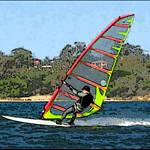
Tom brought me down a GT-31/35 today so despite the cold and rain and only about 12 knots of wind we thought we had better give it a go!

This particular GPS unit is a semi-custom made version of the standard GT-31.(Hence GT-31/35).
The main difference is that on top of all the standard features of the GT-31 it also has a MTK 5 hz gps chip built in. To clarify this, yes, it has
two gps chips in it. The normal Sirf3 chip runs all the normal functions in the GPS and writes the standard SBP file to the data logger. The MTK chip is separate but uses the same aerial/receiver. It feeds its 5 hz output through the shared central processor for writing to the SD card as NMEA data. Currently, the firmware only provides for the recording of the RMC sentence from the MTK chip due to concerns that trying to write more sentences might overload the processing capacity. This means we have not currently got satellite data or HDOP data from the MTK chip. Tom is confident this will be included soon. The RMC sentence does include location(trackpoints) and speed at 5hz.
I describe this as a semi-custom unit because they are apparently individually hand built but there is some capacity to produce these modified units in very limited numbers for a modest cost premium depending on demand. (Contact Tom if you are interested.)
I will concentrate here on just the 1hz data from the Sirf3 chip for comparison with the GT-11.
The first thing that became clear comparing the GT-11 and GT-31 (1 hz Sirf3 data) worn side by side is that the Doppler speed results were almost identical. The GT-11 speeds were within the range of the two GT-11's worn at the same time.
5 x 10 sec averages:
GT-11 #1: 26.149
GT-11 #2: 26.126
GT-31 (sirf3): 26.128
Only one sample I know but a very good sign.......
When the tracks are overlaid in RealSpeed on the speed graph they are so close they appear to merge into one line unless one zooms in to a very large degree and even then the differences are minimal.
The only difference seen is that the GT-31 speeds are slightly lagging behind the GT-11 speeds on sudden acceleration and deceleration. This is almost certainly a sign of the Sirf3 chip’s improved anti-aliasing filtering which delays the writing of the resulting value by up to 1 second. This should have no effect on the average speeds apart from making them more accurate and less subject to aliasing errors.

Comparing Alphas was even more interesting.
You may have read my earlier comments regarding a strong distrust of the Doppler speeds during tight gybes in Alphas. My opinion after lots of testing is that the Doppler speeds from the GT-11 are fooled into a low spike right in the middle of the turn. The trackpoint speeds seem to reflect much more closely the speed feeling that I get from the actual gybe and display a more realistically smooth speed graph.
This is not the case with the GT-31. The sirf3 chip may have partly solved that issue with the Doppler Alpha speed and the results I got from the GT-31 Doppler Alphas were a bit closer to the GT-11 trackpoints both in average speed and the curve on the speed graph. Unfortunately, the GT-31 trackpoints are totally flawed and clearly incorrect. On most of the Alphas checked there is a high peak just after the slow point of the gybe (just the opposite of the Doppler results from the GT-11). It is immediately obvious and clearly incorrect. Tom speculates that it is probably the result of the filtering being confused by the sudden change of direction (which I think is probably also the most likely cause of the Doppler low spike in the GT-11 Alphas).
Much more testing and many more samples will need to be gathered to get a clearer picture of what is happening in Alphas but my preliminary recommendation for Alpha speed runs is to continue to use Trackpoints from the GT-11 but to use Doppler from the GT-31.
See the screenshot below and pick the odd one out!



 sailquik
> 9 months ago, 27 Mar 2008
sailquik
> 9 months ago, 27 Mar 2008