Well somebody has to say it so I guess I'll do it.
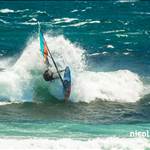
You can't buy good alphas. You have to gybe hard and aggressively. Power/laydown gybes are a very good way to achieve this.
Simply throwing the board into a laydown gybe as hard as possible won't do it either, you will probably go ass over head over the front of the board. I know I do when I get it wrong.
Take a little bit of anger, a decent amount of aggression and a lot of focus and concentration. Now as someone else said, go from the sailing stance into your gybe without slowing down. Try to time it with the wave patterns if you can.
A bit of a pump of the sail as you come out of your stance will give you a little bit of rig neutrality that helps you get into your gybing stance without getting overpowered. This is a very subtle thing and not always necessary but can help in some conditions.
As you go into your gybe sheet in very hard but not all the way just yet. You are waiting for the rail of the board to get enough traction for you to fully commit to the gybe. The amount of time we are talking here is very short, 1 or 2 seconds, possibly even less but it's how you execute this part of the gybe that usually determines how the gybe will turn out.
So what we have done at this point is gone from our sailing stance into the gybe without backing off, sheeted in hard but not completely, and engaged the rail of the board into the gybe.
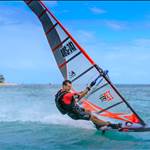
Now, as soon as you feel that rail bite, as soon as you feel comfortable committing fully to the gybe, sheet the sail in until the foot touches the board(or as close as possible) and lean heavily into the turn with as much pressure on the rail as you can manage. What you are trying to achieve is transferring the centrifugal force that wants to throw you over the front of the board into downward pressure on the board that keeps that rail well and truly biting. This is done by the heavy over sheeting of the sail that does 2 things, applies downward pressure to the board that gives power and stability and allows you to lean into the turn much harder and lower than you otherwise would, turning your bodyweight into downward force as well.
Now one of 2 things will happen, the board will either snap around through the turn like a formula one car or you will have a massive and not totally unenjoyable crash.
The TransitionThere are 2 stages to the sail handing, the first is the over sheeting to produce the forces I mentioned. The second is achieving rig weightlessness and neutrality. This weightlessness happens pretty quickly if you gybe with enough force. At this point of weightlessness both the rig and your body will be very low to the water and the board will be about halfway through the gybe, pointing roughly dead downwind. At this point, begin your transition. If you have executed with enough force to this point the board has enough energy to come out of the turn with plenty of speed.
At the point of rig neutrality, Start bringing you body upright enough to flip the sail. This bit takes practice and timing. to low and you will not be able to catch the sail and will get wet. To high and over the side of the board you'll go. This bit is pretty instinctive and you'll know it when you feel it.
As soon as the sail is on the way around, transition your feet. Strap to strap if you can(quite difficult) but not totally essential. If the board is running out of energy at this point, a good solid step forward on the front foot can help give the board a bit of a pump. Boom to boom sail catches are very desirable here.
Hopefully you have transitioned successfully and are planning out of your gybe. If you enjoy it as much as I do you just received a shot of adrenalin from pulling off a very tight and fast gybe.
I don't have a very high success rate gybing like this but I Love going for it. You have to be prepared to have a lot of stacks and belt yourself around a bit but I find it's well worth it to drill a good laydown. At higher speeds it becomes increasingly difficult of course but at this point you modify the technique with the same rig technique but a less suicidal amount of rail pressure and a wider turn.
Of course, the other way to a good alpha is travel at 35 plus knots in both directions and simply survive the gybe, but that's less fun.
I don't claim this to be the textbook way of doing laydowns but it works for me. Use it at your own risk and enjoy the head spins as you go ass over head over the front