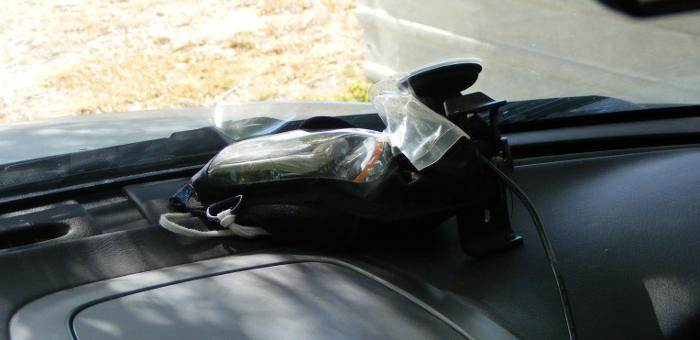
Took the gt31 and proto 5hz for a drive yesterday, had them both in a paqua (not because I expected to flood the car, just to keep them next to each other), on the dash as close to the windscreen as I could get.
Here's a classic example of a simulated gybe.
blue line is the GT31, pink is the 5hz unit.
But there are some examples that don't look as good, the thoughts are, that the satellite has only a clear view in one direction, and changing direction can cause funny things to happen as the gps adjusts to a new set of satellites.
I had thought I should attach the pacqua to the roof racks, but was worried about something nasty happening.
Were you drunk driving on the median strip with the pink line before the left turn..........
Cheers
Marty
Thanks for conducting trials Decrepit, the GPS windsurfing community stands a far better chance of getting a suitable product if we can be involved in the product development.
Select to expand quotedecrepit said..
Took the gt31 and proto 5hz for a drive yesterday, had them both in a paqua (not because I expected to flood the car, just to keep them next to each other), on the dash as close to the windscreen as I could getblue line is the GT31, pink is the 5hz unit.
But there are some examples that don't look as good, the thoughts are, that the satellite has only a clear view in one direction, and changing direction can cause funny things to happen as the gps adjusts to a new set of satellites.
I had thought I should attach the pacqua to the roof racks, but was worried about something nasty happening.
Mike, How did the numbers compare, especially in the alpha?
road test results.
GT31 blue prototype red,
2sec 47.64 47.48
5x10 43.89 43.84
1hr 17.36 16.95
NM 43.68 43.65
alpha 30.03 29.87
26.79 27.05
26.22 26.04
25.65 26.02
25.59 25.12
Unfortunately looks like more accuracy doesn't give you more speed, but I'm not sure how valid these results are with most of the car obscuring the satellites.
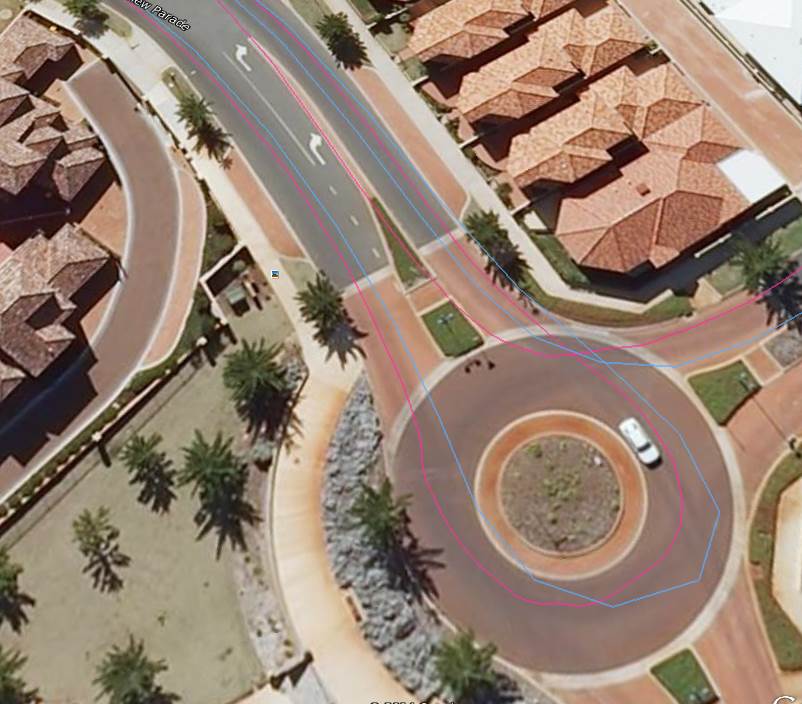
Here's the worst track to show my concern.

It's an old google earth image, there's now a roundabout there, which I did go around! Honest.
There was no cross over of my tracks.
There are no buildings in the vicinity to do strange things with refections. But it is the tightest turn, and it did similar things with both gps's. So my conclusion is the dashboard isn't the ideal place.
And I also can assure everybody, I stayed on the road the whole time on all these pics. Google earth isn't always spot on, that can account for some positional error, but when my tracks go over both sides of the lane, then that's a gps error.
When I get the chance, I'll repeat the course with the GT31 on a roofrack and see if there's any difference.
Tested the proto unit on the water yesterday with the GT31.
Currently looking at the data and have sent it to Sailquik for guru analysis so won't comment further at the moment.
Watch form factor clearly has advantages (no pack needed, slim) and appears to be a well sealed unit.
However the way that your hand sits on the boom means that the screen is angled slightly away from you.
The only way that I could see it without taking a hand off was to wear it on the inside of the wrist and sail front hand underhand.
Then you can only see it on one tack.
Bring on the Google glass version!
As it is hard to say whether the difference in readings is from the different type of unit or just different units, it would be useful to have two GT 31s and the prototye.
The closeness of the 5 X 10 and the nm would suggest the differences average out over time. Not sure about the hr though...
Good to see progress but I can't understand why suddenly 5Hz version pop up.
Common new standard and popular chipset are 10 Hz, so this "new" device will not be interchangeable and compatible with all other software around.
Maybe that is whole selling point to create again niche market device ?
New 10Hz GPS chipsets are available now at twenty - thirty dollars for OEM market.
Select to expand quoteMacroscien said..
Common new standard and popular chipset are 10 Hz, so this "new" device will not be interchangeable and compatible with all other software around.
What are you talking about? a data-point is timestamped, so "more data" is already correctly handled by all the existing tools.
5 Hz files are already quite large. Not sure there would be any gain in going to 10Hz for windsurfing. It is a bit like measuring speeds to 1/100 km/h.

Here's a couple of Mark's gybes with no car in the way, they look much better.
This is the best one at 18.31 proto and 18.24 GT31
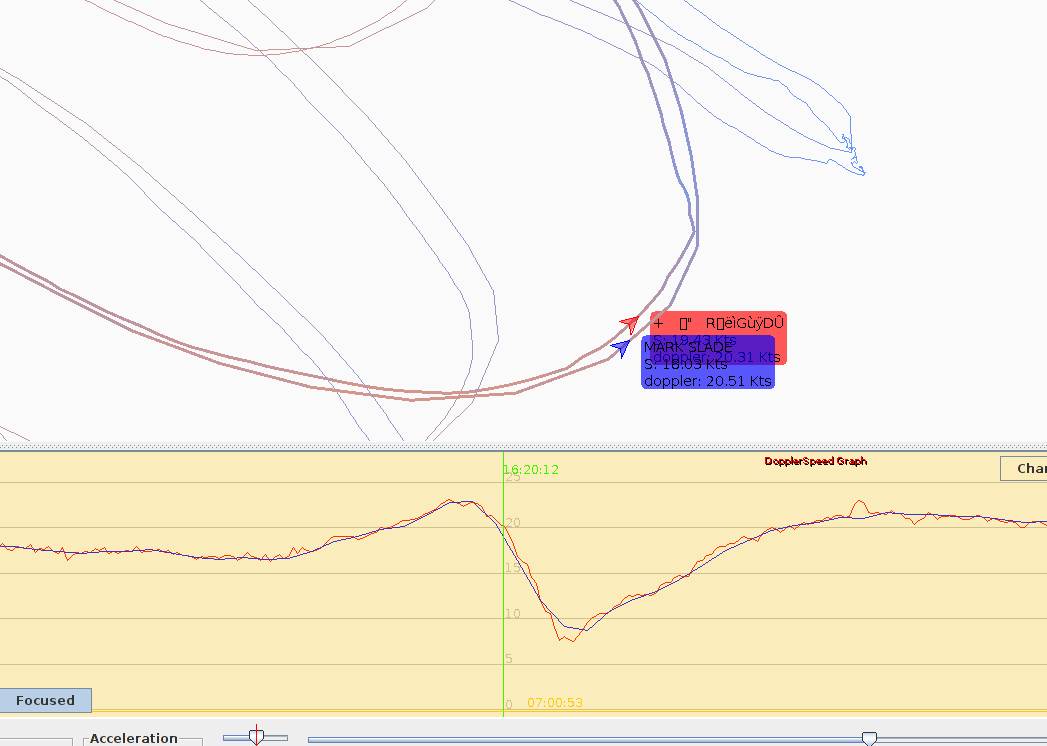
You can see a kink in this track at min speed point, is this Mark flipping the sail? Could be a cause of slight error with unit on the wrist?
Here's the 2nd best
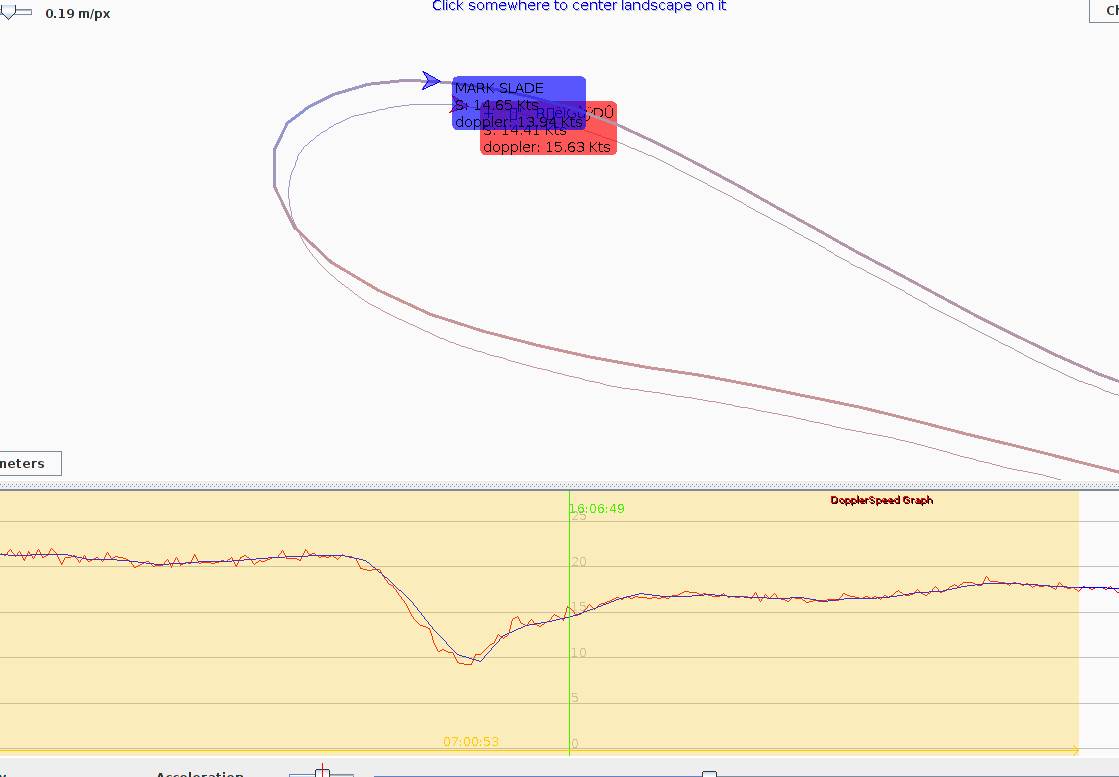
This one doesn't have any kink, so maybe Mark was slower on the flip, or the whole wrist error thing isn't a problem?
Proto gives 18.13, GT31 18.09
So for Mark the proto is giving better results
5Hz vs 10 Hz
at 50 knots at Luderitz sailor progress is recorded every 5.14 meters at 5 HZ resolution
at 10 Hz it will be 2.57 meter
at 20 Hz only 1.28 meter
Maybe that is not a Melbourne Cup - where 5 meters resolution at the finish line means 2 horse length. If could be quite a mess to dispute who won Melbourne cup if it comes to 2 horse and everybody at this range at the finish is potential winner. For sprinter 60 or 100 meters that possibly means that all arrived at same time and share the gold medal.
In our competitions - at slalom racing - also two boards length at the finish line accuracy could lead to hot dispute - specifically if you won by two length by visual and video recording and according to GPS you lost.
Apply this to rugby and 5 meters before the line or behind makes no difference if you score a point.
Get a basketball and your basket suddenly have a 5 meter diameter or Golf and 5 meters wide hole in the ground is all you need to aim at.
I've been using an old version of GPSarPRO to get these results, but realspeed is doing something very different.
I've emailed Mal to ask for his comments. I'll get back here with any news.
 ). Locosys decided not to proceed with this configuration for various reasons.
Hi, today I was out with my Ambit2 S and my own 5hz logger. It is using the NEO-6m from www.hobbyking.com, 20 USD and a Fubarino SD from www.seeedstudio.com, 32 USD and some cheap OLED display. Unfortunately the antenna supports just up to 5hz. So I should have read the specs better :).
Anyway with 5hz already it looks like a lot of data:
The track has 22305 points as compared to the Ambit track that has just 3850 points. The Ambit doesn't always save points every second for some reason, even if the settings say 1s.
The .ubx file has quite a nice precision: best was 1.42 meters and average was 2.05 meters. But it is over 6MB for a 74 minute session.
I also noticed that only GPSResults can handle those .ubx files properly. GPSActionReplay can handle them only, when I set the logger to 1hz. Ka72.com cannot handle .ubx files, but that would be a nice upgrade.
Here are the files, just in case someone with more knowledge wants to compare them:
www.chumba.ch/windsurf/05071737-Mellsten-117-8.5.UBX
www.chumba.ch/windsurf/Move_2014_05_07_17_31_50_Mellsten.gpx
Greetings,
Mete
PS: SkyTraq: I order 2 of these: https://www.indiegogo.com/projects/navspark-arduino-compatible-with-gps-gnss-receiver, it looks promising, but from the specs I couldn't find any speed accuracy data yet.
After checking my copy of Realspeed it does not look like it can read UBX. I am sure Mal could update it to do so though.
Unfortunately, it transpires that the Skytraq chips don't output SDOP type data. 
So we are still limited to the SIRF and UBLOX chips.
I also took the proto for a run yesterday on the water with my GT 31. Wind very light was on a 7.3 and 102 ltre board. Will get Dylan from KA72.com to analyze the files and give his opinion. great that the unit was so light and small, although needed to have the wrist band in almost tightest position so might need to have a smaller wrist band for women ?
They need to make womens sized Aquapacs too, mine is always slipping down to my elbow, pain in butt!
Select to expand quoteKazza said...
They need to make womens sized Aquapacs too, mine is always slipping down to my elbow, pain in butt!
..but your elbow is no where near your butt! 
Select to expand quoteKazza said...
They need to make womens sized Aquapacs too, mine is always slipping down to my elbow, pain in butt!
yep.. I bought a replacement aqua pack and it allows a bit more adjustment. The older ones I've had to swim for the board a few times and almost had the GPs fly off my arm!I wasn't game to stop to shove it up higher as I wouldn't have caught the board..25kts + in big chop..
Select to expand quotesboardcrazy said...Kazza said...
They need to make womens sized Aquapacs too, mine is always slipping down to my elbow, pain in butt!
yep.. I bought a replacement aqua pack and it allows a bit more adjustment. The older ones I've had to swim for the board a few times and almost had the GPs fly off my arm!I wasn't game to stop to shove it up higher as I wouldn't have caught the board..25kts + in big chop..
with a little help from a sewing machine, just shorten the strap...
I found mine too annoying on the arm, and hard to check the numbers too.
I attach mine to the shoulder strap of my flotation vest. Doesn't get in the way, and easier to check the numbers.
Might have to do a tad of sewing then. or make my biceps bigger! I don't always wear my flotation vest.
Yer Sue I've had that problem too sometimes, which do you go for the gear or the gps....somehow both.