
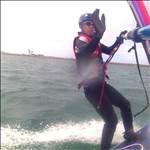
Are you talking about a longboard with the centreboard down? IMHO the pivot gybe as you have described it would be the routine low-speed turn, the flare gybe is more for fun and allows you to sink the tail even deeper so the board can almost pivot on the spot. The fun part is to see how vertical you can get the board. Also fun to try and stall the gybe and see how long you can hold the board with the nose in the air. In both the weight is on the foot on the outside rail of the board.
I would actually label them the other way around, but what the heck.
Don't use the movie above as an example of how to do things. There's plenty of things that are less than perfect. In the jibe she demonstrates, she steps all the way back with both feet, which might make sense on a 12 ft longboard .. but she seems to be on a Techno 293. So she actually has to lean forward towards the rig to control the tail sink.
For a pivot jibe, keep one foot forward and the other back. Shift your weight on the back foot, and lean your head to the back (like someone is pulling your pony tail). That will turn boards like the Techno (and anything shorter) on a dime, with much better stability than if you have both feet right next to each other. Switch your feet when dead downwind, sail out clew first.
The jibe with two feet in the back is mostly for show - and for a good show, the nose should come out a lot more, making it a tail sink where the board points up at least 45 degrees. The stepping back can be useful or even necessary when you are on an old 12-foot race board that is almost impossible to turn through dead downwind.

