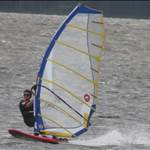
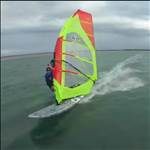
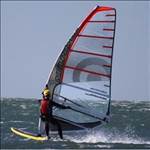
What will be the most efficient ( fastest) way to go over high chop or even rumps ?
a) bend knees at the top of the chop to amortize vertical movement . this way the board ( and fin) remains with contact to the water for maximum time
b) straighten knees and allow board to bounce and fly from one bump to another . Quite hard on knees and possibly for the board too.
So what will be the best way to prepare for crossing bigger bumps at speed? Amortize or fly over? If that helps I am talking about slalom gear and speeds > 25 ktn
To visualize situation we could imagine that we have to pass the wave left behind big motor boat without loosing too much speed. Go hard or soft ? Stiffen position and fly over or amortize the impact bending legs then straighten soon after?
Windsurfers I've seen sailing fast in chop are on slalom gear. They almost ride on the fin and their boards float over the top of the chop. Its quite disheartening to be battling along in chop to hear and then see someone blast past you with a bigger sail and in more control.
Why do rally cars have shock absorbers? Board trim is critical, best board trim is along with all ya rig and harness settings is keeping the board in a good position with your feet, ankles knees muscles as shock absorbers. Imagine a rally car with no shock absorption, it would be faster, and get out of control.
I am re-phraze myself and ask how should we prepare to cross the rump behind big motor boat. Imagine that you race against your friend at reasonable speed around 30 ktn . You both are almost even but there is boat crossing your path. Whole race will decide how will you cross that wave behind. I am only guessing that average high is at least 1 to 1.5 m.
What is the best technique to pass it without loosing speed ?
a) unhook the harness, de-power at the moment attacking wave , amortize to the max the wave, and continue ASAP as passed that wave without any jump if possible with board sitting on the water and fin in contact most of the time
b) keep your optimal position for speed when approaching that wave and then prepare fly at this flat trajectory in hope that you will not catch the rail, loose that dynamic balance ( receipt for success could be minimizing the speed loss to avoid catapult) ? ?
As Hardie said, keep everything trimmed and go like hell. Avoid any peaking waves..unless you are being filmed..then definately hit the peak and post the results!
ps. I am a bit lazy so I tent to chop-hop across the tops of the wake and try to make contact with the tail and fin whilst keeping it all together..same as negotiating and sharp chop at speed..
You're over-thinking it. Just get out in rough water and sail as fast as you can through it. Pile on the power and never, ever back off. After a year of that you wont have a problem anymore.
I was told by a PWA-sailor that it's a bit like the Top-gear video where Hammond drives a F1. He was not going fast enough, so the brakes where not hot enough. If he want a little bit faster, the brakes would still not work and he would crash. If he went a hell of a lot faster the brakes would work and he wouldn't crash. He wasn't going as fast as the other PWA's who told him to be aggressive instead of defensive and go even faster and just trust that the gear would work, like he said: Are you ****ing kidding me, i am going to kill myself!
Good video What is board size you think both sailors used at this example? I am guessing 92 l and 60 cm wide will be adequate. They have excellent control over board at this speed 30 - 35 ktn.
My board starts woobble too much too the sides above 30 ktn and I need to downsize from slalom 118 L /68 cm to get any better performance.
This is exactly example what I am talking about. 3:25 approching the wave, sailor bent knees , depowered a bit , straighten up position and then catch the rail. Strategy of going full speed seems to be right.