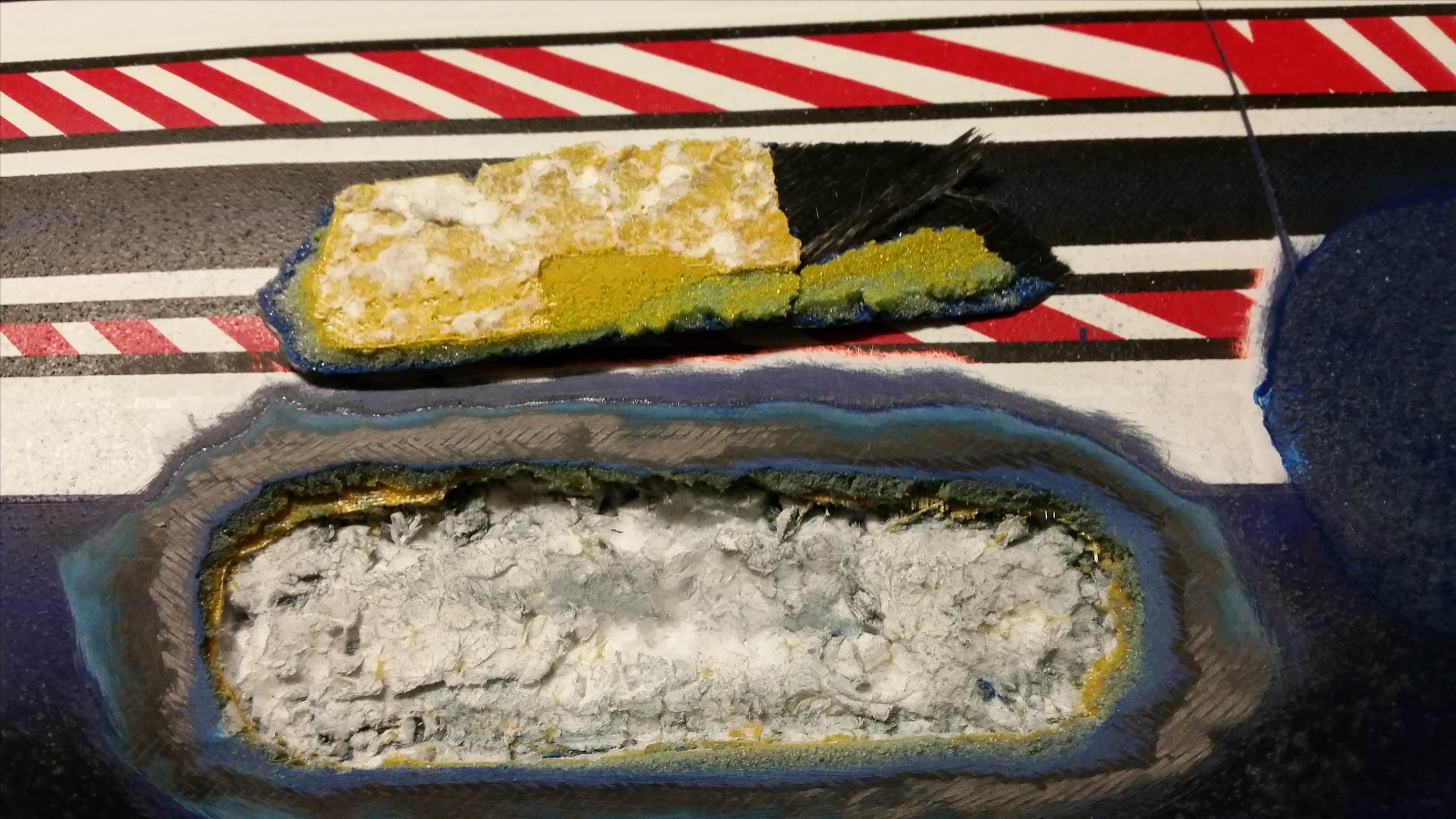
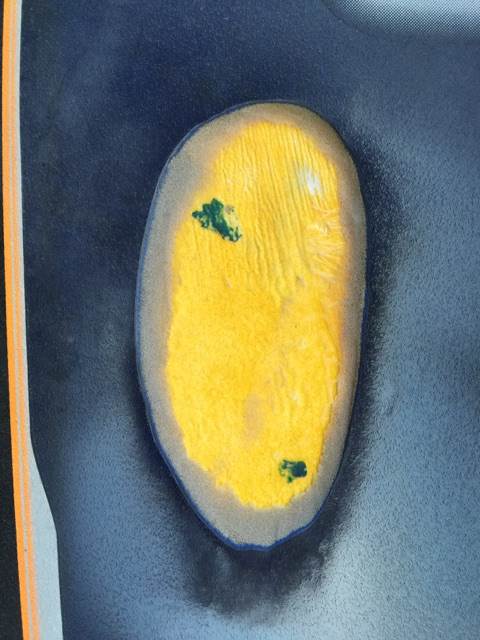
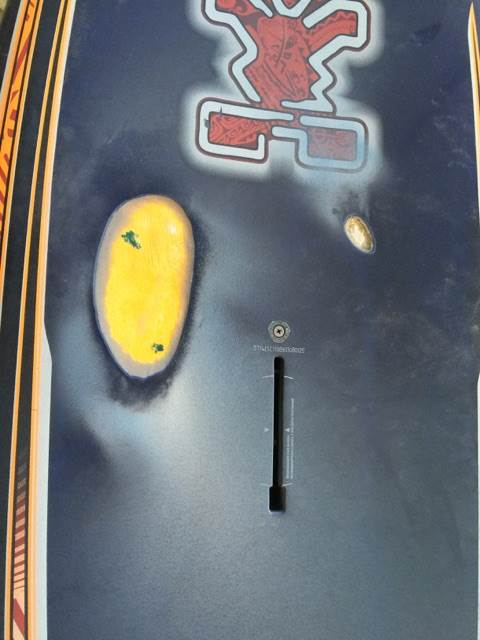
Board is less than 2 years old, you can see from the back ground there is actually three spots where the foam has failed and resulted in the carbon shell cracking.
I am pressing on the back of this piece I have cut out with my index finger to show how the foam has failed and created the soft spot.

Cammd, I feel for you on this, which issue should not happen, and so I would go straight to the manufacturer/dealer/retailer and require them to repair or replace. No point in publicising here, if the brand is prepared to back up the product for you without adverse publicity for the brand, unless of course they fail and refuse to honour their legal obligations. Confidentiality may well be your friend. Good Luck and Best Wishes.
looks dodgy to me . It seems to be breaking down way too quickly , this is what you see on a fifteen year old board. Looks like it's seen way too much light or heat. I have seen this happen to a board stored on a truss under a hot tin roof . The inner foam becomes hard and when you dent the board it doesn't spring back and then you are left with a void ( soft spot ). Could be this or mabee something else , as it is only two years old.
Foam isn't meant to take tensile load, (which is what you're doing by bending it like that). There's meant to be a layer of cloth underneath the high density foam to form a sandwich construction, the foam is only meant to take compressive loads, the fibers on either side of it take tension loads. It's hard to tell from your pic if there's any cloth under that yellow surface.
Agreed Decrep and Rider, that section is not the whole story.
And where is it from? You can do that with any localised impact like your knee
But yes, if it peeled away easily it would seem a lack of resin bonding that PVC to underneath
Select to expand quotedecrepit said..
Foam isn't meant to take tensile load, (which is what you're doing by bending it like that). There's meant to be a layer of cloth underneath the high density foam to form a sandwich construction, the foam is only meant to take compressive loads, the fibers on either side of it take tension loads. It's hard to tell from your pic if there's any cloth under that yellow surface.
Firstly this is not attempt to solicit some sort of warranty claim (I would not cut my board open then expect a warranty) or bag a manufacturer, I was curious as to what was the cause of the soft spots and thought other's would like to see what I found.
The tensile load I am applying by holding the edges of the foam and pressing in the middle is just to demonstrate the failure by opening up the cracked foam so you can see it. I didn't cut three sections out of my raceboard just so I could apply a tensile load and crack the foam.
Select to expand quoteMark _australia said..
Agreed Decrep and Rider, that section is not the whole story.
And where is it from? You can do that with any localised impact like your knee
But yes, if it peeled away easily it would seem a lack of resin bonding that PVC to underneath
So its from the deck in front of the railing straps and behind the mast track, no doubt the most heavily used area of a raceboard and an area where knees are often on the deck when getting on the board.
The yellow surface you can see still in the board is the cloth layer and I was surprised the foam came away so neatly from it so I agree there is a lack of resin. This is actually my sons board, I have another with the same problem in the same area however the foam did not come away so neatly from the cloth layer in fact they couldn't be seperated and some of the foam core came away as well, in that instance the sandwich had a strong bond.
So I think in this section of the board that is subject to heavy use and knee's etc they are just built a bit to light.
Also wonder if they add any extra glass in this area on the 'L' model compared to the standard model given they have a higher side and are supposed to be used by heavier riders.
Both boards are "L" model and the soft spots have developed right where the higher sides drop down to the deck. The yellow material still in the board is the glass cloth so you can see it hasn't bonded to the high density foam. I wonder even after these holes are sorted if this area will continue to be a problem.

Azuli no extra carbon in there I can see
I've recently spent quite a bit of time with Eva, The Board Lady about a soft deck on my recently acquired, but found to be poor condition Mistral EQ2.
She suggested marine urethane injection to support & fill the cracks. MU doesn't stick too well to ASA however.
She suggested that the ideal would be to remove top ASA layer and put another layer or two of carbon to strengthen, but this is pretty impossible if I have to maintain the graphics for raceboard rule compliance. Maybe after I'll try a bit of plastic surgery!!
[on the Starboard forums there is some posts about delamination on early Phantoms, not sure if any relation to these posts ;-) ]
nigel
Select to expand quote
Mark _australia said..
Agreed Decrep and Rider, that section is not the whole story.
And where is it from? You can do that with any localised impact like your knee
But yes, if it peeled away easily it would seem a lack of resin bonding that PVC to underneath
So its from the deck in front of the railing straps and behind the mast track, no doubt the most heavily used area of a raceboard and an area where knees are often on the deck when getting on the board.
The yellow surface you can see still in the board is the cloth layer and I was surprised the foam came away so neatly from it so I agree there is a lack of resin. This is actually my sons board, I have another with the same problem in the same area however the foam did not come away so neatly from the cloth layer in fact they couldn't be seperated and some of the foam core came away as well, in that instance the sandwich had a strong bond.
So I think in this section of the board that is subject to heavy use and knee's etc they are just built a bit to light.
I reckon you are onto it then.
It is an area where the PVC gets a bit bashed. A bit of "under-resining" will make it worse, and quite easy to peel the PVC layer off.
If it came away that cleanly it is a major lack of adhesion.
Looking on the bright side, a relatively easy fix (by the pic you showed)
Select to expand quoteblazing928 said..
I've recently spent quite a bit of time with Eva, The Board Lady about a soft deck on my recently acquired, but found to be poor condition Mistral EQ2.
She suggested marine urethane injection to support & fill the cracks. MU doesn't stick too well to ASA however.
She suggested that the ideal would be to remove top ASA layer and put another layer or two of carbon to strengthen, but this is pretty impossible if I have to maintain the graphics for raceboard rule compliance. Maybe after I'll try a bit of plastic surgery!!
[on the Starboard forums there is some posts about delamination on early Phantoms, not sure if any relation to these posts ;-) ]
nigel
The (proper 2 part) polyurethane does stick well to foam. Often the problem is not the bond between core and sandwich, it is cracked or squashed core.
The polyurethane is harder than the core and sticks it together really well. Thus the bond to the outer ASA layer is not necessarily relevant.
I reckon in maybe 50% of soft boards it does the trick. At any rate, $30 of goo injected in, to get an extra 2 seasons may be better for your needs than a $300 repair to get 3 seasons.
Select to expand quotecammd said..decrepit said..
Foam isn't meant to take tensile load, (which is what you're doing by bending it like that). There's meant to be a layer of cloth underneath the high density foam to form a sandwich construction, the foam is only meant to take compressive loads, the fibers on either side of it take tension loads. It's hard to tell from your pic if there's any cloth under that yellow surface.
Firstly this is not attempt to solicit some sort of warranty claim (I would not cut my board open then expect a warranty) or bag a manufacturer, I was curious as to what was the cause of the soft spots and thought other's would like to see what I found.
The tensile load I am applying by holding the edges of the foam and pressing in the middle is just to demonstrate the failure by opening up the cracked foam so you can see it. I didn't cut three sections out of my raceboard just so I could apply a tensile load and crack the foam.
Sorry I didn't mean to imply anything of the sort. I was just trying to point out that there must be something that caused the pvc to crack like that, because the PVC is meant to take those sorts of loads, it's the underlying cloth that's meant to do that. I suspected the underneath cloth had lost it's integrity, so the sandwich was no longer acting as a beam, allowing the pvc to take unintended loads and cracking it.
But if the underlying cloth is still integral, then it's the adhesion between cloth and pvc that's at fault.
I'm intrigued by the texture of the yellow stuff, is that resin?
If so there appears to be enough of it, is it possible the resin has failed, doesn't seem very likely, but I've never seen the pvc pull away from the core foam before leaving the underlying cloth intact.
>>>>>
Select to expand quote
So its from the deck in front of the railing straps and behind the mast track, no doubt the most heavily used area of a raceboard and an area where knees are often on the deck when getting on the board.
The yellow surface you can see still in the board is the cloth layer and I was surprised the foam came away so neatly from it so I agree there is a lack of resin. This is actually my sons board, I have another with the same problem in the same area however the foam did not come away so neatly from the cloth layer in fact they couldn't be seperated and some of the foam core came away as well, in that instance the sandwich had a strong bond.
So I think in this section of the board that is subject to heavy use and knee's etc they are just built a bit to light.
Select to expand quoteMark _australia said..blazing928 said..
I've recently spent quite a bit of time with Eva, The Board Lady about a soft deck on my recently acquired, but found to be poor condition Mistral EQ2.
She suggested marine urethane injection to support & fill the cracks. MU doesn't stick too well to ASA however.
She suggested that the ideal would be to remove top ASA layer and put another layer or two of carbon to strengthen, but this is pretty impossible if I have to maintain the graphics for raceboard rule compliance. Maybe after I'll try a bit of plastic surgery!!
[on the Starboard forums there is some posts about delamination on early Phantoms, not sure if any relation to these posts ;-) ]
nigel
The (proper 2 part) polyurethane does stick well to foam. Often the problem is not the bond between core and sandwich, it is cracked or squashed core.
The polyurethane is harder than the core and sticks it together really well. Thus the bond to the outer ASA layer is not necessarily relevant.
I reckon in maybe 50% of soft boards it does the trick. At any rate, $30 of goo injected in, to get an extra 2 seasons may be better for your needs than a $300 repair to get 3 seasons.
Thanks, hopefully it will workout. As you say, as the urethane sticks to foam well, & all should be good. Her point is that as the urethane doesn't stick well to the asa, then I need to be very attentive as to sealing the injection holes to prevent further water ingress.
I now think it's just not enough sticky resin to do the intended job , all in the race to be the lightest . As an engineer ( and I've copped it for that ) over engineering , or at least intended engineering will always win ! I don't think saving 12 cents of resin is the reason of this problem. But 12 cents of weight looks good .
Maybe that yellow stuff is expanding epoxy.
Apparently lighter boards are in demand. Less materials = less weight or
Third world labour probably not much job satisfaction or having to make so many per day, just not feeling the love.
Anyway just rotten luck for the OP but repairable.
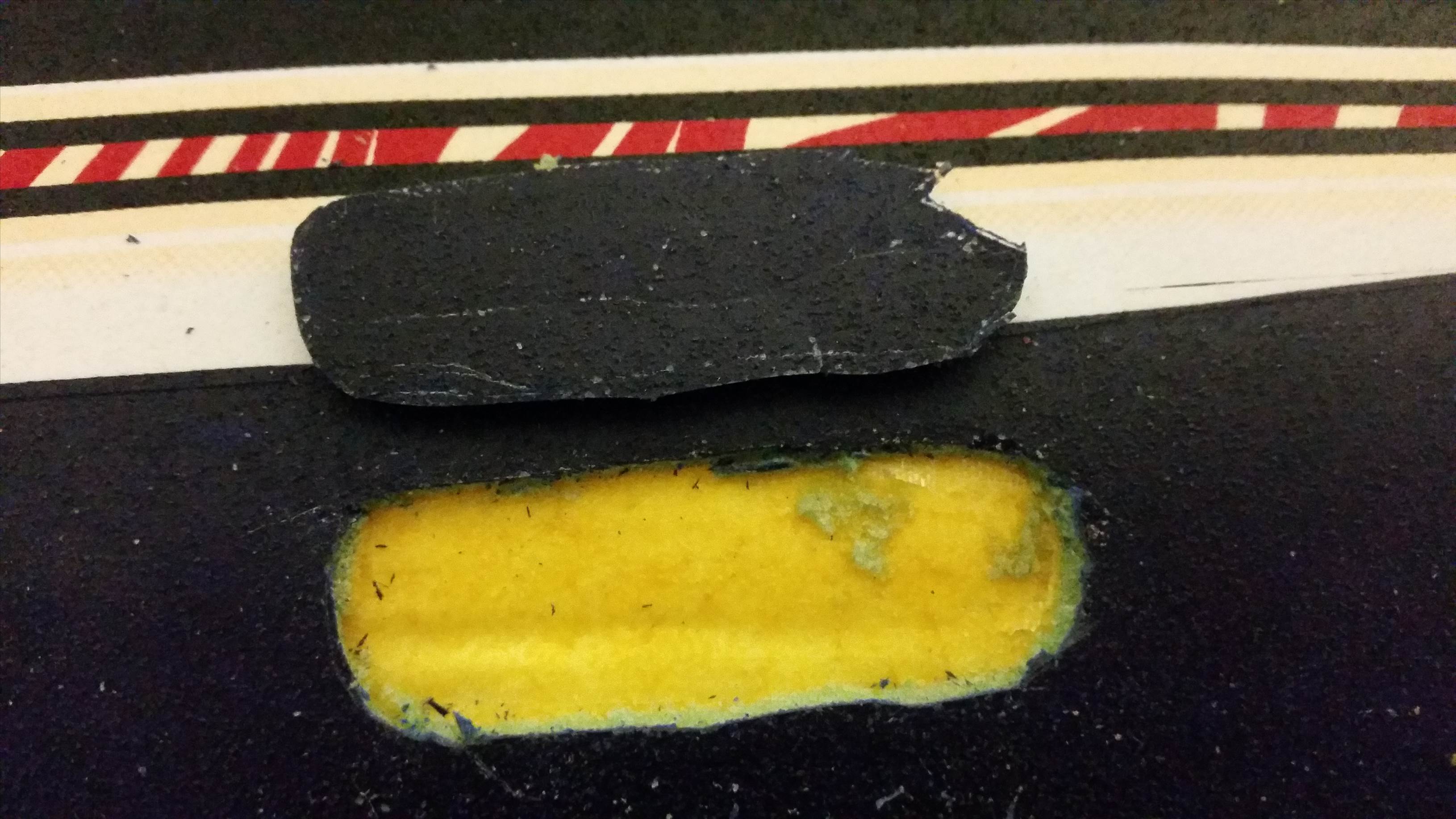
close up of the cloth layer intact
see the indent in the cloth is the same path as the crack in the carbon
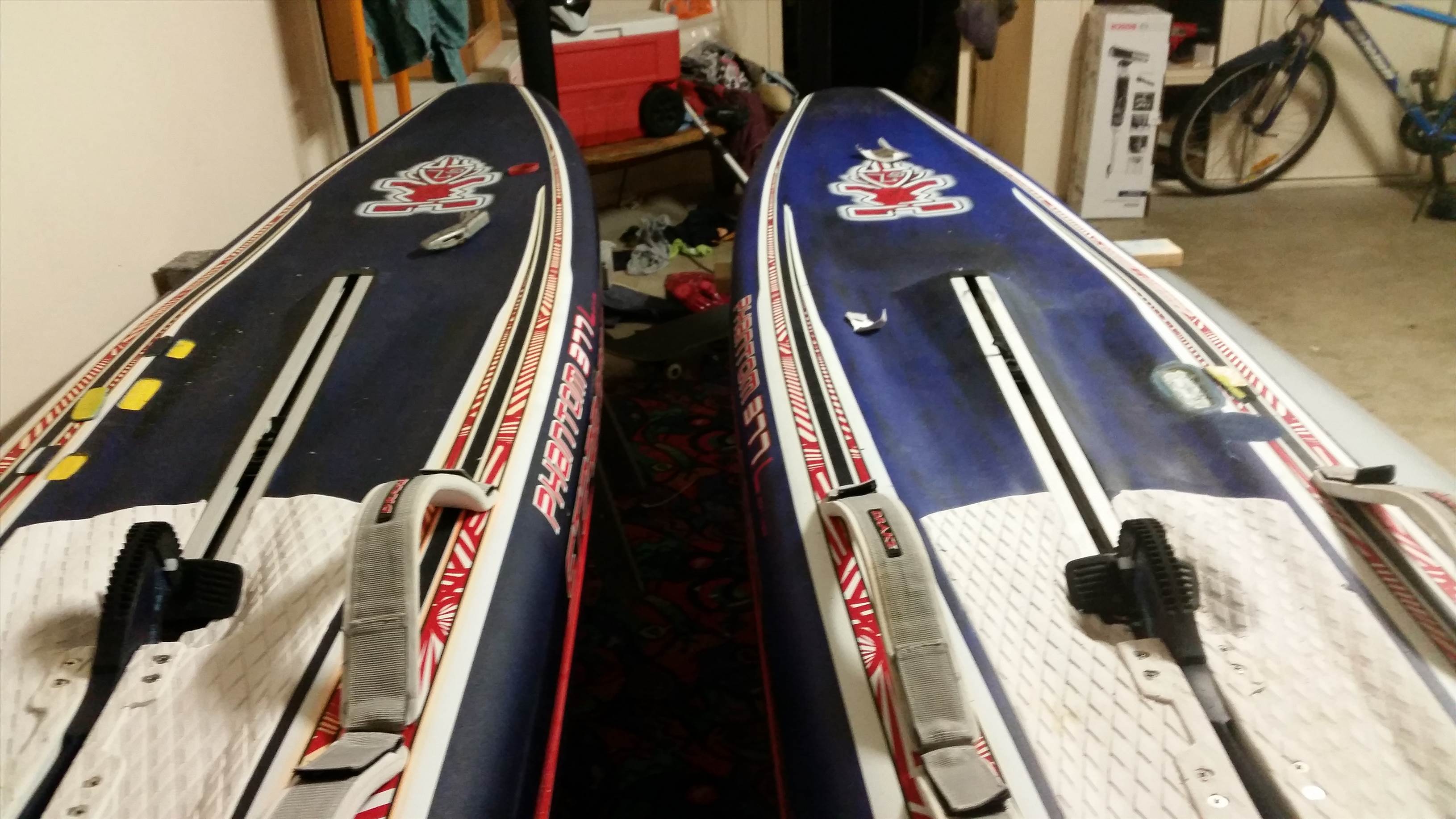
Both boards. They are both the same vintage however the one on the left sat in a shop for a year extra so its had less work as you can see as the paint is not as faded.
Looking at the rail shape now I am thinking it would be really hard to vacuum the divinycell down around that shape unless it is pre-bent
That could be a factor also
Same construction as my 2014 isonic. Just layer of glass over the foam core. Find any staples ?
Mark - vacuum bagging on a production board ? I thought they just squish them together in the two part mould and the foaming resin does the rest.
Yep, that's certainly the difference between the 2 boards, 1st one not enough stick, for whatever reason. The 2nd one is what I's expect to see even on a delaminated board.
But I've no experience with expanding resin, it may not have had enough grip initially or it's deteriorate with use.
Given where the soft spots are, why not just leave it? Would there not be enough intact laminate to carry the load?
Select to expand quoteracerX said..
Given where the soft spots are, why not just leave it? Would there not be enough intact laminate to carry the load?
Not a good idea, weaknesses tend to spread, could lead to a major delamination.
Any pressure in there at all will pick on weak spots and spread them. Just the bung being done up in the water under heavy sailing loads can create pressure surges as you go over bumps and the shell flexes.
This is what the best Ding fixer in Adelaide had to do to my board after I got shafted buying second hand earlier in the year (note was not told of the injected deck before I received it interstate) My bad for being so trusting of the fellow windsurfer......

I think it is from your heal constantly bouncing on the same spots while going through chop, or your full weight uphauling on the same spot constantly as its a race board. It also looks like a spot on the board where the foam was under tension when the HD foam was bagged on, the styro core prob has been compressed a heap of times so is now a dint and the HD foam has tried to hold its shape and removed itself from the styro.
This happens a lot on boards between the front and rear straps from gybing where your back foot is out of the straps and you are bouncing through chop, the board cops a hiding and compresses the core but the skin stays the same shape leaving a soft spot or a delem. The broken HD foam is more than likely form your heal smashing it.
don't know what construction your board is but like the other guys have mentioned, they usually have a layer of glass of some description between the HD and the core.
Select to expand quoteYetti said..
... after I got shafted buying second hand earlier in the year..
Ok, who is it ?. Spill the beans.
It could be the mast pressure (or worst the pulleys from the downhaul system) when the sail is in the water (e.g. when waiting between races in the chop). Leaving the mast at the most forward position (where the track is elevated) when the rig is in the water could help to avoid the mast pushing on the deck.
Select to expand quotejusavina said...
It could be the mast pressure (or worst the pulleys from the downhaul system) when the sail is in the water (e.g. when waiting between races in the chop). Leaving the mast at the most forward position (where the track is elevated) when the rig is in the water could help to avoid the mast pushing on the deck.
Its definitely not the pulleys from the adj downhaul. My sons to lazy to use one and mine is set up so the pulleys dont touch the deck. I learned that lesson by scraping a gouge in the deck of my old rsx.
I think mast pressure is unlikely as well as the failures are not on the edge of the rail where the mast could touch.
I have replaced the broken foam I just need to clean them up a bit and do the carbon and painting and they will be good to go.
I still have to fix a ding in the front of my sons board where he ran up the back of an optimist so ones things certain these repairs will not be the last these boards have.
Area that was damaged is painted black. That may suggest thermal damage, while exposed on the Sun.
I am afraid that no board this day is fully protected from overheating while left of full sun. If we touch the board quite often they are hot possibly close to 100 degree.
So I come with idea solution one may try one day.
What if one of the layer close under our board skin will be made of aluminium foil ? This layer could disperse and transfer heat from one side of the board - exposed to another.
I could envision technical problems for manufacturer to apply the aluminium layer but such board should be then 100% proof from overheating on the Sun .
Obviously much easier will be use white paint to reflect the Sun. I quite often worry about bottom of my Isonic and JP's exposed on the Sun. Just repainting to white could stop that heating instantly....maybe I should just spray paint the bottom ?