Sails.
How do they work ?
Do you believe that they do push you along ? 
or
They do suck you off ? 
You could cast your vote now.
to be more precise the question should be formulated:
If wind suck ( pull) your sail or push ( blow) it ?
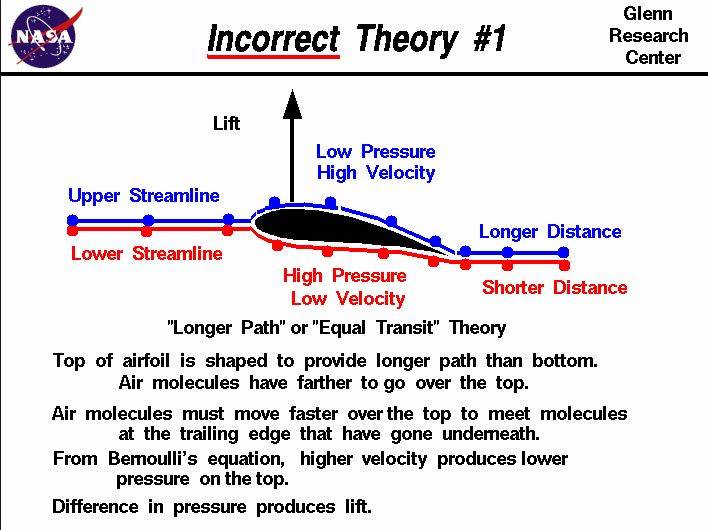
As NASA and Tom Speer (a Boeing aerodynamicist who also designs the wings for the winning US America's Cup team) says, there are basically a bunch of different ways to explain the way sails and wings work. Each of these ways is as correct as the other, essentially. There's also some wrong ways, like the "equal time" concept.
See www.grc.nasa.gov/www/k-12/airplane/right2.html
The "Newtonian lift"/lift from flow turning" theory works best for me. The sail redirects the wind and shoves it out the back. As Isaac Newton said, a force creates an equal and opposite reaction, therefore shoving air out the back shoves the rig forward.
Sure, there is laminar flow, attached flow, boundary layer effects and all that - but they are really about ensuring that the flow moves across the sail efficiently, rather than breaking down into turbulent flow which moves more slowly and less uniformly and therefore you shove less air out the back, and at a lower speed.
Look up Tom's posts on Boat Design Forum. Also look out for Mark Drela, a professor of aerodynamics at MIT and designer of America's Cup wings and world-record human powered aircraft and boats. Those guys really, really know their stuff - and unlike a lot of the stuff around, the theories they speak of also work in real life.
No such thing as Suck just Push.
Air gets pushed from a high pressure zone into a low pressure zone.
like an internal combustion engine piston does not suck air in. the air is pushed by the atmosphere into the gap the piston makes. otherwise forced induction would not help.
Select to expand quoteRAL INN said..
No such thing as Suck just Push.
>>>>.
You'd think macro would know that.
Select to expand quotedecrepit said..
RAL INN said..
No such thing as Suck just Push.
>>>>.
You'd think macro would know that.
 with all respect. This is not about me the original question sounds : what do YOU or anybody else think that it is behind our propulsion .
Sort of poll what our SB community think and I am completely neutral /unconcerned if that is true or not
Select to expand quoteChris 249 said..
The "Newtonian lift"/lift from flow turning" theory works best for me
that looks like "pushing" for me
you are saying that air molecules are pressing on the sail or transfer their kintetic energy onto our sail if I understand you correctly...
your vote then is +1 for pushing
Select to expand quoteRAL INN said..
No such thing as Suck just Push.
Air gets pushed from a high pressure zone into a low pressure zone.
like an internal combustion engine piston does not suck air in. the air is pushed by the atmosphere into the gap the piston makes. otherwise forced induction would not help.
ok, higher pressure air press then on our sail piston
more or less I register your vote +1 pushing ( as oppose to pulling or sucking in another words)
Select to expand quoteMacroscien said..decrepit said..
RAL INN said..
No such thing as Suck just Push.
>>>>.
You'd think macro would know that.
with all respect. This is not about me the original question sounds : what do YOU or anybody else think that it is behind our propulsion .
Sort of poll what our SB community thinkand I am completely neutral /unconcerned if that is true or not
I think what RAL INN was getting at, is that the question is invalid, there actually is no such thing as "suck" so you can't ask the question "is it pull or suck".
And my comment was about somebody with science in their name talking about something that doesn't exist.
Maybe a bit pedantic I guess, we know what you mean, is it the lower pressure on the leeward side or the higher pressure on the windward side doing the work?
Well my opinion is it both, it's the difference between the two that causes the lift, so you can vote me as neutral.
Select to expand quoteTristanF said..
Not much wind about, clearly
Well there is, but I don't sail in the dark.
Select to expand quotedecrepit said..
I think what RAL INN was getting at, is that the question is invalid, there actually is no such thing as "suck" so you can't ask the question "is it pull or suck".
Maybe a bit pedantic I guess, we know what you mean, is it the lower pressure on the leeward side or the higher pressure on the windward side doing the work?
Well my opinion is it both, it's the difference between the two that causes the lift, so you can vote me as neutral.
O well, I expected that my wording my cause some controversy.  To clarify and validate my question :
Lets imagine the you /we divided our sail into 1 x 1 cm squares .
You could not deny that on this 1 cm square surrounding air exert some force - and this force we could imagine as air pressing onto our square - from the one side or pulling this square from another side.
As you said above air is pressing from one side and pulling from another simultaneously
votes + 1 for pressing and +1 for pulling recorded
Select to expand quoteTristanF said..
Not much wind about, clearly
ok that is surprising but still valid answer
you vote neither pulling or pushing is going on
0 push 0 sucking
must be something esle that keep us going over that water and our sail just help us to keep balance straight
The foil shape of the sail bends the wind around the foil and creates low pressure on the leeward side of the sail and high pressure on the windward side of the sail. This pressure differential pushes and pulls the sail from the high pressure to the low pressure. So the answer is both
Select to expand quoteJohn340 said..
The foil shape of the sail bends the wind around the foil and creates low pressure on the leeward side of the sail and high pressure on the windward side of the sail. This pressure differential pushes and pulls the sail from the high pressure to the low pressure. So the answer is both
Great answer John, that's 2 for both.
The incorrect part of theory, is that "air molecules must move faster over the top to meet molecules at the trailing edge that have gone underneath".
It's the "equal transit" that's wrong, not the difference in pressure!
Select to expand quoteRAL INN said..
No such thing as Suck just Push.
You've not seen me attempting to sail this year. 
I can assure you there's been a hell of a lot of sucking going on


Select to expand quoteMacroscien said...
. . . You could cast your vote now. . .
I have no opinion.  I would like to vote "informal".
Thank you.
Select to expand quoteBristol said..
Macroscien said...
. . . You could cast your vote now. . .
I have no opinion. I would like to vote "informal".
Thank you.
Don't be shy. Whatever we vote today is not going to change anything ,
and sail will be pushing you or sucking or even both as usual.
Select to expand quotedecrepit said...TristanF said..
Not much wind about, clearly
Well there is, but I don't sail in the dark.
Where's your commitment??? It's all about TOW!
Select to expand quoteMacroscien said..
...
if that means that model air plane on International Space Station doesn't have a lift ( in absence of gravity but still plenty of air around ?)
...
Yay, something new :)
I reckon if you threw a model glider in the ISS it would do a back flip and stop.
Select to expand quoteNotWal said..Macroscien said..
...
if that means that model air plane on International Space Station doesn't have a lift ( in absence of gravity but still plenty of air around ?)
...
Yay, something new :)
I reckon if you threw a model glider in the ISS it would do a back flip and stop.
Remember that my questions are designed not to clarify but confused you ( assuming that you thought that you know already what is going on with sails and airfoils in general) .I guess that my example above points to some weakness in arguments in article ( requirement for gravity to achieve lift)
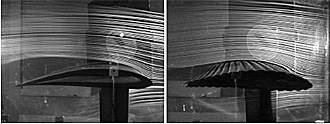
Just to add to the confusion, on Mars rough is better than smooth when it comes to wings...though there is no "water", so no Martian windsurfers.
Select to expand quoteMacroscien said..Bristol said..
Macroscien said...
. . . You could cast your vote now. . .
I have no opinion. I would like to vote "informal".
Thank you.
Don't be shy. Whatever we vote today is not going to change anything ,
and sail will be pushing you or sucking or even both as usual.
Well, I guess I want to determine something first; when I breathe in, am I sucking a breath in or is the universe pushing a breathe into me?
... quite aside from the science, it is the feeling of being pulled along by the sail that I love.
So, pulling for me.