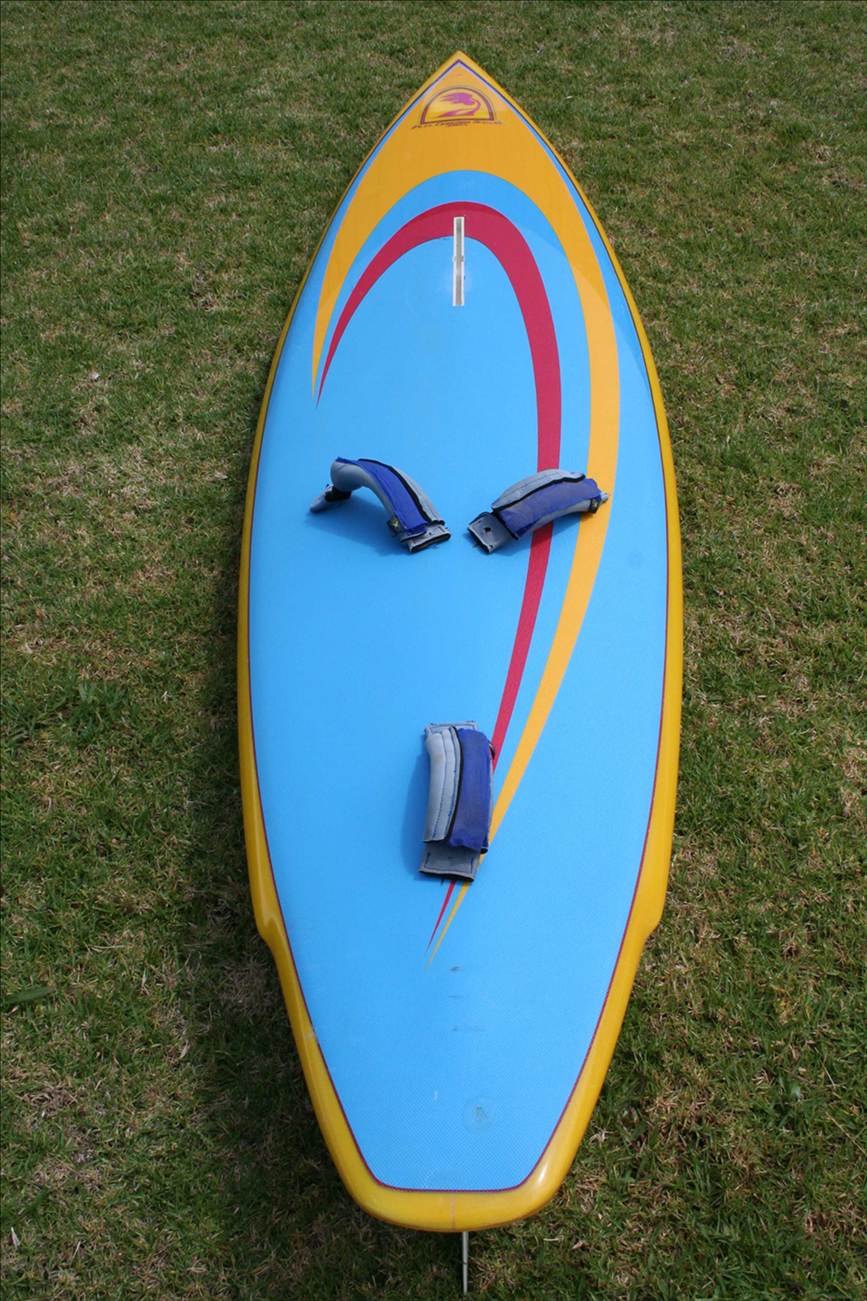
I was thinking about updating my board but I guess I should find the volume of my existing one first (wouldn't be too happy buying the same volume again
)
Any suggestions as to the best way to guesstimate it?
Too hard.
When we say volume what we really mean is "will it float me?". Same volume in litres as you bodyweight will float you just. Just. An expert could uphaul juuuust.
But there is also kinetic bouyancy, where as soon as something moves it feels more stable. A wider board is better in that regard, thus why newer boards are so much better. Plus newer boards are more floaty due to weighing less and having styro not PU foam and all sorts of things.
That is so far away from the feel of a newer board that thinking about the volume of the old board is possibly irrelevant.
Tell us what you weigh, your sailing level and where and you will get plenty of suggestions.
Get a large pan with curved edges that can hold about 120 litres. Put a large bathtub in the pan. Fill the bathtub up with water to the brim. Push the board into the water. Collect and measure the amount of water displaced. Subtract the volume of your arms from total.
Otherwise accept you cannot compare this board to modern boards. The volume of your board, whatever it is, is of little relevance.
Other aspects like where the mast track and footstraps are located are more important. What I am trying to say if there is a modern board of the same volume as yours, it will be very different and probably much better to windsurf.
It should be measured in old school volume, so subtract whatever it weighs from the new school volume. This is how the shapers of the time measured boards.*
*I pieced that info together from old suger packets and seabreeze threads.
Fill a big bucket with water mark a line on the side of the bucket were the water level come to. Submerge the board completely in the water. Mark on the side of the bucket the new water level. You now have the volume of water the board displaces which would be equal to the volume of the board.
Only problem is you need a big bucket! ![]()
Go inside and get the bread knife.
Cut the board up into 1cm x 1cm x 1cm blocks.
Count all the blocks.
Divide the answer by 1,000 to get the number of litres.
If the last block can't be cut into 1cm x 1cm x 1cm then cut it into 1mm x 1mm x 1mm blocks, count these and divide by 1,000 to get an equivalent 1cm x 1cm x 1cm block.
Keep going until you reach the level of accuracy you are after.
(remember to number the blocks so you know where they go if you want to re-assemble it)
I think the best way would be to use something like boardcad or akushaper and recreate the dimentions. You should get something relitively close.
Wouldn't a professional board building company use some sort of 3D scanning machine to measure volume?
So they use a robot to mark the line?
Do the maths, how big is the bucket they use, then put an 80l board in it, then an 85l board in it. How much higher is the water mark for the 85l?
Archimedes had it figured out ages ago.
Fill the container till it overflows.
Then put the board in and submerge it, capturing all the water that overflows as you're putting the board in.
Now you can measure or weigh the water that was displaced.
^Assume they need to measure formula boards too, and raceboards?
Is there a 3m vertical, metre wide beaker?
Thanks for the advice guys (even an offer to work it out
r2908). Maybe I should just try some newer boards on the water. Local guy offered me just that (thanks Philip
).
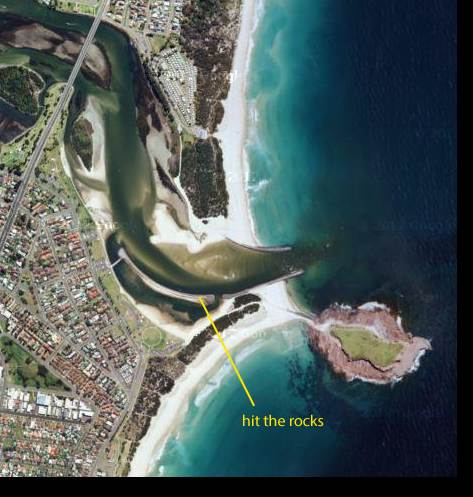
What spurred me into updating the board was last week I was sailing at Lake Illawarra entrance and the tide was going out like the clappers. Wind died and I dropped the rig into the water & couldn't uphaul it
. So here's me sittin on the board heading out the entrance - problem ahead was where the ocean met the outgoing tide the water looked very angry (maybe sucking the rig & me under). Managed to get to the breakwater rocks before that but foot got cut & bruised from whatever creatures live on those rocks.
Anyway I decided
- to get a board with a bit more volume
OR
- don't sail at the entrance on the OUTGOING tide
. If I do, just make sure I have a valid VISA for New Zealand ![]()
How is sailing the entrance at Windang/Warilla? I used to windsurf there in the mid 90s and it was pretty good. There was the concrete wall on one side and sand on the other. In a southerly you could sail out of the entrance into the ocean to the north of Windang Island.
In a NE seabreeze sail off Warilla Beach or in the entrance.
Now there are bloody huge break walls and it doesn't look that windsurfer friendly.
Your question seems like it should be
"What volume of board should I get?"
Just try different boards until you find one that's right.
24 posts and not a single easy solution... FFS! (ignoring the best answer of "just test them"...)
1. Take board, put in calm water
2. Put some weight onto board until is just sinks.
weight ~ volume
* assuming metric system... and you can take into account the the salt in the water if you really care.
Another thread where everyone is right ![]()
Barn is right that the water level rise in a container large enough for a horizontal board, is stuff all and you'd struggle to be accurate.
Legless is right that in a vertical container it would be a piece of cake.
I think a couple of us said that it is irrelevant as modern boards are better in so many ways.
But it took a kiter to suggest half the board at a time in a wheelie bin ....... which would be so damn easy. Shut up, Chris. ![]()
An experienced windsurfer could give you a good estimate, just by standing on it, in the water, with rig.
Sit the board in a pool and add gym weights on to
the deck until the board is below the water surface
work out how much weight you used times it by something devide it by something add and subtract just for the hell of it and you'll be more confused than ever.f![]()
One litre of water = 1kg
I cant belive how shiny and new that board looks for its age. It dosent look used to me, must be really slippery when wet!