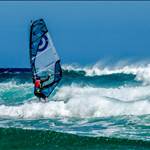
I can't do this at all.
I can't oversheet because I'm well overpowered. Bearing away has me sling-shot into the turn, power-gybing, too fast, bouncing and usually crashing across two or three or more lumps of swell. And that's where it all ends; crash.
What is the technique for gybing when well overpowered?
Oversheet the sail , straight front arm ,bent back arm, look backwards, flip sail
Select to expand quoteevlPanda said..
I can't do this at all.
I can't oversheet because I'm well overpowered. Bearing away has me sling-shot into the turn, power-gybing, too fast, bouncing and usually crashing across two or three or more lumps of swell. And that's where it all ends; crash.
What is the technique for gybing when well overpowered?
Stay in both footstraps until on the new side.
Do what the pros do, turn upwind slightly to lose some speed and retain control, then start the turn.
Solution- De-rig and rig a smaller sail. It's mother nature telling you to go back to the beach and rig smaller before either you or your board gets damaged.
Select to expand quoteevlPanda said..
What is the technique for gybing when well overpowered?
Changing down 
Down haul and out haul the crap out of it .
no more power .until your forced to change .
sails are so good these day the wind range is amazing ...
quick turns also works .
Select to expand quoteDarrylG said..
 Too much power
Just lay it down
Nice one Daz but Annie's not even watching 
Maybe she's looking at who's about to run into you 
And straighten your front arm, you are being lazy
I can gybe pretty good in light winds (13-15 knots) but at Pelican Point in 20-25 knots gybing around those two orange buoys,sometimes for an hour on end I get found out.
I rarely fall off but I lose a good 100 metres in distance to Isaac and Shane on each turn.
Perhaps I should move to the dark side like slowboat and concentrate on gps
Very slow improvements each year are realistically the best you can hope for.
A fin that reduces the bounce or lift of the board can help.
Select to expand quoteMagic Ride said..
Solution- De-rig and rig a smaller sail. It's mother nature telling you to go back to the beach and rig smaller before either you or your board gets damaged.
No it's not.
Learn to oversheet and depower the rig.
Please people there's some good advice and.....?
Talk to the people in your local that do it well
I would split this overpowered gybe into two different cases:
a) overpowered in relatively flat water
b) overpowered in really bumpy chop when board is flying in the air between bumps during turn
If first is matter for me to attempt entering gybe at full speed, which sounds like a fun above 30 knots, the second still require still more training. I will follow Kato advice next time strictly.
Select to expand quotekato said..
Oversheet the sail , straight front arm ,bent back arm, look backwards, flip sail
I'd love to sum it all up in a brief reply but have failed. Sorry.
Closest I can come is:
Maybe I'm just not trying to oversheet enough? HTFU?
and/or
I need more experience in these conditions.
___
Perhaps it's technique I use in lighter winds where I don't oversheet through a gybe, but more power all the way through because it's fast and fun and keep me planing all the way through? And that's just locked into muscle memory? This doesn't work in 30+ because big bumps.
It feels like I can't oversheet because I'm already venting like 25% of the power to keep the board on the water while coming over swell. Because I'm not Robby. And to sheet in more ....I just don't have the weight. (or do I?).
Because I'm going slower that I can perform a sharper turn because swell my apparent wind is really low, making overhseeting difficult/impossible.
As for rigging down I'm on my smallest gear already 
Conditions:
Last Sunday was 30+ in the bay. Tide wasn't running so the swell wasn't that large. but each wave is like, what, 3m apart? Gybing has to be either a realy, really sharp turn or has to traverse across a few waves.
Gear:
4.7m wave sail (hsm super freak me), 80l wave board (evo), and an 18cm fin.
Max downhaul with a little bit of body in the sail to avoid twitchy response.
Other:
Zero jet-skis. Almost no parking because heat wave. No pretty girls on the beach.
It's really, really easy gear to sail but I'm well overpowered and on a knife edge a lot of the time anyway. Only one catapult after a poor landing that day thankfully.
Here's what usually happens:
- I find a lull and some flatter water.
- I slow down and try to time gybe with some swell
- I'd love to oversheet but I physically can't do it. (HTFU?)
- I turn into the gybe
- accelerate. A lot.
- hit bumps.
- crash spectacularly.
I'll add that I'm confident gybing in anything under 25, planing exits most of the time yada yada. But once it's above that everthing changes.
most people are, rightfully, suggesting to do this:
You're not going too far downwind are you? In those sorts of conditions I head up-wind to lose a bit of speed and then accelerate through the turn. If you go too far downwind during the carve, the board will pick up too much speed. Cutting the rail a bit deeper will smooth out the chop a bit as well. Try oversheeting a bit earlier, maybe you are leaving it a bit late?
Select to expand quotekato said..Magic Ride said..
Solution- De-rig and rig a smaller sail. It's mother nature telling you to go back to the beach and rig smaller before either you or your board gets damaged.
No it's not.
Learn to oversheet and depower the rig.
Please people there's some good advice and.....?
Talk to the people in your local that do it well
Fair call Kato and you certainly can gybe well and make it look as simple as it sounds!!! EvilPanda may need a windsurf trip to Invy/ Sandy Point where there are a several good gybers or chat to some of the local guns and get them to watch you??
The issue I sometimes have is I think I am actually committing and doing all those things but I don't fully do them. This is when I crash. Pushing the mast forward enough with straight front arm and fully committing leads to mast foot pressure -I think this really helps bouncing particularly in the Bay here in Melbourne where chop can be a b**** in 25 plus knots southerly.
If Mr Miyagi from Karate kid taught carve gybe he might say:-
Carve gybe yes /carve gybe no/ but carve gybe never in between. 
Select to expand quoteAUS1111 said..
You've heard it 1000 times; Bend your knees! A lot!
I prefer "lead with your knees", bending them is the first thing to do to lower your center of gravity, it also helps put the board on the inside rail, then it's commitment, no half-hearted tries, those never work. You must commit!
I let go of the sail when I go thru the eye of the wind, it lets me know, I think it's about half way thru the gybe, it happens so fast that it's hard to tell.
This is very choppy water style, you don't want to draw out the gybe, that just makes for more bumps that you'll have to encounter, and throw you off your commitment.
Select to expand quoteHaggar said..
Call that choppy? The swell lines up pretty well, I can see flat spots. Is it even 30 knots?
Panda, I'm with you. Gybing overpowered is not as easy as experts think it is.
It is easy for strong athletic people to gybe well but for light weight not so co-ordinated people gybing overpowered is hard. I know it is more technique than strength, but if you are not a fast learner that technique comes at a certain cost in pain, which is the end result every time I practice overpowered gybes. Torn adductor muscles and hamstring after the last episode, a massive bruise on my forearm the time before that.
When overpowered, I am unable to sheet in sufficiently and I get pulled over. I especially find it difficult to have the front arm out straight and weight forward and sheet in sufficiently at the same time. I can do one or the other but I cannot do both fully. That requires more co-ordination than I am capable of.
It is all very well to say change down, but whatever sail you are using, sometimes a gust will come along that is too much. Sometimes that gust will come when you are approaching the bank and are forced to gybe. That is what did me in last time. I should have tacked, but I was trying to practice powered up gybes.
I have tried lay down gybes but getting the sail back up is difficult.
I am not even talking about serious chop, just strong wind in flattish water.
Any ideas welcome but I m not saying I will be able to put them into practice...
Select to expand quoteIan K said..Haggar said..
Call that choppy? The swell lines up pretty well, I can see flat spots. Is it even 30 knots?
I'm guessing they got their Knots confused with KM/hr.
Lumpy but not 50 knots, the spray is not even getting blown, at 50 knots the top of the waves would be blown off
Im no expert but some tips I recieved early on that have helped me....
? With very choppy and overpowered conditions, try and focus on really pushing the back foot down to get the rail into the water. This forces the board to cut/carve through the water and takes most of the bump/bounce out. The actual explanation to me was "think of it as trying to stomp on the inside rail"
? Think the classic bow and arrow stance (Front arm straight and back arm sheeted in)
? Due to the first point you will be curving quicker so flip the sail earlier so you don't need to hang on
Again I might be wrong but those tips helped me in 30+ knts
Good luck
Evil try this, when you want to oversheet rotate your shoulders ( look backwards) the foot of the sail will touch your back foot ( slalom sail) carve hard kill speed then flip. Best I can do with words 
Select to expand quoteIan K said..Haggar said..
Call that choppy? The swell lines up pretty well, I can see flat spots. Is it even 30 knots?
Agree. Total BS on 50 Knots. 50Km/hr maybe. In over 40 knots the tops would be going stripped off those waves in sheets of spray and there is no way those guys would hold the sail for even a second clew first out of those gybes. Make a good story though?
In 30 knots on flat water, or small chop corrugations, or flattish water on wave faces between swell lines, all the above advice on over-sheeting and setting the rail with commitment with loose, bent knees will work well.
In open, washing machine water with large uneven chop and waves, gybing in 30+ knots of wind on a slalom board is an exercise in survival. Any way to get around dry is a big success! Sometimes you will find that the above advice helps and it goes right if you are lucky. Most time is is better to slow down as Roo said by turning upwind a bit and then slam it around as quick as possible when completely de-powered by sheeting out as soon as you turn, carving the board through on momentum and/or a wave only, and then trying to grab the boom and sheet in on the new tack.
As you sound like you were on Freeride gear, that should work easier as well.
It's also easier on slower wave gear because the slower board stays in the water better and turns much tighter, and the sail is easier to de-power and lighter to swing, but you have to be nimble and quick.
At least, thats my strategy.
Lots of good advice on specific technique points above already. Here are some thoughts about things that may also help:
- Work on your jibes in easier conditions. Try bending your knees too much (not really possible); letting the mast lean into the turn 45+ degrees to load the rail; keeping the front arm straight; going into the jibe at full speed; and concentrating on the "boom shaka" (front hand slides all the way to the mast) during the sail flip. Use a GoPro and Clew-View or similar mount and check the jibes at home. Use a GPS and GPS Action Replay to check your minimum speed and percent score in jibes.
In "easy" conditions, it's very easy to get sloppy and develop bad habits. For example, you get away with standing pretty straight on flat water, but it will bounce you out in chop. Being critical and getting feedback from videos and GPS data can counteract that. It can also help develop confidence that lets you go into jibes faster and sheet in harder, with long front arms, when conditions get rough (and the natural tendency is to slow down and bend the arms).
One common cause for not being able to oversheet when jibing overpowered is that you're sailing with a partially open sail. As soon as you bear off, sail power increases, making any sheeting in impossible (and sometimes ripping the sail out of your hands). The solution is to move your hands further back, especially the back hand, and to consciously sheet in before you even start the jibe. It can help to change course a bit, or do this while a wave gives you some extra push, or sheet in during a small lull.
Select to expand quoteRoo said..
Do what the pros do, turn upwind slightly to lose some speed and retain control, then start the turn.
Correct excpet that is not to lose speed but to be able to oversheet, so:turn upwind a bit and at the same time with your rear hand as far back as you are confortable, oversheet and start your turn with the sail oversheeted (so your hand need to be really back on the wish). It feels a bit like starting a forward loop but without jumping. Then if you have turned quick enough, you'll feel the sail depowered a lot.Changing tack is when it gets fun.
Select to expand quoteAgrid said..
Maybe you're just not going fast enough.
What Agrid said has lots of merits. As you are aware that you can travel faster than the "true wind". If and when you are traveling faster than the True Wind, it is actually trying to catch up with you when you initiate your gybe. Lets say the "True Wind" is 20 knots, and you are moving at 24 knots. So when you begin your gybe, you do have a tiny window of opportunity to avoid having the full force of the 20 knots hitting you hard, from behind.
Contrary to the opinions of some, you actually want to go faster just before your gybe. To do that, you can do any or both of these...
(1). Bear away to gain more speed, and/or
(2). Pump your sail a few times.
Yes, it seems ridiculous when you are at the verge of losing control, but that is what a "real" gybe is about...at the edge ! As Peter Hart said, if you are not going fast and not nearly losing control, you are not going to succeed.
Personally, I fell off many hundreds of times before finally reaching that "Eureka" moment. It is about confidence too. If you think "fall", you bloody well will.
By the way, there are of course many other techniques that go with a gybe, and many other have already done a good job explaining them.