Hausey said.. Chris 249 said..
.......
The last two times the foiling Moth class puts its annual meeting report on the web they reported "stagnant" membership despite a $2 million loss by a class builder who went bust promoting foiling. Meanwhile, some new boats (and some old boats) that are cheaper and simpler are going gangbusters and selling much faster than the foilers.
Foiling is great fun, but the issue is that giving too much promotion to an extreme view of a sport does not help. The two major market surveys of the sport said that people do not think it's boring, they think it's inaccessible, expensive, and elitist. Spending too much time promoting foilers just makes it seem even less accessible.
The "high end action sports" that are growing are ones where the gear costs a few grand, not about $28k (if I recall correctly) at a minimum for a Moth plus regular big chunks to upgrade kit, or $55k (for a one design foiling cat). Effectively people are being told "sailing is like this, and you can't afford it to buy this stuff and you can't go and sail on someone else's gear because there are no boats like this around", which is not an enticing idea.
......
About getting publicity - it's dead easy to find out which Olympic sports rated best on TV. The figures have been released by the IOC's Olympic Programme Commission. The figures show clearly that "spectacular" sports don't rate as well as "accessible' sports. Whitewater canoes rate much lower than flat-water canoe racing. Mountain bikes and BMX rate much lower than road and track cycling. "Extreme" sailing including 49er skiffs and Tornado cats rates lower than flat-water rowing in a straight line. Little girls doing gymnastics, people swimming at about 6 kmh and people running are what gets the ratings and the participants, not people bouncing down rapids or mountainsides or over waves at 25 knots. Them's the facts.
Interesting information Chris - which boat builder lost $2M ?
I sailed moths in 1981-2 and they had the Worlds at Botany Bay. I'm guessing - though reckon their might have been about 60 entries?
Back then a new hull cost me $1200 and I fitted it out myself - made the wings, rudder box etc. all out of aluminium. It was a "scow" and I soon found out that "skiffs" were the way to go. I gave up Moths - put in so much time and energy and realised I'd chosen the wrong type of hull. Then I got a Laser and enjoyed racing again - because everyone had the same boat. Used to beat a mate who went on to win world championships etc..... Though suddenly all I wanted to do was windsurf - it was so free compared with sailing boats.
Windsurfing racing on One-Designs was fun - but not as fun as doing freestyle or getting into the waves .... and then the gear progressed - and still is.....
Was down in Hobart for a short time recently, and saw for the first time a foiling moth - incredibly sophisticated piece of kit - all carbon - made in China - with what looked almost like a windsurfing rig from Andy Mc.D? According to one of the the young blokes I had a chat to at the sailing club after their practice sessions, he'd recently got back from the Australian titles in W.A. and he said that there was about 50 entries. So despite the cost (like you said $30k) - doesn't seem like there has been much change with membership in this particular development class over all these years.
Though most other classes that were around in the 80's have probably disappeared? They didn't adapt and move with the times!
One of the other young blokes I had a chat with was a RSX sailor who said he was going to quit and get into Finns - he was too tall for a Laser he said. He'd competed at international level in the RSX and only did well in the strong wind races only. He said that if Australia was only going to get competitive in the RSX - a bunch of younger windsurfers would have to get together with a good coach. Interesting that he said that despite it being a one-design class - there was huge inconsistencies in the fins - and if you got a good one - it made all the difference - almost zero to hero with a great fin ?! All to do with flex and pumping he said!
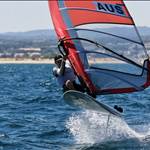
I'd never seen an RSX before - what a frigging heavy piece of crap! No one would buy one if they weren't the Olympic board. It's 2016 and they have to sail something the weight of a stock windsurfer? They might as well be sailing stock windsurfers then?
In the end - all of this ....
......is just first world problems for rich kids!
The sea levels are rising, massive problems around the corner... really - who gives a ****!
Watching the 'womens' gymnastics at Olympic level is always going to rate high - and that's got nothing to do with accessibility !
People from the Moth association (and people who did warranty work for Bladerider) say that Bladerider lost about $2 mill building foiling Moths. They did an amazing marketing job, though; until then, only something like 10-17 new foilers a year were being launched. But, as you say, the Moth numbers now are actually lower than they were in scow days, even compared to other singlehanded dinghies like Lasers and Sabres. I had a skiff for a while around '86, when they were taking over from the scows, but in some ways they weren't as much fun to sail for me. It's not use here; in the USA they revived the Classic Moth (built to 1960s rules, banning wings, full battens etc) about the same time as the foiler Moth was created and the Classics are just about as popular as the foilers. It's the same in NZ - the foilers died out but the NZ Restricted Moth (a one design based on the 1940s Mark II Moth) is still a small class.
Not too many classes have disappeared since the '80s for not moving with the times. I've been keeping records of national title attendance, and the Oz dinghy classes that have vanished in that time are the 145 (ply homebuild 14'er), Vee Jay (although they are trying to revive it), Solo (which is a huge class in the UK, but was too similar to the Sabre to work here), Gwen 12 and Rainbow (both 1940s designs that were dying by 1980), Sailfish, and Thorpe 12. So about 10% of the dinghy classes have died in 35 years. Of the classes that died, the Gwen 12 and Vee Jay did try to move with the times. The 145 was only about 10 years old when it died, although it was quite strong for a while, so it was still pretty new when it died.
The classes that have shown strong growth since those times are the Laser Radial, the Sabre, Opti and 29er - all strict one designs, and generally pretty slow. It's the same in the UK - the cats have shrunk a bit, the performance two-adult trapeze dinghies and skiff types (boats like the 505 and Fireball and the UK production skiff copies) have collapsed in numbers, the small "family boats" (Heron, Mirror etc) have lost numbers, and the slow-ish singlehanders (Opti, Radial, Solo) have grown. Recently, RS Sailboats has launched the Aero, which is aimed at basically being a modern Laser (no wings, very simple, but very light) and within the first year or so they have sold as many boats as the Moths did in the decade or so since foiling started. It all seems to fit in well with the changes in society, and it seems to be following the same forces that have created growth in sea kayaking, plastic kayaks, SUPs etc.
I'd love to see high-performance development classes and extreme sailing doing well; it's just that promoting them as the main image of the sport could hurt the sport. And yep, I'm not defending the RSX at all! If I had my way the Olympics would have two boards - a cheap OD longboard which would be used for racing most of the time, and a shortboard, sort of like the Formula 42 idea but with cheaper longboards.

 I could just see the mass's flocking to the TV to get a glimpse of this action...love the screaming guitar solo to amp up the adrenaline! Whoo hooo