Select to expand quote
Subsonic said..dimacced said..azymuth said..boardsurfr said..
Another thing that's absent in winging is the roll momentum from the rig and mast foot, which requires wider tails to counter-act it for stable rides.
That's interesting - I feel it with smaller extreme HA wings.
Can you explain the roll forces that are unique to windfoiling please

I personally think momentum is there in both winging and windfoil, and is given by the rider body connecting sail to board transferring with his own body the force from the wing/sail to the board, and the hole si getting a wind force on the center of effort which is at a certain eight respect to the board, so the rider needs to counterbalance by leaning out and getting COG aside from vertical to get an opposite and equal in size momentum in search for equilibrium.
the only difference is that in winging the sail is not connected to the center of the board and you can move it out on the opposite rail, this you can't do in windfoiling since UJ is in the middle and fix, so the stance may be dirrent, in any case sail upright for maximum trust and body leaned outward farest away possible from the sail to counteract momentum...that is why so long lines on windfoil race.
We don't really experience rig induced roll moments in wind foiling, nor would a wing. The Americas cup boats and GP 50s do, as their rig is stayed to the boat. That's why they have their foils set much further forward, and outboard on the leeward side, to counteract the roll moment.
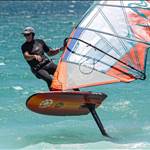
I believe what he's getting at is that wind foilers have to "share" the board platform with their rig, which means we generally need to be outboard when we're up at speed. Moving your feet away from the centreline means you lose some leverage over a foil that exceeds the board width. Hence the wider boards, so we can maintain leverage over the foil when we're outboard. Wing foilers don't really have their feet too far away from the centreline of the board, so roll moment is easier to manipulate.
I am not sure wether I got your point correctly. On foiling we are subject to torque generated by the sail, it is our body that connects the force source (sail) to the board, if you let the sail go it will fall downwind. We do not perceive that much force due to the poor power our sails/wing generates and the very low drag the foil has. Should you take off the foil and do windsurfing instead, immediately consequences are, more drag, so more sail needed, and more torque generated and you need to lean much more outboard to compensate and you perceive more clearly that your body is the connector and force, torque transfer to the board.
As a matter of fact the sail surface and efficiency of an america's cup boat is enormously different, so that they are much more efficient and get 4 times faster than wind speed, while on foiling we get almost as fast as the wind or slightly above 1,4-1,6 times the wind in the best conditions (racers with big sails and very small foil).
So less power generated =less torque, but still torque is there both in winging and windfoiling.
Should leverage being needed to compensate for torque generated by the foil underneath we have this both in winging and windfoiling alike, though wing foilers stay quite centered on the board while windfoilers need some width to counteract that.
While this is generally true, some windfoilers these days claim they feel better with straps located more towards the center of the board, I think the difference is the kind of riding you want to do: should you go faster with more power you may need leverage, and the balance you get is totally different (lean out much, longer fuselage for more power and upwind ability, more sail cloth, more board width), should you go for a more manoeuver oriented ride, you get a totaly different set up, that very much resemble the wing one (Balz muller riding the Pegasus 108 that is 60 cm wide with very mych centered straps).
I start believing that wingers need less forces to get moving, so that even poor source of pure as the wings are are able to let them go; and less forces means difenet stance on the board.
I am afraid many of the difference in stance are coming from our eritage, we have been windsurfers before getting into windfoiling so we have that kind of stance engrained, wingfoilers come from many different sports, some from kiting and they have wider stances, some from windsurfing and they tend to use the wing as a sail...there is a component of physical motor patterns we are somehow linked to and have diffciculties in abandoning. Experimenting is the only thing we can do to explore and understand.