Select to expand quote
RuddeBos said..
My thoughts
I'm trying the advice by really extending the gybing arc, so everything is very stable and steady. So my speed maybe falling, which as I flip the sail, it is starting to load up again.
I've been trying to keep my front arm really straight to keep the rig away from me.
Does the rig have to be leaned into the turn at a greater angle than the board or similar to the board?
Is the rig flip a simple rotation or more complicated slice and flip? Or is this dependant on the load generated?
As the rig rotates, is it rotating around the mast or around a point on the boom, as happens with the larger sails?
Could I be using too large a sail?
I've been using a 5m with the Starboard SC in gusty winds up to 20mph but flat water.
Unfortunately the wind has been really unstable since I've been out. So I've needed a suitable sail to get out from the beach in 5mph, but as the clouds came over, the wind has ramped up.
so options
1. Take a smaller sail, and rig it so it's got enough power to get off the beach?
2 rig the 5m flatter?
3. Wait until the conditions are better...that's not going to happen !
I've getting the feeling when it's appropriate to use rig first or feet first.
The occasions when I've started to come out switch from the gybe, definitely feels the right way to progress, as the board feels so much more stable.
However, just as that stability switches on through the exit, the problems happen.
Could it also be that I need to rotate a little more through my waist, in the switch position , or place my feet a little differently to make it easier?
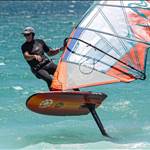
In the photos, Emily or Tony don't appear to be twisting, but face directly down the board.
Anyway I think I need to commit to practice a bit more early on in a session, as my natural reaction is to revert back to my old tried and tested foot first gybe.
Thanks Rod
I wouldn't go overboard on extending the gybing arc. The main thing is committing fully to the gybe and carving a nice arc so that the sail will come back into the right place. In Azymuth's video above I think Simon is using a more advanced technique to go faster where he holds onto the rig longer and has a definite flip. That's faster and better in lighter winds but I think it's better to start with gybing around a flagged out sail. The board and rig should be rotating at about the same speed through the gybe in opposite directions. The rotation of the rig is around your front hand which is next to the mast.
As UTC says, for a second or two you should feel like you are just surfing the foil and there's no propulsion from the rig.
This isn't a great example as I'm a bit underpowered going into the gybe but you can see how slowly a tiny sail is rotating through the gybe:
www.instagram.com/p/CK7ATWEFCDX/A 5m sail is ok to learn but a 3.7 in 20 knots would be easier! The bigger the sail, the slower the rotation. You might have to give the boom a push with your back hand before releasing in lighter winds with bigger sails.
Don't let the rig get too far away from you as it's more difficult to control when the power comes back on. Even in Tony Logosz showboat gybe above he has his elbow bent and Emily Ridgway has the mast no more than a foot away from her body. When learning try to keep the mast right in front of your nose (say 12 inches away) all the way through the gybe. This will make sure that you lean the mast with your body into the gybe. Also when the power comes back on you can extend your arms to soak up the power. If they are already straight the power will throw you off balance.
Rigging the sail flatter might help as the battens will rotate more easily and the power will come back in more gently.
Sailing switch does require a lot of body twist which you slowly get used to and become more supple. Try reducing the angle by bringing you back foot slightly forward and onto the rail. You can also wriggle you front foot out of the strap a bit. This allows your body to face the front of the board a bit more rather than to windward.

 RuddeBos
> 9 months ago, 29 Mar 2021
RuddeBos
> 9 months ago, 29 Mar 2021