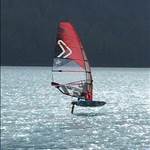
That's why I started this thread, to get the discussion going so that we all come to an understanding about the naming convention for shims.
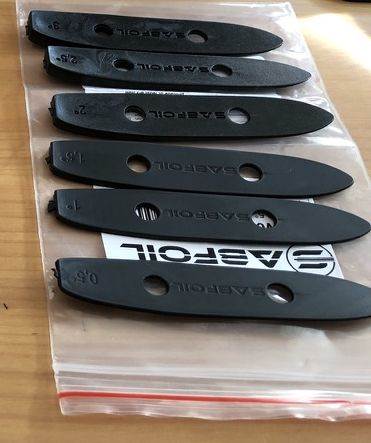
Like what is shown in the picture above I also have that set of SAB shims. They are labeled with numbers that do not have either positive or negative signs. That means they are positive degree numbers. I can prove this below.
At Boeing they say, "In God we trust, all others bring facts and data." Here below are some facts and data.
The first photo shows my -0.5 deg shim mounted under a 450 stab. I use this for my 950 wing.
The second photo shows, from left to right, a -0,5 deg, -1.0 deg, and the SAB-provided 1,5 deg. All were mounted such that up is the forward direction on the foil. The squared end is forward, the pointy end is aft. Note that the thickness is greater on the aft end for the negative shims, and that the thickness is greater on the forward end for the positive shim.
Now let's show some measurements, taken with a vernier caliper. Sorry, metric folks, these are in inches. I'm a yank. The third photo shows those measurements. The gray and white shims I got from Sailworks, and the black shim is from the SAB kit. Again the measurements show that the forward end is thinner than the aft end for the negative shims, and the reverse for the positive shim.
This proves that a negative shim REDUCES the down angle of the stab, This, therefore, REDUCES, the AOA of the front wing. This REDUCES the lift at a given speed. Examine the first photo again. If the aft end is thicker than front the down angle is reduced. In the photo this would rotate the stab 1/2 degree clockwise. Since the stab is on the bottom of the fuse, clockwise in the photo is a reduced down angle.
After two years of on-water experimentation with shims, I can testify that a negative shim REDUCES the lift and keeps the foil down during virulent gusts. Reducing the lift lets me use more back foot pressure to control the pitch of the foil.
QED