CAN17 said..WhiteofHeart said.. CAN17 said..I am 65 kg and fly in 7/8 knots with my formula board and blue pryde aluminium foil and 7.5 sail. I get overpowered at about 13 knots on this setup. Have not tried smaller sails as other light weights have above. I have only foiled for one season so far...much more to learn

Sorry for the farther derailment of this thread. But has anyone foiled with there mast base past center in light winds or is it to sticky getting up. I usually run with it way back sometimes even covering the serial #. But my sb 08 is known to be used with the mast base sailed pritty far back.
I have used the pryde foil quite a lot, nice foil, fast, but not optimal for lightwind. The front wing is small (about half my wing literally), and the power is pretty far back. The further your power is forward the earlier you fly. In light wind I'd put the base as far back as possible with this foil. I used it with a JP135 and the base was at around 123cm for light wind, with the straps all the way back and a washer under the stab for more lift. On my custom board the most forward position of the masttrack corresponds to 123cm from the tail, I mostly use it at around 98-100cm from the tail with a way more front foot powered foil and straps further back (front insert aligned with front screw of the box) than a lot of serial (foil) boards go! This gives an incredible amount of light wind power/performance, but does get quite a handful overpowered when you are not used to it. I designed the dimensions and insert positions together with balz, making it a really extreme, but perfect setup for light wind.
Yah, i find it lacking lift in anything below 8 kts. Im light so can get by in light winds with the back washer in. But would amgine the amount of lift significantly lower for a bigger rider. Just a guess but a 100kg rider could probably get going in 12knots with same setup? Didn't realise it has the front wing too far back but makes sence. The wing is 72cm so not that big either, hence why I have run with the base all the way back in light winds. Are manufatures not able to make g10 ( low cost wings) in 80cm+ in span without being overly thick.
What foil are you using in light winds? Fuse length, wing size??
I appreciate you detailed replys and love for the sport!
I think the pryde alu is great value for money (compared to the rest of the market at least), so in that respect I think they did great. On top of that it is one of the stiffest (if not the stiffest) alu foils on the market, meaning also good to use for heavier riders, I do however think you are right, a 100+kg rider would need 11-12 knots to get going with it, so its not ideal for light wind. I wouldn't say thefront wing is too far back, it is jibable when coupled with the JP135 and when set up right, but having it a little further forward just improves lift. The problem with g10 is that stiffness and thickness are 1:1 related with this material, meaning a larger wing has to also be a lot thicker to be stiff. On top of that, I think they want to be able to guarantee stiffness for everyone, and when supplying a bigger wing, the torsional forces on the front of the fuselage get bigger, add to that a 100+kg rider, and they might feel a little less confident of its performance at pryde group.
I have 2 foils I use a lot. For racing and light wind / small sail freeriding I use the Lokefoil LK1, one of the stiffest and fastest full carbon monoque construction foils available on the market. For the small sails I use a 1200cm2 wing, with a bigger sail in minimal wind or during courseraces I have a 1000cm2 wing, similar to the starboard millenium wing. For more wind and more powered up/down racing I have an 850cm2 wing, and speed a 600cm2 (with which I clocked 58.68 kph, which I think is quite fast). The fuselage isn't that long, around 85-90cm I believe, but the front wings location relative to the foilmast is similar to that of the starboard race, resulting in a lot of front foot power and lift. The position of the stabiliser relative to the mast is of less importance, especially for freeriding. Having the stab further back increases stability a little, but mostly 'locks' the foil in place more, meaning it is easier to bank the board over to windward and lock it in place. For freeriding and the occasional race like I do this is unnecessary, and I actually believe that even for racers it isn't necessary, since (I believe it was him, but correct me if I'm wrong) Thomas Goyard won a foil PWA using the Loke, and it wins a lot of national events.
however, since a couple of months I have been helping the kitebrand F-One in their windfoil R&D, their foil is at the moment my foil of choice for freestyle from about 10 knots, their biggest windfoil wing is 900cm2, meaning I need a little more sail (5.7 in 10kts compared to 4.8 with the loke1200), but it is very stable and easy to sail, is fast enough, and above all, the brand philosophy is to try to present an indestructable product which can be used by any level in any conditions, and has to be able to put up with the extreme forces of freestyle windfoiling. Until I discovered F-One I broke a number of foils and wings in one way or another, thus making F-One my foil of choice. Lately I have been testing different prototype fuselages and masts, which made me aware of the effect especially the mast placement on the fuselage has. For the next series (2020) we are putting the front wing further forward (mast further back on the fuselage), also for freeriding purposes (not only for racers) as it opens up jibing a lot more and enhances light wind potential. I am waiting (and hoping because it is not my in my hands) for F-One to make me a bigger wing, for I cannot jump the Loke without risking damage (I am quite heavy with 86kgs, and its design objective was making a racing foil), but do like the feeling of being able to use even smaller sails. I will try the supwing for windfoiling soon, but am having my doubts, with the needed fuselage distance to the mast, which is 0cm as with most supfoils, and the wingshape as explained below.
In my experience the one light wind wing isn't as good as the other to get most out of the light wind performance. I have tried thick, low aspect wings like the naish for light wind, but did not like it. The LK1200 is a freeride wing, but still very high aspect compared to most, making it more efficient. It is thinner than most, has a 92cm wingspan, and 16cm chord. (My racing LK1000 wing is 96cmx11cm I believe, with an even thinner profile and a smaller angle of attack, making it even more efficient, but also less powerful, therfore the use with bigger sails) I feel this is better for light wind in the end, because a more efficient wing will attain higher speeds, increasing relative wind, meaning you'll just be more powered up in minimal conditions compared to a low aspect wing. On top of that, due to its higher speed and lower drag it glides better in the lulls.
The reason I have a low aspect wing in my quiver (F-One 850) is because it delivers a softer feel, I use this wing overpowered a lot in freestyle conditions, and it greatly improves handling, ease in gusts and ease of mind (because it is less fast) compared to a similarly powerful high aspect wing. I think in the higher ranges is where the lower aspect wings belong, because no efficiency is needed there and ease of use becomes a bigger part of the equation. Ofcourse the low aspect wings have the advantage of having more float, meaning they need less speed and pumping to get out of the water, but for me personally the tradeoff with endspeed, acceleration and amount of drag isn't worth it, I'd rather work a little harder to get going with a more efficient shape (which isnt a problem for me), than be stuck falling out of the sky in the lulls and feeling chronically underpowered.

 I mean it's so out of the box to what I'd consider possible I have never considered putting my smallest sail (4.2) on my foil setup in such light wind....but I guess I need to try it before I knock it right.
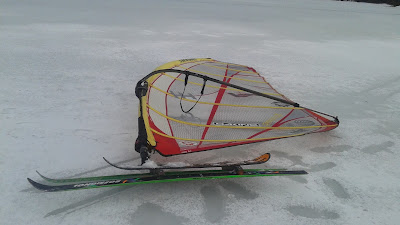
 Now imagine all the fun of sailing on ice and snow and doing it on a warm summer's day.


 more then anything I've always enjoyed wood working and making cool projects like these has given me a better appreciation for hydrofoils and I am fascinated by the science behind it all. Even though I'm not a engeneer or physicist, but I don't think you have to be to carve up a piece of wood