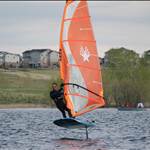
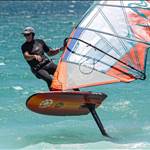
I disagree with a lot of things being said in this thread right now. It took me about 5 sessions unill steady flight without touching down unwanted toor regularly or making any funny crashes.
starting in light wind is in my opinion the best, for you will learn to feel the trim, which in foiling is of way bigger importance than in regular windsurfing. Most people who start overpowered do all kinds of funny things like put the mastfoot all the way forward, go for power 50/50 distributed over both legs or even backleg heavy. They start saying things like "starting to control the board with my legs, but am still overcompensating" (no offence intended). They sail around with the toilet stance and the boom at chestheight, never really getting the kit to do the work for them.
first, to debunk some myths:
- mastfoot all the way forward: people tend to do this because the pro's do, but the pro's actually have a very good reason for this, namely that their foils are way more powerful than anything a regular windfoiler would sail on, with the front wing situated at least 5cm further forward than most, while having their straps way back. Putting the mastfoot further forward allows for controling gusts when using the more advanced techniques explained below, but requires a well tuned kit, powerful foil and sail, wide board, above all, loads of sailpower. When you are not hanging down from the rig having your mastfoot forward will only impair your early planing, manouvrebility etcetc.
- power evenly distributed over the legs might sound like a good idea, but will decrease control for in a gust or when speeding up or slowing down the point of balance shifts, making you kind of trying to balance a board on a ledge which keeps moving forward and backward beneath you. Now the answer to that is to either have the power further forward or back (seen as what the pro's use you may guess, but I will explain), having the power under the backfoot will result in a sticky board, in gusts your board will land uncontrolably, upwind potential is limited, early planing is limited. It seems that front foot power is the answer, for it opens up jibing, early planing, upwind sailing, control in gusts, etc. Etc.
- controling the board with the legs: lets just say people are actively trying to do this, and it results in a dolphin effect. It like standing in a really narrow rowing boat, the more moves you make to compensate, the harder the boat will wobble, same goes for foiling. Ofcourse it is hard to do something else (especially since you have no idea what you are doing as a beginner, which is completely understandable and normal), so instead I'd recommend going out in lighter winds, for it allows for just less movements having to be made. Keeping the board balanced is mostly done by shifting weight forward and backward (I do this with both legs straight, only bending the frontleg when going really fast or when so much overpowered I cant keep my sail closed), shifting the front hand forward and back will lower or heighten flightheight respectively, and the position of the backhand has to be placed in accorance with backhand preassure in the sail, for a lot of power on your backhand will result in a lot of power on the back foot = rising board, and vice versa ofcourse. It is not done by bending your knees into the toiletposition like some people like to do when windsurfing in choppy waters, or wobbling your knees all about..
- Boom at chestheight (or even lower): has to do with the power/balance point thing mentioned at first, but having your boom at chestheight kills the power from your foil, meaning you will be sticking to the water, and in gusts your sailpower response will be slower, meaning your board will do more funny things (like go all over the place). High boom is the answer for foiling, at the boomhead eyeheight or higher.
starting in lighter winds will help you setup foilkit the way it is supposed to, mainly because otherwise it will not fly. Go out in (too) little wind, boom at eyeheight or higher, footstraps all the way back, mastfoot back (unless you are using a PWA foil), stab set to more power (more rake). It will take a few sessions to adjust to the powerful feeling beneath your legs, but after getting used to it it is a bliss and will help control in every windstrength. When your kit is setup correctly IT WILL FLY OUT OF ITS OWN IN A STABLE MANNER, requiring no effort whatsoever.
Ofcourse you could also sail in more wind with an adequately small sail. Say 7.0 for 8-12 knots, 6.0 for 10-14 knots, 5.0 for 12-16 knots, 4.0 in 16-20 knots for an 80kg sailor with a regular +/-900sqcm wing.
Today I was out with 8.6, formulaboard, racefoil with 1000sqcm frontwing, all set to maximumpower in 16 knots, while at 6 knots this trim gives me enough power to fly. When racing the foils, control is attained by staying completely stiff on both legs, staying sheeted in and hanging weight in the harness to keep the nose down through the mastfoot, providing maximum power efficiency + control. On the small kit however I'm upright and just sheet out in gusts, and move my backfoot out of the backstrap on reach or downwind courses when overpowered.
i have to say that as foiling is still a young sport everyone is still learning, I have been doing (at the least) twice a week 6-8 hour sessions for 2 years now, but don't dare say I am all knowing or everything I say is true. At the moment this is where I stand with my current state of knowledge.

 Imax1
> 9 months ago, 5 Feb 2019
Imax1
> 9 months ago, 5 Feb 2019