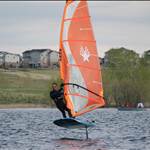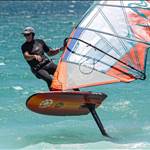
It depends a lot on skill, what you're used to. I've foiled different boards like a Bic Nova 170 D (fat and wide), a Warp 71 (very light), a Skate 110, and a Slingshot Flyer 280 (almost a longboard or race SUP). The difference in gettingthe board to flyis huge. I usually sail the Skate and slalom boards,andpumping these was easiest to me. The fat Nova did not seem to accelerate at all when I pump, even with lots of sail pressure. The Flyer accelerated so well that the initial pumps were easy and directly converted into speed; but when pumping downwind to get going, I then felt that I had pressure left in the sail to work with. Guys with much better skills can pump the flyer up onto the foil in almost nothing. The same is true for very wide boards.
Select to expand quote
IndecentExposur said..
I think Physics would disagree. Smaller the board, the more resistance you'll have in the water; with the same power, a wider board will distribute the weight and bring it to speed faster and plane faster. Hence the reason there are formula boards, etc. Above the laws of physics, everything else is opinion. :)
The physics are a bit more complicated here, with different issues when slogging and planing. Assuming the board has enough volume to float you, a
narrower board will have
less resistance. A longboard will alway slog faster than a Starboard Go.
But when planing, a wider board will plane in less with than a narrower board of similar volume. If you look back at Jim Drake's windsurfing physics essays, he actually has two different formulas for narrow and wide boards. But basically, it's about where the displaced water goes. If the displaced water is pushed
down, the
board will be pushed
up - that helps it plane. If it is pushed to the side, it's basically just wasted energy. The wide the board, the higher is the ratio of down/up push vs. sideways push - hence wider boards plane earlier.
Board length comes in as a third variable, since it affects hull speed. Short, fat boards have a low hull speed and high slog resistance, so require hard pumps. Skinny longboards transition smoothly.