Yes the righting moment doesn't look to be as much as on Cats, though I read somewhere that the T foils are ballasted? Also that the AC75s are about 20% heavier than AC72s but that the soft rigs weigh half as much. I also read somewhere that separation of the two longitudinal axis of the T foils is regulated to 4 point something metres with plus or minus ~1 mm tolerance. I'd think an advantage of the T foil's adjustability about the longitudinal axis is that they can trim out underwater mast lift and have the foil at the bottom do all the work. When using J foil daggerboards in cats you can't do this. The masts must be generating lateral lift at right angles to the lift at the bottom of the J. "The square on the hypotenuse is equal to the square on the other two sides" but when adding the lift vectors you don't square. To paraphrase Pythagorus "The induced drag on the hypotenuse is less than the induced drag on the other two sides."
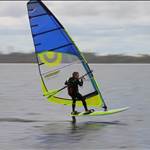
Windfoilers can aim to do this. Have the mast freewheeling through the water not generating lift. A go pro aimed at the trailing edge of the mast would be interesting. I think the wake would clearly show when you were trimmed with the mast at neutral AOA.
Be interesting to see which direction the more everyday 18' skiffs go. Aus 299's photo looks about the size of a potential successor to the 18 footers whereas the superfoilers have already gone multihull with J dagger boards.