Ok there's no link this time. Those who are not interested can stay off the thread, those who participate please keep to the subject matter.
When water temperature decreases, the viscosity of the water increases. This increases drag, increases turbulence and decreases the extent of smooth laminar flow.
Shown below is the effect upon a fairly typical single fin foil of change in water temperature from 20 degrees celsius down to 1 degree celcius. The speed and chord length in this example are kept constant.
As can be seen the Reynolds number is much lower in cold water, this shows the increase in water viscosity.
RAF 27 AIRFOIL (raf27-il)
 Details (raf27-il) RAF 27 AIRFOIL
 RAF-27 airfoil
Max thickness 9.8% at 30% chord.
Max camber 0% at 0% chord
Water temperature 20 degrees C Velocity m/s26.843 mph43.2 kph
Chord width m0.19685 ft2.3622 in
Kinematic Viscositym2/s1.054e-5 ft2/s
Reynolds Number735,166 Water temperature 1 degree C Velocity m/s26.843 mph43.2 kph
Chord width m0.19685 ft2.3622in
Kinematic Viscositym2/s1.769e-5 ft2/s
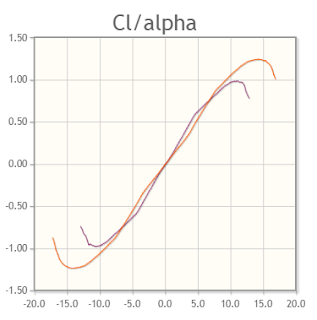
Reynolds Number438,009 The red line in the two graphs below represents the higher water temperature, and the purple line the lower temperature.
As can be seen here in the Cl/alpha graph ( which shows changes in lift vs angle of attack) at lower water temperature the fin will stall ealier (stall is seen where the lift suddenly drops as angle of attack increases). In cold water the fin will stall at about 11 degrees aoa and in warm water, at about 14 degrees. this is a significant difference.
Below we can see Cd/alpha or drag vs angle of attack. As the angle of attack exceeds 7 degrees the drag produced in cold water soon becomes double that of the drag in warm water, and the difference increases as the angle of attack goes higher.

Results vary widely depending upon the kind of fin foil used, and the chord length of the fin. Increasing the chord length of the fin raises the Reynolds number and is one way to overcome the angle of attack limitation seen in cold water. All else being equal however, increasing the chord length will also increase skin friction drag. Increasing speed also increases the Reynolds number.
So, increasing speed, water temperature or the chord length of the fin all have the same effect on the Reynolds number. Chord length and water temperature are fixed during any given session.Speed however, constantly changes and the surfboard fin is required to operate over a range of speeds during a ride. A fin which is optimised for low speed will be larger than is necessary at high speed, and vice versa, and a fin which is optimised for warm water might experience stalling issues in cold water, when used at the low end of the speed range.
Issues are most likely to become apparent in cold water when using high aspect ratio fins with short chord lengths.
Ideally a different fin or set of fins will be needed for different water temperatures. the foil section can be changed, but the most obvious way to alter the fins is to use a longer chord in cold water, and a lower aspect ratio fin.
Thanks to airfoiltools.com for the graphs, foil section and reynolds number calculator

 RoyStuart
> 9 months ago, 13 Oct 2015
RoyStuart
> 9 months ago, 13 Oct 2015

 if not I've finally lost it