termite said..Thanks Hydro! Heaps to think about there.
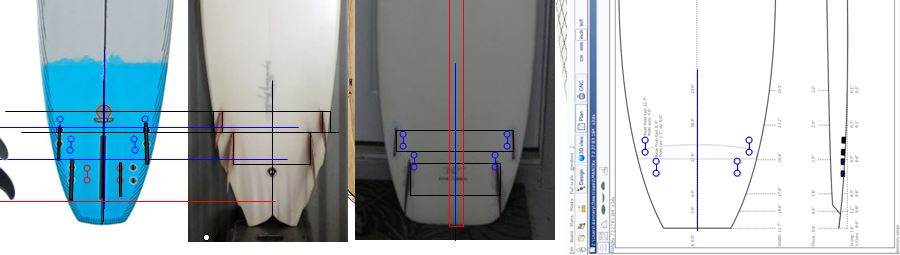
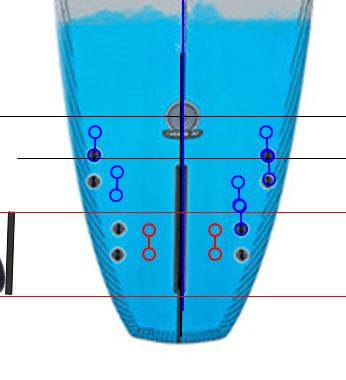
I really like the idea of extra plugs. I'm now thinking of a plug in front of the forward quads so that I can set them forward enough to act as side bites for a 3 plus one set up.
How good is the Carbon Jet! I rode one and am now up to making my 7th version with some minor and more substantial tweaks (all vast improvements of course

). I owned that exact Webber but sold it because I preferred riding the Carbon Jet.
I found the Mckee formula for their quads and will probably use that for the basic quad placings
www.mckeesurf.com/?page_id=267Thanks again. I hope your new setup goes well.
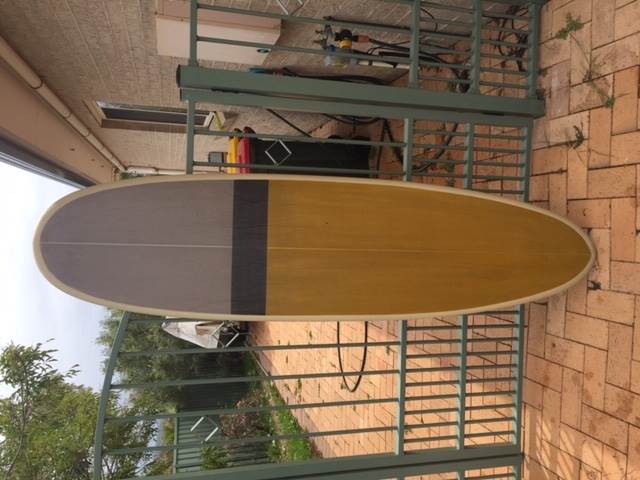
Pic below is CarbJet copy #3 built in polystyrene and epoxy.

Yeah I love my CJet but everyone else baggin me out because it's a tainted pop out. Screw them I say.
I recon a guy like Beau Young would have some idea of what works and doesn't, besides it's his name on the label and at the end of the day he's a dual world champ, Webber isn't. No slight on Webber, it's just that Beau's cred is stronger to me.
So you recon the CJet goes better than the Webber? Wow, that confirms I made the right decision then. I was inspired by some aspects of the Webber but wanted the fin variability that the CJet gave, and which I could then even tweak further.
I've been all over Mckee's site and downloaded and his tables, I plugged them into excel and graphed the relationship of spacing to board size and found it was a linear relationship, so a formula can be easily derived for any board size and tail width based on this.
But as you likely have discovered there is a lot of conjecture about exactly what is happening with the Twinzer dynamic. One article comparing them to the forward canards on a jet fighter and slip stream effects etc. All well and good if they align with the trailing wing but Twinzers do not do this, so I think it has more to do with energy distribution and release through delayed winglet / canard stall angle due to pressure distribution between the fins in close proximity. Way too complex to explain the full dynamics but this would allow the fins to punch through the normal stall angle of a wing and hold / delay the slide or pressure release. Hence feeling more grippy than a traditional quad but just as zippy.
So the key is likely the proximity of one to the other in the fin placement, but likely for other reasons than people think.
Which is why I'm gonna punch holes in my Cjet, need to have a couple of new plug locations to get the fin proximity. But before doing that I will simply try the swapped quad arrangement and see how it "feels", good old fashioned scientific and engineering based experimentation ;-)
That copy you made is a ripper, I love the wide swallow tail. That would be a sweet shape for a dedicated twin with trailer or quad, the swallow would bite nicely and give you some added hold on the rail.
So do you actually shape these or model them and get them shaped and glassed third party?