ThNks for the comments guys.
@stevo, I normally sup surf at Maori bay. If you've been out there during the summer and seen a guy on a sup in a 2/2 short sleeve wetsuit chances are it's been me.
Select to expand quotecolas said..benjl said..
How do you find your board in overhead stuff at 32" wide?
In my experience, you do not actually need a pulled in tail for "big" waves, although I am no big wave specialist, I have not the training and condition to survive beatings by more that double overhead waves.
You need a pulled in tail if you want to be able to turn tightly in the hollow parts of the waves. But I found that straight rails are more stable at speed, curved ones slow the board and may induce "speed wobbles". Guns have actually long, straight rails, even with narrow tails. But you can get the same stability with a wide-tailed board, because it can have more parallel, thus straight rails. And the board will be faster, which will be a boon to make fast big closing sections. And it will take off earlier, so you can take off before things get too hairy, and get just the added time to setup your trim line to make sections.
So, if you are not doing SUP contests, and are more in survival mode than rollers-under-the-lip mode, a 29" wide "tomo" will be as stable or more than a 32" "mini gun" shape, and will be more efficient to enjoy the rides. I would however get a semi-pointed nose, or semi-tomo, trying to punch through whitewater with a big shovel nose is akin to russian roulette.
Actually a semi-pointed nose, straight rails, wide tail... is what makes the fish shapes so great for speeding across steep sections. So maybe use just a fish design?
Have a look at Cheyne Horan surfing a Lazor Zap at Waimea back in the 80's if you think wide tails work in big waves :)
Heaps of speed but no control.
Select to expand quotehilly said..
Have a look at Cheyne Horan surfing a Lazor Zap at Waimea back in the 80's if you think wide tails work in big waves :)
Read me again: I said straight rails worked at speed. The Lazor Zap was all in curves, and the single pivot of the rake-less starfin didnt help (I have one, it turns on a dime but have no stability in curves)
Read this: surfsimply.com/surfboards/the-fish-aint-no-small-wave-sled/
I have been used curved outlines in some powerful Hossegor (for me), they turn very well, but when racing the sections you definitively feel like you have left the handbrake on after coming from boards with straighter rails.
They are quickly hell with chop on the wave face, though. But pics by Benji on the first message where nowhere like Waimea, but clean waves with fast and hollow sections, a very different setup.
If Benji goes custom after discussing requirements with designer. Then turns up at beach with shiny new custom stick in hand and repeatedly fails to get through the white water/waves, no better than his current boards, what generally happens then. Does the designer take board back and rework or is Benji stuck with a custom that doesn't fulfill his requirement and not easy to sell on.
Just wondering?
Any impressed with Benji using a Vbox in such size waves. I have the smaller vbox and only used it for up to head high. I always assumed it would not work above that, with the tail, so used a traditional shaped board. Really keen to take it out in bigger stuff ,but i have a smik twin for that now...Nice decision Vbox or twin..
Funnily enough a cheap 7'9 vbox proto came up for sale yesterday so I brought to conflate to my 8'1. 11l difference, 0.5" width and 2" length but a completely different board on the water.
i had expected tighter turns, more dynamic but actually preferred by 8'1 for bigger and smaller stuff.
felt like the added stability of my 8'1 allows me to shuffle my feet more to get on rail and really get in early to waves. I took the 7'9 to about 1.5x overhead today and surprised a few surfers who initially gave me glares for being on a sup.
I do find it it picks up speed so quick and those parallel rails give it stability ona bigger wave. The biggest difference I've found so far are fins. I hated the quad + knub and been running thruster every time. I found no difference in speed but the extra pivot is well worth it.
a few sets of fins in medium and from the same company made it handle soo differently though. I found an am2 style of template was best for really drivey turns but still easy release.
The guy I got my vbox off said it was definitely not a board for overhead waves but I find it as home here as waist high. Provided it's not about to close on me I have only had one wave so far that I was scared to paddle in to- and that was post cyclone and the sheer amount of water in that wave was immense plus about 2.5x overhead.
I also noted a huge difference in volume placement between the proto and evo 2. Depending on what model you have may make a difference again to fins and how it rides.
Do you guys find it easier or harder to get over white wash on lower volume boards? The 7'9 was noticeably more skittish and unstable but I could counter balance it more effectively meaning I actually came
off it less than my 8'1. Although it was also a heck of a lot more work over a 2hr session
Select to expand quotebenjl said..
Funnily enough a cheap 7'9 vbox proto came up for sale yesterday so I brought to conflate to my 8'1. 11l difference, 0.5" width and 2" length but a completely different board on the water.
i had expected tighter turns, more dynamic but actually preferred by 8'1 for bigger and smaller stuff.
felt like the added stability of my 8'1 allows me to shuffle my feet more to get on rail and really get in early to waves. I took the 7'9 to about 1.5x overhead today and surprised a few surfers who initially gave me glares for being on a sup.
I do find it it picks up speed so quick and those parallel rails give it stability ona bigger wave. The biggest difference I've found so far are fins. I hated the quad + knub and been running thruster every time. I found no difference in speed but the extra pivot is well worth it.
a few sets of fins in medium and from the same company made it handle soo differently though. I found an am2 style of template was best for really drivey turns but still easy release.
The guy I got my vbox off said it was definitely not a board for overhead waves but I find it as home here as waist high. Provided it's not about to close on me I have only had one wave so far that I was scared to paddle in to- and that was post cyclone and the sheer amount of water in that wave was immense plus about 2.5x overhead.
I also noted a huge difference in volume placement between the proto and evo 2. Depending on what model you have may make a difference again to fins and how it rides.
Do you guys find it easier or harder to get over white wash on lower volume boards? The 7'9 was noticeably more skittish and unstable but I could counter balance it more effectively meaning I actually came
off it less than my 8'1. Although it was also a heck of a lot more work over a 2hr session
Not tried my Vbox as thruster yet as i do like the quad-nubster setup for real tight squirty pivot turns.. The 7'9 make the calf's ache after any seesion. I'm 78kg and like how i dominate the board more in mess conditions rather than the board getting pushed around. Will be trying thruster next.
Recently purchased a 7'10 Smik twin fin. Wanted a board for all conditions in WA so when demo'ing, i took it out in shoulder high, 20knt winds onshore mess to see if it would work for me when conditions were not perfect. I don't normally go out in such windy conditions but want to make sure board was the one.
With this board design, i found I'm standing really close to the front of the board when paddling out, near the front edge of the grip mat. In that session I hardly fell in and when i did it was not particularly from the conditions. Reckon being so close to front it was less bothered by the mess but still had the length behind me for stability and the width where i stand, not where i surf it. The back of the board is only just above surface.
When on wave I just step back and off i go. Smooth twin fin feel. Smik is more stable than V'box. Wife who is just getting into SUP preferred the SMIK to Vbox for just paddling around, as far more confident on it, even though volumes & length are similar. Just width is different.
I would get rid of the Vbox now I've got the smik but I love the shape and oddity of the Vbox plus the squirty turning and I can oillie it out wave.. sometimes. Its a skateboard.
You just have to demo demo demo to find the right design.
Select to expand quoterobdog said..
Fanatic pro wave 9'10"
The Feeze

Nice pic.
You cannot beat length in windy conditions. If wide tails worked in big waves all the surfers would be on them. The title is "Board for bigger waves" I assume we were talking the size in this pic. I surfed a well know outer bombie with a guy on a Deep Minion once. I had the pleasure of seeing him drop down the face and the board did a complete 180 as it was lifted by the wind. It did not end well. Length = speed = early take off = a bit of a safety margin. Narrow boards and thin tails allow you to control the extra speed generated. On waves like this you do not need the lack of swing weight of a short board, extra lift of large fins, width and extra thickness that you do in smaller waves to help generate speed. The parallel rails are created by keeping the board narrow.
Select to expand quotehilly said..
I assume we were talking the size in this pic.
Re-read the original post. The pictures in it were not of what you call "big waves". Rather "fast head-high fast closing sections with no channel to get out", that's quite different. And the post was also how to get out through the breaking waves, not something you do on purpose at Waimea :-)
Hi benjl,
Your's is an interesting question. If I understand correctly you are after a board that has paddle speed and stability to get out the back when it is big and closing out.
I Honestly don't think any particular board will change the way you cop a flogging on the inside, when it's big and closing out I don't even try to stand up, I just grind it out on my gut till I find a break and then paddle like hell.
Once out the back then stability and paddle speed come in play as when it is big you generally have a lot of water moving around, so I step up from 7'11" to an 8'11" which is around 14-16L more and has more of a pin tail than my standard short surf model. This makes it easier to scout the line up, easier to set up waves and get in earlier and has more hold once on the wave.
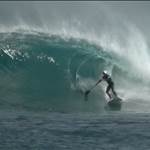
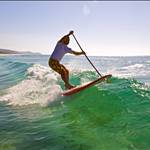
Hey guys, here's a couple of pics from lastnight. 1.5-2m ish waves following a recently cyclone. Normally this beach is dead flat!
Still 'small-ish' from my point of view but took the 7'9 vbox proto out. Got 1x little barrel and also one photo at the end for a laugh when I freeze-framed the moment after jumping off the board when it closed out.
Same story here- the white wash walls were about head high and when the waves came in sets of up to 6x waves I got pounded if I took any of the first 5.
What are the design thoughts about a board with a really stepped rail so it still has a heap of volume in the middle and centre, but almost a step down in to thinner rails and tail?
Semi full but pointed nose, straight-ish rails so could keep the length down but speed up.


I guess you will have to find your own compromise:
- photos #1 & #3: a wide tailed design will make you take off a tad earlier, to start gather more speed for managing sections as in #2, #4, #5
- on pic #2, a wide tailed board (Simmons, Tomo, Fish) will zoom across the wall at ease. A pulled-in tail with rocker will allow you to go hit the lip vertically on the shoulder, though.
- pic #4 & #6, you should try to avoid getting there in the first place, by racing to the "shoulder" earlier and faster.
Personally, I now favor an hybrid design: a wide nose, (semi-tomo) that I can push on for early takeoff, but a more pulled in tail with wings to keep some looseness in hollow sections. And in steep fast sections, I can move a bit forward on the board to use the more parralel rails there for extra speed. I do not like the full wide nose of the Tomo design for SUPing, as on the Hypernut, Vbox, etc, as I find it harder to paddle, cumbersome in turns, and having more pushback going through whitewater.
In my current quiver ( seewww.seabreeze.com.au/forums/Stand-Up-Paddle/SUP/Holes-in-your-quiver?page=2#2147379 ) this means:
I would have chosen the boards #3 or #5 starting from the left.
#2 and #4 are looser in the power, but take off a tad later. They are better if the wave opens more.
#6 and #7 take off earlier and are faster to make sections, but turning in the power is tricky: foot placement is more critical, and you skid out in case of mistakes. Great for the same kind of waves, but smaller.
#1 can be super fun... but there is always the risk to break a longboard in two in this kind of waves.
Thanks Colas - I like your semi tomo with pulled in tail suggestion. Any specific board makes and models I can have a look at to get an idea?
iinterestingly enough, the 7'9 vbox proto is a very different ride to the end version vbox evo 2. I think the volume changes on the evo 2 make it quite a different and better board. Despite being 4" longer, 12l more and 0.5" wider I reckon I could handle bigger waves and get more lose on the 8'1. The rails would have to be at least 0.4" thicker in reality on the 8'1!