


Select to expand quotehilly said..warwickl said..willow75 said..
haha , not a photoshop joke... pacificpaddlecompany.com/product/wing-sup-foil-board/
The long tracks seem a great idea - means you can use different foils/wings/fuselages and really take the swing weight out of the board if you want - or go track back and make it stable for learning..
Plus - do this to simplify mast installing

Will not work on a sup. Too close to tail. Good idea though.
It looks like could work on a sup like the Jimmy Lewis. It has that step right behind the box.
Willow75.
Yeah the photo just looks off to me.
I like that 19" track. Hopefully they will be available to the general public soon.
Select to expand quoteFishdude said..hilly said..warwickl said..willow75 said..
haha , not a photoshop joke... pacificpaddlecompany.com/product/wing-sup-foil-board/
The long tracks seem a great idea - means you can use different foils/wings/fuselages and really take the swing weight out of the board if you want - or go track back and make it stable for learning..
Plus - do this to simplify mast installing
Will not work on a sup. Too close to tail. Good idea though.
It looks like could work on a sup like the Jimmy Lewis. It has that step right behind the box.
Willow75.
Yeah the photo just looks off to me.
I like that 19" track. Hopefully they will be available to the general public soon.
It will work on my Smik and Naish SUPS plus kite foil board
Select to expand quotewillow75 said..
Yep, double length tracks starting to appear - will be great I reckon.. no matter what board I have used so far I always end up max forwards in the slot.. So makes sense to have more range.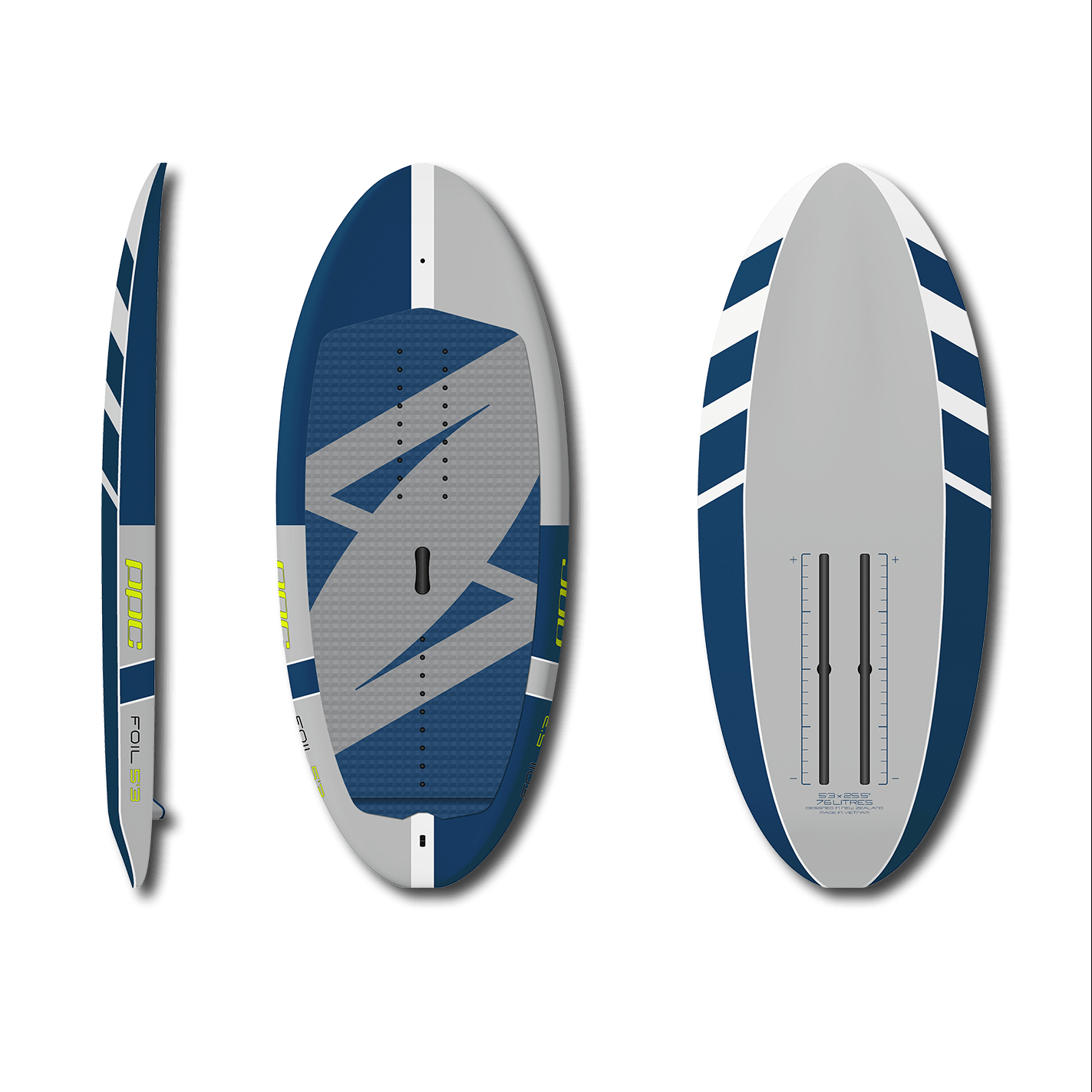
Here's where you can purchase one of these boards -- see end of video. If you live in New Zealand you're in luck!
Wow, I love the stuff that gets buried in unrelated threads - those ideas from StingerSup and Colas on bottom surface prep are pure gold. 5% better - I'll take it!And Colas, I hear you - I was lurking here and not posting during the time when everyone called you an idiot for your foil placement ideas. It always made perfect sense to me to match up the boards flotation center and mass center with the foil's lift center. For me that's the holy grail and I haven't had a SUP board that can match those three yet. I really do think this is the reason SUP doesn't pump well (much more so than just the weight). I am kicking myself for not standing up for you then - you were really alone out there on a limb with this. Hope you feel vindicated that everyone is coming around now.
Select to expand quoteemmafoils said..
2 very different bottoms on recently released Wing specific boards, the Fanatic Skywing and the F-One Rocket Wing. Hard to see but the Rocket Wing has some small side bevels, more aggressive tail bevel but otherwise pretty smooth. Which is better for winging?


also one thing to note about the Fanatic Sky Wing boards is that the deep double concave and large bevels are only on the two smaller boards 5'0" and 4'8". The larger 5'4" x 95l board has a flatter bottom and smaller rail bevels. You can see the bottom shape here:
www.instagram.com/p/B-_857kjUaH
"The compact shapes are split in two directions: The two smaller models have their focus from freeride to waves, with a curvier rocker line, forgiving bevelled rails and deep double concaves creating a flat section for early going and smooth touch downs at the same time.
The larger 5'4" is focussed on the earliest take off possible with minimal board size. The flat rocker with sharp release edges in the tail cater for maximum glide needed for a quick flight in light winds."
can't wait to try the 5'4" (whenever it arrives)
Here's an interesting design. I'd love to try one of these.
The bottom shape reminds me of the Armstrong boards.
www.cametkiteboarding.com/new-products/surf-foil-board
Select to expand quotedejavu said..
Here's an interesting design. I'd love to try one of these.
The bottom shape reminds me of the Armstrong boards.
www.cametkiteboarding.com/new-products/surf-foil-board
I'm almost positive that's a Kalama board. same exact dimensions volume and shape as the E2. hopefully its a legitimate rebranding not a rip-off. Its also a full $500 cheaper.
kalamaperformance.com/product/e2-carbon-sup/
Select to expand quotecolas said..Stingersup said..
Borrowed this idea from gliders.
The aim was to create another point for the water to more readily separate from the board, which has a fairly large flat bottom (sunova 6'8 downwind foil).
Then what you should do is find a way for the water to wet the hull in "sheets" rather than droplets.
Basically sand at 400 or 600 grit your hull. See "the board lady":
boardlady.com/fast.htm
"In tests I was involved in for an America's Cup boat, we found that simply sanding a glossy bottom with 600 grit paper, reduced the surface friction by about 5% at ? hull speed, i.e. at about 4.5 knots."
Bad: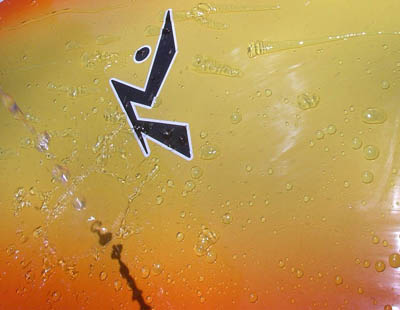
Good: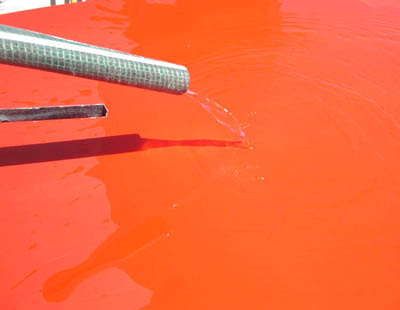
Aware of this data from windsurfing background, it really works. Try waxing your fin and the results are tragic. However....with our foil boards we are trying to break free of the surface and not achieve that laminar flow. So I thought, what the heck, the scientific method demands I test the hypothesis. So I went out w everything remaining the same, JP 7' Sup, Naish 2000 foil and 5.0 FOne Wing. First sesh, sanded finish, which I was already familiar with and is the norm. Back to beach and a quick wax job of the bottom and side bevels. Modified Brazilian. Water beaded like a showroom car. ;)
I definitely felt like the board was releasing sooner and was more slippery. How much more, hard to say, but it was noticeable. I'm thinking that we come up at such low speeds on a wing or sail w large foils that the 5% gain in speed from a sanded finish might be insignificant. But being able to break free of the laminar flow is everything, not to mention losing the water weight of water sticking to your sanded finish. Look at our wing boards or Sup's.... huge step tails or cutouts, beveled rails, shorter and shorter board lengths. It's all about unsticking. Would be curious to see what others find. I'm thinking more for freestyle type wind boards or wing boards w larger foils. Not so much for smaller racing foils and large planing surfaces.
Select to expand quotejondrums said..
Wow, I love the stuff that gets buried in unrelated threads - those ideas from StingerSup and Colas on bottom surface prep are pure gold. 5% better - I'll take it!And Colas, I hear you - I was lurking here and not posting during the time when everyone called you an idiot for your foil placement ideas. It always made perfect sense to me to match up the boards flotation center and mass center with the foil's lift center. For me that's the holy grail and I haven't had a SUP board that can match those three yet. I really do think this is the reason SUP doesn't pump well (much more so than just the weight). I am kicking myself for not standing up for you then - you were really alone out there on a limb with this. Hope you feel vindicated that everyone is coming around now.
If you listen to 'The Progression Project' series of podcasts - soundcloud.com/progressionproject - theres an interview with Kane de Wilde (I think the 1st of 3 interviews with him, maybe the second) where he explains how he sets up his gear to make sure its balanced. I only listened to it once as I was falling asleep (hoping I would absorb his skills subliminally!!!!) so may have got it wrong, but I think he said to lift your whole board/foil setup by holding the front wing by its leading edge, and when its all balanced in this position (i.e. not falling forwards or backwards) you've got it setup right... but I'm going to listen to it again as I may have got that wrong. Worth checking out for this and many other reasons especially if you like to get REALLY technical about foil setups, especially tail stabs. Most of it was over my head!
Select to expand quotejondrums said..dejavu said..
Here's an interesting design. I'd love to try one of these.
The bottom shape reminds me of the Armstrong boards.
www.cametkiteboarding.com/new-products/surf-foil-board
I'm almost positive that's a Kalama board. same exact dimensions volume and shape as the E2. hopefully its a legitimate rebranding not a rip-off. Its also a full $500 cheaper.
kalamaperformance.com/product/e2-carbon-sup/
Wow, you're right, it's almost identical. I say almost because there may be differences that I can't see, but I sure can't see any! Hope people aren't copying his design's without permission.
Select to expand quoteDWF said..Dommo49 said..
The tradeoff with such wide bevels is that they lack directional stability, which is why he has to have those keel fins at the front of his board or he'd be paddling in a circle!
Dommo49,
You overlooked one important point. Kalama corrected for that lack of directional stability by NOT shaping the rails. His totally square rail and square template make it a wash. The nose fin has nothing to do with your point. The nose fin helps any and all boards that are super short.
Jimmy Lewis gives away directional stability with his pointed nose!
They both have managed their design compromises well.
You're right, all board designs have compromises. It's crazy how such different designs can work so well, but I reckon a lot of it is down to the users preference, and a lot of that is down to what you are used to and feels right for your style of riding, paddling technique etc.
My point about the keel fin was direct from Jimmy Lewis while having a discussion with him about them - he said they do nothing. Who am I to argue with a board shaping legend????? Jimmy's boards work well, and so do Dave's, and you make them much more different if you tried. Good point about Dave's rails, but Jimmy says his rails with the very short, high angle bevels do the same. I'm sure they're both right. Change one design aspect of a board and it could potentially change all the characteristics, so at the end of the day I reckon there are loads of ways to do the same thing.
Select to expand quote
There are 2 types of 'touch down'... very gradual touch down followed by gentle release back into the air and also a great big slam down and bounce back up. It's logical that flat/concaves will both be better for one of these and not the other.
And both of these could be while going straight or mid-turn, both of which will be affected by the hull and rail shape - and rocker! I have been listening to 'The Progression Project' - soundcloud.com/progressionproject - series of foiling podcasts, and the more people I listen to (especially the board shapers), the more I'm beginning to think that we should be selecting boards from shapers who foil in the same style as we are (or at least are trying to!!!!!!!!). Board shapers will be designing for a set of characteristics that are suited for whatever they are doing (or trying to achieve) - the purist surfers will prefer different characteristics to a dedicated downwinder etc. Also factor in if they prefer long gentle carves or quick aggressive cutbacks which will also make a difference. I'm sure wave size will also have an impact. During the relatively early evolution of kitesurfing gear I remember a press storm erupted when Lou Wainman (Wikipa team rider) admitted that he never even bothered to take the Wikipa 2 line wave kite out of the bag unless he was at Hookipa as those were the conditions it was tested in and designed for, and as such didn't work in any other conditions. Long live the custom option!!!!!!!!!!!!
Select to expand quotepaul.j said..
We have played with a bunch of concaves on the foil boards but still keep coming back to the flatter bottom. We still have some double concave boards oit the back of the shop that funny enough no one ever chooses to ride which kind of tells me that they just are not quite as good. I found them super sticky for lift of and also very sticky when touching down compared to the flat bottom board I ride everyday.
A lot more advantages can be made when playing around with outlines and rockers if you ask me at the moment. Below are two new protos which are quite different again.


These look really interesting. Have you tested them out yet? If so what do they feel like? Any advantages?
Here's a discussion of two distinctly different shapes -- flat bottom and double concave with bevels. Concave deck on both types.
Hi.
Here is my wingboard for light conditions. It's a 5'9'' - 20.1/2 - 95L, I love this board ! It's a little bit an opposite direction of what i can see on the market but it's so good. It works like a displacement hull, it glide very very well so i can increase my speed even when i'm not flying and create my own wind. The big round rails are very smooth when i touch the water and i can put more angle when i'm flying because of the narrow width.
Select to expand quotegurval said..
Hi.
Here is my wingboard for light conditions. It's a 5'9'' - 20.1/2 - 95L, I love this board ! It's a little bit an opposite direction of what i can see on the market but it's so good. It works like a displacement hull, it glide very very well so i can increase my speed even when i'm not flying and create my own wind. The big round rails are very smooth when i touch the water and i can put more angle when i'm flying because of the narrow width.
Your board is very interesting but... Your wing... Fuselage-less?... Yeah that is ah, Super lnteresting!
More photos and insite please of that wing thing. I don't think anyone would mind a little subject change on your wing.
Can you pump that wing?
I like the looks of that board even though it goes against the current trend. I have surfed a side cut surfboard that has a similar plan shape. The narrow waist wide tail set up is very fast. It also seems like having the relatively high volume under the rear foot would be good for foiling. I would love to see more shots of it if you'd care to share them.
Hi.
I will open a new thread for the SingleWing foil, if you want more informations. Actually i have just a small video on my instagram, like a teaser, with a very short line kite. www.instagram.com/p/B8aj3zWotmV/


