Select to expand quote
Chris 249 said..
Hmm. I had assumed that they were on a longer passage and got caught out in the middle of it.
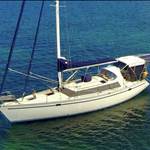
That looks to me like an old racing #3 or 4 and a furled and covered mainsail. So perhaps they put out to sea under that rig, which would explain why they sagged way offshore and why the sail tore. Under jib only they may not handle at all well upwind and may have needed a lot of helm.
Perhaps the issue is once again not using proper storm sails. A storm jib and storm trysail combo will keep the boat controllable, won't blow out and get hung up, and would allow the boat to be steered more easily.
Certainly a torn jib and furler problems should not cause a round the world boat significant trouble. There's a fairly easy way to get a boat of that size to self-furl a jib in windy conditions - just go around in circles and as the jib blows to leeward each time it will furl itself. It's really quite easy, and then one can secure it by wrapping halyards around the sail.
EDIT - after seeing Ramona's pics one can only hope that the problems had been well and truly fixed and good trials done before the boat left in those conditions. One can understand that the leak may have been something that could only be fixed in a major port, but in that case you'd have to wait for benign conditions.
I hope the RMS officer provides a report to the relevant authorities.
Reported rudder problem may have precluded circling to furl jib. Without main, might be hard in a gale to get her to point up and through the wind even with a working rudder. No mention of the engine, and whether that was part of the mechanical difficulties. Partly raising the main to get a bit of lee helm perhaps only feasible if already rigged with a decent 3rd reef. Alternative might be a storm trysail, if there was one on board, or better still one on the deck in a bag by the mast with halyard connected and sliders/luff in a separate track.
As I understand it Volvo 60s were designed with 5 watertight compartments and were virtually unsinkable. Perhaps that changed, or this boat was modified. Also standard at one stage were gudgeons on the transom for an emergency rudder. Of course even with these and if there were an emergency rudder on board, mounting it in 5m seas and a gale might be impossible or far too risky to attempt, especially if the boat could not be pointed into the waves. A sea anchor or drogue might have been useful, at least to slow her down and get her facing into the wind/swell.
In the end if they were too tired and too seasick (as I think one said when they were back on shore), and had no means to slow or manoeuvre the boat, better to seek help before getting blown even further offshore, and physical capacity deteriorating further. She reportedly covered from 80nm offshore when EPIRB triggered around midday to 160nm offshore by the time the crew were rescued the next morning.