This last question to be answered by a "power equation" of a sort.

I am saying it all with "tongue in cheek" without any scientific value.

A motor boat has a strong engine 50-200hp+, or whatever, and a hull built for it, all the power ready to be used at a fingertip just push the throttle. Period.
A SV has similar power ready to be used - and l see your faces screw up reading this - but the fact is, the power is there.
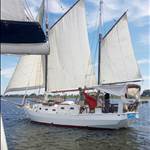
The difference is that the throttle on a sailing boat is only controlling 10-50hp and the rest is in the sails and the keel. There is awesome power packed in the sails and the hull of a sailing boat and if someone is not willing or able to use that power, well...one gets blown on a lee shore.
Most modern vessels are built and rigged the way that they are more than capable to sail off a possible lee shore without the help of an engine. The days of the traditionally rigged sailing vessels sans engine are over, when the "horrors of a leeward shore" was an every day nightmare. If worst comes to worse they can turn on the " iron genny" for extra power to pull them out of trouble but only as a last resource. Not getting into a situation like that is proof good seamanship!
Relying only on the relatively weak motor and hoping for the best is a mistake can turn lethal and definitely bad seamanship.
The boat with the 'behind the mast furler' which is really an abomination in my eyes, did not use the power stored in his vessel's sails and hull. The power was there, he just did not use it. It is like a motor boat with an auxiliary motor trying to get off the rocks with the small motor while the large powerful engine sits next to it idle.
Not getting there is the real solution.
People have very strange ideas of what an "experienced sailor" or "good seamanship" is.