Select to expand quote
shaggybaxter said..I am just chuffed to hear that everyone is safe. Sitting on a hull for anything even resembling 15 odd hours...man that'd be cold enough to seriously debilitate anyone, even in full kit. I feel for them, it must be just shattering after all that hard work making it a reality.
Jules, I don't know if I agree about wide beam = pinned upside down. I've never heard of one case where a boat stayed inverted due to a wide beam. And I specifically asked this exact question of a
lot of yacht designers.
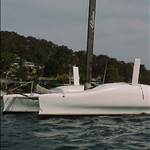
The X2 is a pure race boat that's all about getting every gram of weight out that they could whilst still qualifying for the S2H. The quoted specs of 2400kgs it less than half of the 12.50 with similar LOA/beam ratio.
I was comparing the difference in keel stubs a while back Nice example of the different design philosophies and weight reduction from a cruiser/racer to a thoroughbred racer albeit she is 10' shorter (the 12.50 keel is 50% deeper draft from the pivot bearing for a scale of reference).

Edit: Sorry Julesmoto, you mentioned issues with righting of not just beamy boats, but with keel issues. Didn't read it properly, apologies.
There's been quite a few instances where a yacht stayed upside down with keel attached for far too long.
1- In the 1996, Thierry Dubois' Open 60 remained inverted with keel on for at least 24 hours.
www.racecarmarine.com/News/95756/When-yachts-capsize-in-mountainous-seas-and-high-winds2- The de Ridder designed Liberty 47 in the 1991 Japan-Guam race stayed upside down for 15 to 45 minutes dependiong on your source, and only re-righted after enough water had come in to create a free-surface effect. Only one crew survived.
The Japanese then tested a conservative quarter tonner in calm water. They tipped it upside down four times andon three occasions it re-righted within 4 minutes once, after 9 minutes once, after 11 minutes once, and then did not re-right after 70 minutes! They believe that the difference was caused by the different trim the boat took on as it leaked while inverted. Without those slow leaks the boat would have stayed upright - and that was a fairly standard sort of boat. Of course, in reality waves will start the re-righting motion but the Japanese is fascinating because it shows how even in the same situation the same boat can take vastly different time to re-right. When the variation is so high even when the conditions are exactly the same, it's hard to make hard and fast rules from individual capsizes.
3- The Kiwi 35 Wingnuts stayed inverted and intact in a race on the Great Lakes, causing deaths.
4- In the 98 Hobart Naiad was inverted long enough for a crewman to drown.
That's just a few off the top of my head.