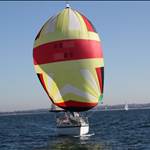
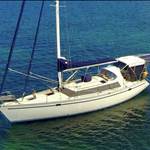
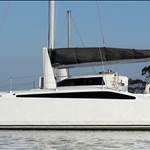
Where I sail in SA, monohulls still dominate and people ask me why I like sailing cats so much.
So I decided to write it down. In a sentence, sail faster, flatter, straighter, safer, drier, shallower, and following seas.
Full write-up:
blog.arribasail.com/2016/10/fun-sailing-catamarans.html
I'm not saying cats are for everyone, but IMO they tick a lot of boxes, esp. when you're primarily sailing coastal waters. 
yep love cats and even tris, I hate the thought of carrying around tons of weight just to stop the boat falling over, and having to swim down so far to scrub the keel is why I have had 20 plus multis but never a keelboat.
You are either a multi lover or a mono lover.
Personally cats are great at rest but in a big blow and big seas would prefer being in a mono anytime.
Select to expand quotetwodogs1969 said..
You are either a multi lover or a mono lover.
Personally cats are great at rest but in a big blow and big seas would prefer being in a mono anytime.
True enough about what sailors love, and there is no accounting for taste! But there sure seem to be a lot more more mono sailors who converted to cats, but not the other way round (myself included). On top of that, I only ever hear the "floating caravan" argument from folks who have never actually sailed cats.
Anyway, as I wrote in the blog post, a sailor’s point is view is always going to be shaped by their vessel and the waters they sail.
I really love the idea of cats. They look so comfortable and roomy. A mono hull would be more stable in swell though and that "heeling" that's a discomfort in a monohull equals balance in waves. I just cant see how a multi could handle largish waves as well.
I certainly wouldn't rule out having a cat. Like you say , get in shallow waters. Easy to clean. Really fast virtually unsinkable.
We do cat sailors feel the need to put crap on monohull?
Is it a feeling of inferior?
Have a cat in a trailing sea especially a 3/4 and see how safe it is.
Do you want me to go on and name every problem with a cat or except that it is each to their own and everyone like what they have and have it for a reason.
Or by like me, gone from A class and off the beach cats back to racing keelboat again, why maybe missed the little JOG boat or maybe just a new challenge.
And the all the crew at present still sail/race OTB multis. Is taking some time to get used to sailing "half" a boat again
Each to their own.
Hi Folks thouight about writing a little blog as just recently after completing a few deliveries lately i am converted to cats, would like to sail on a tri as the modern tri is even better i am told they go to windward better ,dont buck as much, good short handed, the only down side is not much room down below.
I have sailed Monos for the past 45 yrs covered every ocean, i race mosty weekend on monos and sail about 8 or 9 deliveries a year on monos until just recently i helped deliver a couple of 40 ft plus cats which has me converted 54 hrs Sydney to Southport, 22hrs Sydney to Eden ,10 days Hammo to Melbourne
I have sailed through Port Phillip heads in 40 kts been in bass strait going to windward for two days in 40kts okay it was a bit rough but it was good to cook and eat compared to cooking on a yacht, Sleeping was comfy ,lots of shelter,stayed dry and berthing in a marina in 40 kts was good.
Downside on cats use more fuel ,cost more to run ,cost more to slip sometimes, and yep not to good going to weather but hey if your cruising wait till the breeze swings
So yep Think about cats when looking to buy i know i am .
It is really simple everyone.
there are good multis and bad multis just like there are crap monos and good monos.
there are plenty of crap mono sailers and some very good multi sailors.
so depends on the boat and the person.
i have always found that multi sailors that put crap on monos are usually really crap sailors period regardless of what they are sailing.
google "cam Lewis"sometime to understand this.
Select to expand quotetwodogs1969 said..
We do cat sailors feel the need to put crap on monohull?
Is it a feeling of inferior?
Have a cat in a trailing sea especially a 3/4 and see how safe it is.
Do you want me to go on and name every problem with a cat or except that it is each to their own and everyone like what they have and have it for a reason.
A cat is in its element in a big trailing sea, the fine hulls track true. and are really easy to steer. Beware cats with wide transoms though, they can slew around a bit. Only draw back is the jerky ride. They have so much stability you get thrown around in a sloppy sea and the fine entrance and big moment of inertia makes anything smaller than 12 meters pitch a lot. i have owned 4 monos 26 to 54 ft and 3 cats, 40 to 48 ft and I find the cats easier to sail single handed and just as safe in any sea. It is really rare to sea green water on the deck or in the cockpit
.
The big ferro ketch was easy to single hand and had a lovely motion in a big sea, but you could be nearly up to your knees in green water on the foredeck in a big sea.
A good boat is a good boat and a dog is a dog no matter how many hulls there are.
Select to expand quoteSectorsteve said..
No one is putting crap on anyone in this thread!
What sort of statement is that  Ha Ha
Ha Ha 
I like cats but she gives me daggers when we leave the dock and we are rolling around!

Select to expand quotecisco said..lydia said..
Just get a pogo
I second that.
No one is saying cats don't move around, but the thing about a "pogo" at sea is that the movements are small and swift. For example, a swell slaps your port hull, a quick lift of the port hull ensues, then a second later the same swell passes beneath and hits the starboard hull and lifts that hull, restoring boat level. Coming from a mono it takes a little bit of getting used to.
Anyway, like I said, this is why _I_ like sailing cats.
I actually enjoy both mono and cats depending on the type of sailing I am doing at the time, for a quick weekend sail I would prefer a mono, but for more than a couple of days the extra room you get with a cat cannot be beaten, so just put me down for sitting on the fence as I never could understand the point of the mono versus multi argument anyway, the one thing I will say is that I believe that multi's are over priced for what you get, yes I know it has to do with the production numbers being lower on multi's and even understand it, but really the price differential is astounding 
Select to expand quotescruzin said..
twodogs1969 said..
You are either a multi lover or a mono lover.
Personally cats are great at rest but in a big blow and big seas would prefer being in a mono anytime.
True enough about what sailors love, and there is no accounting for taste! But there sure seem to be a lot more more mono sailors who converted to cats, but not the other way round (myself included). On top of that, I only ever hear the "floating caravan" argument from folks who have never actually sailed cats.
Anyway, as I wrote in the blog post, a sailor’s point is view is always going to be shaped by their vessel and the waters they sail.
There's also a huge amount of simple personal preference that is (IMHO) often ignored by both sides, and also there still seems to be an element in the multi community who are at least as prejudiced as any mono sailors.
We've had about 10 multis in the family, mostly cats. Until a few weeks ago we had five at one time, ranging from 18 to 38 feet, although one has yet to be sailed. We are all mono fans AND multi fans, and from that perspective I'd say that some of the points in your blog are open to debate.
There's one very obvious reason why more people may switch from mono to cats - that's because there are vastly more mono sailors (among racers it's about 98%, I think) so there are simply more people who CAN make the switch. It's interesting to note that years ago there was a high proportion of cat sailors (I think at one time in the '60s the Quickcat was THE most popular boat in Victoria, and of course the beachcat boom of the late '70s/early '80s saw big fleets) and yet very few of them went on to sail cruising cats. Certainly in the past there have been some quite prominent offshore racing multi owners who switched to monos, so it's certainly not a one way street.
It may not be true that multis are easier to hold on course downwind; for example our old 36' cat tended to wander, probably due to the skeg design, and it was a PITA to steer. One of the designers said that was not uncommon and was an intrinsic problem with skeg boats. The fact that you rated the cat's downwind ability higher than the mono's ability to short tack is another example of something that is a purely personal issue, rather than anything to do with one type being better or worse.
The claim that a cruising cat is typically 20-30% faster than a cruising mono is completely wrong, from all the objective data I can find as well as personal experience. If we compare ratings of cruising cats like Seawinds (for example) to Beneteaus, the cat is often rated slower. There are 56 foot cruising cats of modern design that are rated only about 4% faster than boats like the East Coast 31! I remember keeping an eye on the results of a Murray Isles 40-something cat when the owner made a big deal about almost beating an Etchells - it turns out that he is normally slower than a Mottle 33 with roller furling in his club racing. The 33' Gemini is rated about as fast as a Careel 22. Those are just a few examples, but the same sort of stuff comes up regularly.
Even if we look at the faster cruising cats, we'd have to compare them in all-round conditions (including short tacking in light winds) against a comparable mono - and how do you decide what a comparable mono is? Do you compare on price, LOA, interior room, sail area, waterline length, or what? Would (say) a Schionning beat (say) a Bieker cruiser/racer of similar sail area or cost? Dunno - but since we don't know, how can we say one is faster than the other?
Lighter? Compare the hugely popular Lagoon 380 cat with a mono equivalent like the Beneteau Oceanis 380, and the mono is actually lighter - as well as just 2/3 the price. Obviously many multis are much lighter than monos, but some of the cats are getting damn heavy because of all their volume, equipment and skin area. It's a bit like the unsinkable claim - my family's first big cat wouldn't have floated if holed, and it was probably lighter than many newer boats. How many owners of heavy cruising cats have checked the flotation claims? Where are the buoyancy tanks placed and how high will the boat float if it rely on them?
The superior visibility from inside some cat bridgedecks has to be balanced against the often very poor visibility from some cat's outside helming stations. Cockpit layout would seem to be so much a personal preference that there is no objective way to say that one is better than the other - I for instance loath the cat helm stations that leave you sitting up on a pedestal, but other people may love them.
Twin engines can make cats extremely manoeuvrable but they deliver less horsepower per dollar than a single, and require twice the maintenance.
About motion - the sort of motion that causes seasickness is very much a personal thing, as scientific motion sickness studies demonstrate. Therefore the quick motion you may like may be terrible for others, just as I hate the slow motion of a heavy displacement mono that others love.
On the other hand, unlike some people here I'd be very happy on a good cat in big seas - the number of cruising cats that flip is very low. Although it's hard to find real proof, the good ones also seem to be arguably safer offshore, and that's a huge factor, especially in these days when whales are getting so common. They often make fantastic cruising boats in many ways, although a while ago when we were thinking about a new boat we would have had to pay a huge amount more for a cat we liked than for a mono we liked.
None of the above means that cats are inferior; it just means that as Phoenix says, a good boat is a good boat no matter how many hulls it has, and there are too many factors to say that any one type is better IMHO.
Select to expand quotetwodogs1969 said..
We do cat sailors feel the need to put crap on monohull?
Is it a feeling of inferior?
Have a cat in a trailing sea especially a 3/4 and see how safe it is.
Do you want me to go on and name every problem with a cat or except that it is each to their own and everyone like what they have and have it for a reason.
WARNING - LONG POST!
I've been trying to find out where the tendency for multi sailors to feel aggrieved came from. It could have come from the fact that while some of the early multis were great in many ways, many of them also had significant problems, and there was a vast amount of complete bull**** from those who were promoting them.
Some of the early multis were nice boats; my brother had a 25' Piver tri that was a fine little craft. But if you read Piver's books, for example, you're faced with page after page of lies and crap about his designs. He claimed that little 25'er could sail a thousand miles in a single day, for example, and that his little beach cat could do 40 knots. He lied about mono design and made childish claims of how fast his boats went which were completely contradicted by his own statements about weekly runs and passage times.
Others were no better. Nicol and Morwood from the AYRS were either ignorant or dishonest (or both) in their multihull promotion. They claimed, for example, that the 1960s Nicol 34' tri Vagabond did 27 knots to windward - utterly ludicrous, considering the foiling AC72s were claiming similar upwind speeds. Much was made of the bull**** that Vagabond beat all the best big Australian monos - complete crap. The only "big boats" she came up against were two notoriously slow cruisers which were beaten across the line by the good 35-36' conventional racing monos in the Hobart. The 34' racing tri Vagabond therefore did nothing that a 34' racing mono of the time could not have done. The reason mono sailors weren't amazed by Vagabond's performance had nothing to do with anti-multi bias. It was simply that she did nothing amazing.
Rudy Choy was a bit better with his cat promotion, but not too much; apparently he simply ignored most of the structural and design failures and instead made a big deal when the cats won (which they often did; they seem like great boats in many ways).
The Amateur Yacht Research Society was revoltingly dishonest when it came to multis, going so far that they later admitted when discussing obituaries of sailors that "in the early days of the catamaran it would obviously have not been wise to have published accounts of accidents to them as it might have delayed their acceptance by the yachting public." In other words this "research" society actively concealed the fact that people were dying on multis, to aid a marketing effort. Unbelievable.
Choy and Piver abused each other in the press quite often, which couldn't have helped matters. Since Piver apparently saw the C/S/K cats as competitors and was a compulsive and shameless liar, to the extent that after reading his books you have to seriously question his sanity, it was understandable that Choy would want to fight back. Other multi pioneers speak of the same sort of infighting among the beach cat classes.
Some of these propagandists also claimed that Herreshoff's cat of 1876 was banned, and used that as proof that they were being discriminated against. The claim is wrong - the cats were actually welcomed just like any other type - but given the information that was available it is understandable that people used to believe it.
On top of all this there was an appalling death rate in offshore tris; I think something like 30 people died in Australian and NZ multis within a few years, including three children. Given the small numbers of boats involved, it was extraordinary, and it came at a time when the mono loss rate was very low.
It seems that this mixture of problematic boats (although they were very cool, in some ways) and insane or unethical marketing would have made many mono sailors of the time get their backs up. On the other hand, you can see why people could have loved the early Nicols, Pivers, C/S/K cats etc. When you get a bunch of people who are (rightly) excited about cool boats and they meet a bunch of people who are (rightly) saying "hey, these things are killing people and the marketing is a pack of lies" it's never going to end well.
The sad thing is that the attitude still persists, to some extent, on both sides. It's understandable from some angles, but it's also time to let it all go. Sadly the anti-mono feeling seems much stronger than the anti-multi feeling especially from some of the multi sailors who just like feeling smugly superior to other people. It's interesting to see how much some multi sailors have emotionally invested in the idea that Herreshoff's cats were banned, for example. Maybe it is just that they want a nice safe way to feel like rebels against an establishment, in the same way that accountants buy Harleys to "prove" that they are really wild guys inside.
The annoying thing is that those who keep on stoking the fires are just hurting sailing, and in particular multi sailing. Many people blame most of the issues with multi sailing on mono sailors, instead of actually trying to work out what has to be improved.
PS - I'd be quite happy on my brother's 38' cat downwind in quartering seas, although not on the 31' racing tri I used to race.
I think if anyone gets the chance, is to have a sail on all 3 formats, as experience is different for each one.
Coming from mono's, the Manta tri I had seemed so fast, 5-8 knots instead of 3-5.
It is a strange feel, you get to heel like a mono but then the arma's kick in, and you stand upright and go.
Going below it felt you were still 'in the water', though not as deep.
With the cat, it feels definitely like you sail ontop of the water, and you get feedback more instantly.
Lift the outboard up, and your handbrake is taken off.
6-11 knots is normal, and 3-4 seems like you may as well walk., all just family sailing on nice days.
On any boat though, its the design that's more important. Cats need daggers and watch the weight/windage.
They are all addictive in their own way.
Rudy Choy, Nicol and Piver have long gone. Modern cat design and construction, and modern mono design and construction has also come a long way since then.
Strangely there was an article in AYRS 1971 about tank tests conducted in the US in 1963 by Edmond Bruce that defined everything that needed to be known about displacement cat design. What is strange is that nobody took notice and it was decades before the hull forms he advocated were used. His shapes are now almost universally employed with only small variations. Modern improvements are mostly in the use of lighter and stronger building materials and methods.
When I was fishing for a living I used to encounter several cruising sailors a day some days. If I was droplining I would be in the one spot for most of the day on the shelf and could keep tabs on the relative speeds of the passing vessels. I was always surprised at how slow the catamarans were. I put this down to the amount of crap they were often carrying. Once they are overloaded they bog down. For the same amount of money you would get a much larger mono. If you could keep the stores and fuel and water levels down to something sensible the mono will cruise better. The cat wins with the greater deck space when you get there.
I stand by the claim that cats are “typically” faster compared to a cruising mono of the same length (LWL). Obviously there are slower cats and faster monos, but the power-to-weight ratio ultimately dictates speed, and it should come as no surprise that cats typically weigh less. That much is simply physics!
I mostly sailed Catalina 42s when I was a mono sailor and at at 8,165kg they were undeniably slow. Mind you, I still loved sailing them. By comparison, both the Seawind 1160 and Lightwave 38 displace 6,500kg (I'm talking max displacement, not light ship). And yes, for a 38’ cat, the Lagoon 380 is indeed one of the heaviest - and slowest - which is why I own a Lightwave. BTW, Australian designed and built.
Anyway, it’s great a see a robust, respectful conversation. Next time I may post "Why I like red wine"
Yes 1 of the limiting factors of multis is carrying capacity, my 38 ft cat can safely carry 2000kg which is not a lot for an offshore trip. It means that I need to keep things simple with outboards instead of diesels etc. Hopefully having less stuff will mean less time fixing stuff. Overloading is not just slow but can be dangerous as well. I looked at 1 tri for sale and afer a sea trial decided not to buy as it felt heavy even though it was fairly empty, turned out the builder had overspecced the materials in the build believing stronger is good. The reason it did,t sail the way that it should was the boat was 1800 kg over its loaded weight before putting any stores on board.
I don,t think anyone here is saying monos are no good, just why they like what they like, and I,m sure some monos are a blast to sail too, and they certainly can feel strong at sea , but I have always liked multis shallow draught ,parking on the beach etc, and when we did have mono trailersailers the wife and kids were always panicking that they were going to tip over once they got a lean on, even though they were totally safe.
The French cats like the Lagoon are heavy solid glass boats and don't do much for the ocean going cat reputation for fast passages. I brought 12 meters long Lyra in at 5.25 tons, fully loaded with 400 l of water and 400 l of diesel. She averaged better than 10 knots across the Coral Sea with long periods of 12 knots and did 19 knots max.
She cost twice as much to build as as a mono of the same length. But she had twice as much accommodation. Queen size island bed, queen second cabin, office, galley the size of an apartment kitchen and full headroom in the engine room. So that makes a great cruising boat -- but.
When it comes down to the enjoyment of sailing I like my little Ranger mono. It might not be going as fast but it feels as if it is screaming along. And I feel as if I am sailing the boat, not being sailed by the boat.
So as many wise men have said in this post it all comes down to personal taste and needs. You just get a good boat and love her.
I've never sailed in a Cat so I can't say what I like better. What i do like though is that for $60k I could buy a 36ft mono and sail off to potentially anywhere in the world. By the time I'd have saved enough to buy a Cat that could do the same thing I would be have missed out on many happy years sailing.
monos are better value for money generally, but not all cats are super expensive, my 38ft Wharam cat is made for offshore and was less than 60 k to buy, but the same as your example of a 36 ft 60 k mono it isn,t the latest and greatest, even the Pogo will be cheap eventually.
for anyone that hasn't sailed on a cat, you should add it to your bucket list, just so you can get the pure hoot of it.
Find someone at your marina and start chatting.
Ideally, something that sails well though, not many of the often overweighted cruising models.
We treated ourselves to a short sunset sail on a 62ft charter cat recently.
Even with 18-20 knots of breeze, it wouldn't do more than about 9 knots and was a real fizzer.
My top 5 sailing experiences to date have been in 5 totally different boats, ranging from an International cadet, to a 62ft schooner and a laser.