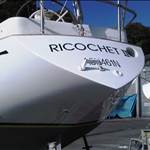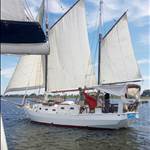
Used a bit of Modwood left over from a deck;
www.barrenjoeytimber.com.au/modwood-deckingEkodeck is another one;
www.bunnings.com.au/137-x-23mm-5-4m-decking-backbeach-leatherwood-composite-ekodeck-designer_p0109382?store=7302&gclid=EAIaIQobChMIr5aVnub29AIVQJFmAh2v6A3xEAQYASABEgLFUfD_BwE&gclsrc=aw.dsSee below 3 photos of the Farr727 set up. Very agricultural but it worked. The Modwood piece is cut so there is a tongue on the bottom which slides in and under the middle of a plastic horn cleat and the red rope secures it. The blue rope around the pulpit finishes the securing. Aft end of pole in saddle on deck. If I recall right extension out from the bow about 1.2m. No bobstay or lateral stays needed. Forget what the pole diameter was maybe around 60mm - wall thickness and alum material unknown. Kite luff around 9.6m, foot around 5m. For a Ross930 we made a carbon fibre prodder extending 1.5m out and that uses a 6mm Dyneema bobstay to the bow cutwater eyebolt but no lateral stays. The alum one which the carbon one replaced needed lateral stays and struts as well as the bobstay - it looked terrible.
See paper here with loads measured on J/80 tack line; not sure why the paper did not simultaneously record the apparent wind speed and boat speed with the load and apparent wind angle data - true wind speed could be calculated and plotted rather than just noted in the text as an average and gust peak. The kite area is noted as 63.1sqm. The rule is 65.
www.researchgate.net/publication/266477724_Dynamic_measurement_of_pressures_sailshape_and_forces_on_a_full_scale_spinnaker There is another more effusive version of the paper here - suggesting a kite area of 68sqm.
hal.archives-ouvertes.fr/hal-01582953/documentFigure 3 of the first paper shows a kite halyard load of about 1320N at the assumed highest true wind speed during the trials which was noted in the text at 16kts or 8.25m/s. The tack line load is a bit less - say 80% of the halyard load as the clew load will have some vertical component. So 1056N.
From this the tack line load per sqm kite area (63.1sqm) =16.7 Newtons/sqm or 1.7 kgf/sqm. So this is at 16kts. The load will increase with the wind speed squared. So at (say) 25kts the load will be 4.2kgf/sqm. At 30kts 6.0kgf/sqm. A post on Sailing Anarchy on tack line loads has an input from someone suggesting 5kgf/sqm so this is in the ballpark. Of course all sorts of other factors need to be used in suggesting a general rule of thumb including the stability of the yacht in question, gust responses of the running rigging and the yacht, "upset" load case factors to account for murderous gusts and numerous other operational issues. So a 50% margin on top of this 4.2kgf/sqm at 25kts or 6kgf/sqm at 30kts would be prudent.
For the lateral loadings on the prodder end a 10% of the tack line vertical load assumed for the lateral load corresponds to a 6deg tack line angle off vertical. Maybe 15% or 20% could be used as a design value.
Would expect that for your 85mm alum pole only 800mm out from the fwd securing point you won't need a bobstay or lateral stays. If you had the wall thickness the section modulus of the pole could be calculated and the stress at the bow securing location calculated from the bending moment force x length. This stress could be compared to the 0.2% proof stress of the aluminium material the pole is made from. For 5083 H116 around 200MPa is expected. A margin of 2 to 3 on this would be advised.
www.atlassteels.com.au/documents/Atlas_Aluminium_datasheet_5083_rev_Oct_2013.pdfA Eureka 30 yacht uses their normal symm kite pole for a prodder with about 800mm extension out with no bobstay or lateral stays.