G'day Bundeenaboy,
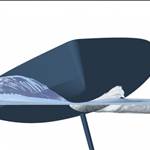
When you ease your halyard, the draft, or deepest part of the sail, moves backwards. It will settle near the center, equidistant between luff and leach. This means the luff is flatter, or "finer".
When you tighten your halyard, the draft moves forrard , to settle at about 30% from the luff. This makes the luff rounder, or less "fine".
In stronger winds a rounder entry is better as it is less powerful, heels less, gives you a wider groove to sail in and is more forgiving in seas.
The stronger the wind, the more the increase in pressure forces the draft back to the center anyway, so you need lots of halyard tension to offset this creeping of the draft back to the center as well.

In lighter winds a fine entry is better as the sail shape is more powerful, it heels more but is a lot narrower groove, so harder to steer well. Light airs means flat water, so this helps to offset the "harder to helm" issue.
Ever get those days where both your leeward and windward telltales on your jib collapse if you steer up/off a degree? That's too fine an entry, to remedy simply increase halyard tension.

Edit: when you increase halyard tension, ease your sheet first, or do it in the middle of a tack. Don't do it fully powered up, its not the best thing for your sail to be stretching the luff when under load..


 .)
.)  Sometimes the grey matter between the ears does not compute what I'm looking at. Not much wiggle room to leave cockpit to unjam the reef line where I was when I realised.