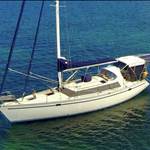
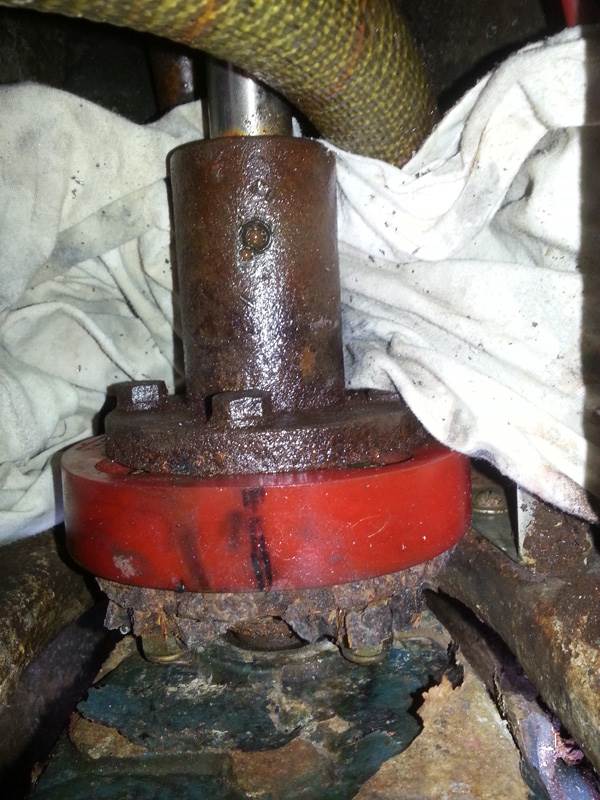
I'm trying to get the prop shaft out of my Clansman to replace the cutless bearing, probably the gearbox coupling also as its badly rusted on the gearbox side, and eventually move the engine back to access the bilge pump, float switch and clean the bilge.
I've removed one grub screw but the second one is rusted in. I've soaked it for days with WD40, but my good quality allen keys are twisting with the effort - using an extension on them.
I gave up and decided to drill it out, but good quality sharp drill bits are no match for the hardness of the screw and they get blunt quickly (using lubricant and slow speed) with little impression on the grub screw. The little bastard seems to be indestructible!
I'm reluctant to put a torch in there to heat it, but have now run out of ideas.
Does anyone have a suggestion?
If you want to drill it, use a masonry bit. Just sharpen the tip of the masonry drill to remove some of the negative rake( make the tip look more like a steel drilling bit), run it slow and keep some water running on the bit to keep it cool so you don't melt the solder holding the tungsten to the shank.
If the hex in the grub screw is not totally destroyed yet you might be able to unscrew it using an impact driver bit.
Failing that you may be able to anneal the grub scew with an oxy torch concentrated on the screw. Get it red hot and then let it cool out. Do not quench it with water unless you have a fire going or it will harden it up again.
If you are trying the impact driver bit, support the underside of the shaft with a block of hardwood.
This is a critical area of the yacht so do not give up on it. You need to disassemble the whole lot, replace what ever needs to be and then reassemble using Never Seize or the like and then regularly maintain it.
You could try this non destructive method www.henkel-northamerica.com/
Regards Don
Could try soaking a 50:50 mixture of acetone and automatic transmission fluid. Try to avoid using a hammer.
Heat on the boss is not such a bad thing, provided you do it evenly to prevent cracking, and keep fire protection gear handy. Presuming also that you do not have LPG on the boat. Worked a treat recently freeing a SS bolt out of an alloy plate.
You can buy mini-blowtorches which work of cigarette lighter refills, easier to control in a confined space.
You will also need what used to be called an "Easy-out" -left handed thread bolt remover.
Thanks for all the suggestions guys.
I tried sharpening a masonry bit as per the first suggestion by Jolene. By the time the impact driver was suggested I had gone too far and drilled out the hex.
Unfortunately, as often happens, the drill went off a little bit into the softer steel of the coupling, so a small part of the grub screw was left in there against the shaft.
Since the engine has to come out at some point anyway, I have now decided to pull the engine back into the boat with shaft attached, remove the shaft and coupling and repair it on the bench.
At first this seemed a bit daunting until I called a mate for his opinion. He said that he did the exact same thing on an SS34 he sailed for 17 years. This was while at anchor near Tonga with the help of two female backpacker crew members. He used scuba to remove the prop, instructed the girls on how to pull the engine back, (which was set up and ready) then hammered in a wooden plug.
As a matter of interest, the SS34 at the time was called "Shanty" and later in life became pink and very famous!
From the sound of it you are going to move the engine forward with the shaft attached but why dont you try to undo the large bolts that holds the coupling from the back of the gearbox, remove the engine and than withdraw the shaft and couipling from the hull
Regards Don
Thanks Don, I had thought of that after I made the post and will probably do it.
Most of the engine is disconnected now, should be able to lift it forward in the next day or two.
Cheers,
Once had a similar problem - there were grubs screws but additionally the collar was "rusted onto" the shaft as well.
So the coupling was undone, the prop shaft end pushed back a few inches and then an angle grinder was used to cut a groove lengthwise (along the shaft) through both the coupling's disc and it's collar. Only then could the coupling be moved via a drift.
Yes the grinder left a 1/2mm score on the shaft, but being lengthwise and covered by a new coupling's collar, this was a non-issue. The new coupling was quite economical from a non-marine supplier.
Select to expand quoteShotchas said..
Thanks for all the suggestions guys.
I tried sharpening a masonry bit as per the first suggestion by Jolene. By the time the impact driver was suggested I had gone too far and drilled out the hex.
Unfortunately, as often happens, the drill went off a little bit into the softer steel of the coupling, so a small part of the grub screw was left in there against the shaft.
Since the engine has to come out at some point anyway, I have now decided to pull the engine back into the boat with shaft attached, remove the shaft and coupling and repair it on the bench.
At first this seemed a bit daunting until I called a mate for his opinion. He said that he did the exact same thing on an SS34 he sailed for 17 years. This was while at anchor near Tonga with the help of two female backpacker crew members. He used scuba to remove the prop, instructed the girls on how to pull the engine back, (which was set up and ready) then hammered in a wooden plug.
As a matter of interest, the SS34 at the time was called "Shanty" and later in life became pink and very famous!
Some times you can chip out the residual of the grub screw in this case with a pin punch and then when your ginished drill the boss out to the next thread size you can buy for a new grub screw
 Theres some thing to be said for a worn out engine leaking oil makes a good rust preventer which would have been handy in your situation.
Black heat is the best solution if you have the space and are fully prepared in case of fire. The dissimilar metals always expand and contract at different rates
I could only get one nut off the coupling after lots of soaking and lots of heat.
After a bit of thinking, off came the bell housing and out with the engine which is now sitting on the deck. It's good to have it out and accessible to see all the parts which need replacing, mostly rusted clamps. Also found a dodgy hose from the sump drain which would not have lasted long.


I'll also be happy when I've given the bilge a bloody good clean and replaced the pump and float switch.

The prop shaft is finally out, now I can remove the coupling and replace it.
Does anyone know where I can buy a cutless bearing?
Select to expand quoteShotchas said..
So while you have the engine out I recommend you unbolt the engine mount brackets and get them sandblasted and hot dip galvanized. Then I suggest you have an adjustable set of solid engine mounts made up.
They will be pretty much the same as the flexibles you have but minus the rubber and therefore that much shorter. You will then need hard wood or hard plastic blocks to go under them to make up the height.
Solid mounting the engine is the only way you will ever be able to maintain a decent engine to propellor shaft alignment.
While you have the gearbox separated from the engine, drill a drain hole in your bell housing. You could tap it and put a plug in it if you can get at it when the engine is back in. Then you need to check your drive plate for loose springs and rust. Replace if necessary.
The drive plate will have an SAE spline. It will most likely be an automotive clutch plate minus the friction material and a fair bit cheaper than buying a "marine" drive plate.
Also while you have the engine out, remove the sump and set it up with a drain hole at the rear with an elbow and pipe leading to the front of the engine with a stop cock on the end of it and a screw in plug.
Doing this will enable you to do oil changes very easily and drain the sludge from the lowest point of the sump as well.
You might not have the skill or gear to do this yourself so bite the bullet and pay to have it done professionally.
What you refer to as the "Cutlass" bearing is not a cutlass bearing. It is the "Stern" bearing.
Cutlass is a brand name referring to "Cutlass Rubber Bearings" from which I steer well clear of. I much prefer a Tufnol bearing.
Google and Wiki it all up to learn. Look up lignum vitea as well. Then of course you need to make sure you have a good stern gland that is easily serviced as well. It is one of the things that keeps the briny out of your boat.
While you have the donk out get all this stuff right. It will save you a lot of dramas in the future.
Cheers Cisco.
Good luck finding any Lignum Vitae Cisco, that has been on the C.I.T.E.S. register now for over ten years, meaning that if there is any in Australia at present then that's all you will ever see.
I recall seeing a big lump of it in a tug being used as a prop shaft bearing many years ago.
Make sure you change your hoses while you can in there
Read my last post in what did you do to your boat today
Select to expand quoteHG02 said..
Make sure you change your hoses while you can in there
Read my last post in what did you do to your boat today
Yes all that plastic hose needs removing. Replace it with the same as that bit of red rubber in the lower left of the photo. For a bilge switch buy a Water Witch from Whitworths. Shaft bearing is best bought from your local machine shop that does marine work. It will probably have to be turned down to suit anyway. Locally there is a plastic manufacturing place [Albion Park] that does supply this stuff. Mates fishing boat with a 2 inch shaft cost just over $20 for the blank.
Select to expand quoteKarsten said..
Where in NSW are you?
Outside Murwillumbah in the hills......
Cisco, thanks for the comprehensive advice.
I intend to get it "shipshape before re installing it but I'm not sure why you recommend a drain hole in the bell housing?
The sump does have a drain hose with pump attached as per the photo, but I discovered the hose was cracked at the fitting, so will be replaced.
From previous reading somewhere I thought "cutless" referred to the design, having splines to wash grit out, thereby not "cutting" or abrading the shaft. Regardless of that, can anyone recommend a supplier for a stern gland?
HGO2, I found the same as you, rusted hose clamps which could not be seen. I previously replaced some with the expensive stainless ones from a local hydraulic supplier.
This engine has less than 50 hours on it, although has been sitting out of the water for at least six years. It must have been installed with some original components going by the rust in some areas, i.e. engine mounts and gearbox coupling, plus some ****ty hose clamps!
Coupling on the gearbox side.
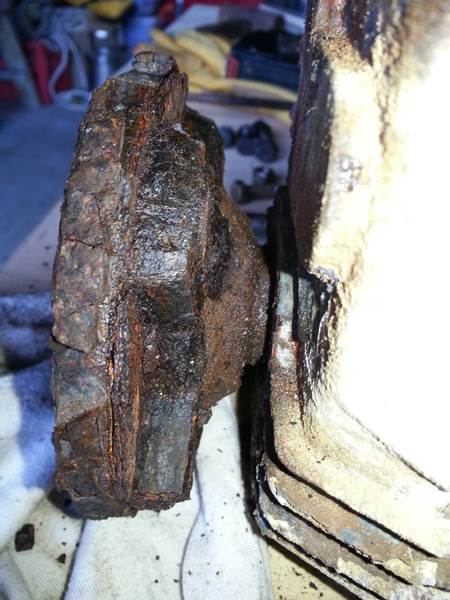
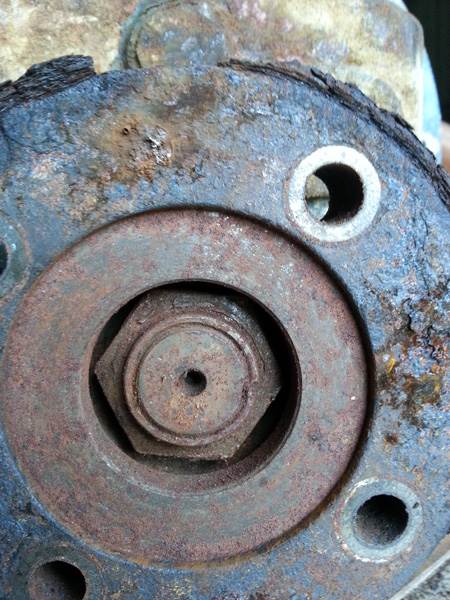
It appears to have a locking ring over the retaining nut which has been "peined".
There's no way I can see how a socket will fit over that nut. Has anyone done this before? I would like to get the coupling off and replace it.
Cheers
Select to expand quoteRamona said..HG02 said..
Make sure you change your hoses while you can in there
Read my last post in what did you do to your boat today
Yes all that plastic hose needs removing. Replace it with the same as that bit of red rubber in the lower left of the photo. For a bilge switch buy a Water Witch from Whitworths. Shaft bearing is best bought from your local machine shop that does marine work. It will probably have to be turned down to suit anyway. Locally there is a plastic manufacturing place [Albion Park] that does supply this stuff. Mates fishing boat with a 2 inch shaft cost just over $20 for the blank.
I agree Ramona, the plastic bilge hoses are rock hard and a pain in the arse. The cooling water hoses will all be renewed too.
"Shaft bearing is best bought from your local machine shop that does marine work. It will probably have to be turned down to suit anyway. Locally there is a plastic manufacturing place [Albion Park] that does supply this stuff."
Living in "the sticks" I'm not sure who would have this locally, I'll have to chase it up and maybe get some blank posted to me, then have it made up.
The coupling came off the shaft on the bench, with a lot of effort, heat and a burned finger. Took about an hour. There's no way the shaft could have been removed from the stern.
The coupling has me curious. At the gearbox side there was a layer of rust about 4mm in places and the gearbox housing paint had flaked with oxidisation on the housing, so it seemed to be localised. I chipped off the rust on the coupling and underneath, the coupling looks perfectly ok, as if the rust had migrated to the surface of the coupling.
I am now tempted to have it sandblasted and re-use it after careful priming and painting.
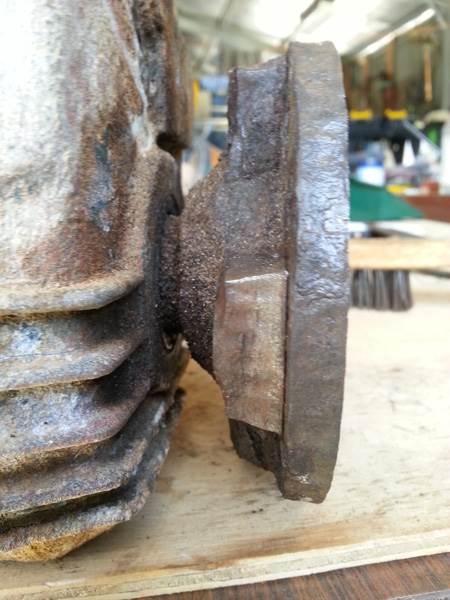
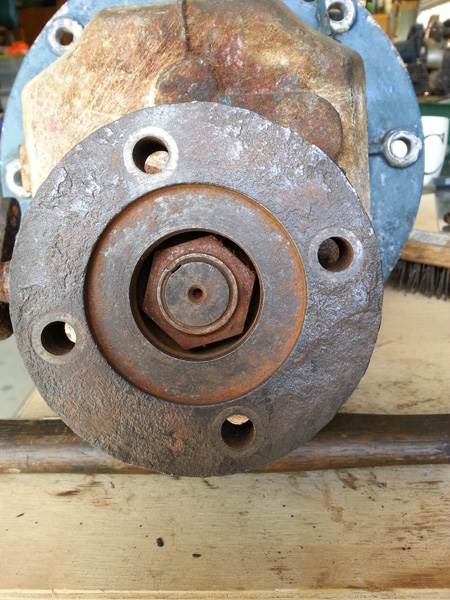
Should there be anodes mounted somewhere on the engine and shaft to prevent this?
The only anode on the boat was on the outside of the hull above the prop, with no electrical connection to anything else.
Select to expand quoteShotchas said..
I intend to get it "shipshape before re installing it but I'm not sure why you recommend a drain hole in the bell housing?
The bell housing can get water in it. If it does the drive plate will rust onto the shaft and you will never get it off.
Also if it gets water into it, it will splash up onto your starter motor and cause it to fail.
I had this all happen on a Salar 40 with a Perkins engine.
The grooves in the bearing are for water cooling/lubrication. In your case it may be more economical to measure the shaft and sleeve and buy a suitable bearing from a company like Porters in Sydney. Companies like Vetus also sell stock sizes of stern bearings. The ideal way is to front up at Porters with your shaft and A bracket if you had one and get a bearing turned up while you wait. [Make an appointment] Otherwise have someone competent to measure for you. I am guessing the Clansman would have a 1 inch shaft. Local fish Coops may also be of help.
I a use a screw driver a hammer and possibly a shifter all at the same time for these type of operations!
if that fails I go to plan B a six pack and then a change of tack the following day.
Select to expand quotesouthace said..
I a use a screw driver a hammer and possibly a shifter all at the same time for these type of operations!
if that fails I go to plan B a six pack and then a change of tack the following day.
And of course a bigger hammer
Lastly, if all fails, hide all evidence to show you tried
Select to expand quotesouthace said..
I a use a screw driver a hammer and possibly a shifter all at the same time for these type of operations!
if that fails I go to plan B a six pack and then a change of tack the following day.
That kind of marine engineering will not get you far in the real world.
Just what you need to bugger a Benetau or Jennau or any other yacht.