Select to expand quote
MAGNESIUM said..
I am going to order a new main sail,
lots of places to take your money and end up with the bottom of the line sail for top dollar.
I want a offshore spec triple stitched bulletproof sail .
I have always had a crosscut sail but like the idea of a Tri-radial and it's advantages of longer life and shape , any reviews on the
Tri-radial cut Challenge Newport PR 7.1 .
also from the guys who have done serious ocean crossings
what would you spec on your offshore main to make it a really tough sail?
stuff that the average sail maker wouldn't consider .
Having brought more big mainsails than most people I will weigh into this.
So after over the years buying, Bainbridge Dacron, Spectra, Carbon and Vectron it is pretty simple choice.
First buy the best cloth you can afford.
Second, whether tri radial or cross cut depends on the layout.
a big problem with tri radial is that the vertical seams fail first especially if reefed as the load is pulling across the seam not along it and thread strength diminishes over time
And vertical seams are the hardest to repair so be aware of that.
But if you want bullet proof there is only one choice.
HOOD VECTRON. (I have ordered 4 across 3 boats for offshore sailing)
In 25 years i have never torn, damaged in any way a Vectron panel. a mainsail brought for 2002 Hobart is still used by the boat as the primary delivery and cruising main.
Sure the Vectron at first does not hold its shape the best as full on race sail but after that it is fine. Some rigs as Kankana point out you may not get a choice because of rig geometry
Also importantly, flogging the sail does not deteriorate the cloth anywhere near as much as laminates.
Flogging is death to a sail.
having said that Bainbridge Dacron holds up well for long time where cheap Dacron is vrap from day 1
As to configuration, either 3 reefs of 1 and 3 (no 2nd reef) as if you are past 1 you are normally headed to 3 and besides most boats only have 2 reef lines and mousing is a pain if cruising. Or see the solution below.
Try not to have metal reef eyes on bigger sails but use webbing and the snatch block or low friction ring. Less damage to the sail when flogging.
Specify larger corner patches and reef point to spread the load. (Sailmaker will hate that as the computer cuts them)
If you are using battern cars, think about specifying extra wide luff tape and double sew it as when reefed in heavy air you will get huge luff flutter between the cars.
As for batten pockets and ends, price is an indication of quality as are battens.
Try to use a local sailmaker as unless you have a very accurate rig diagram, the chaff patches for the batten pockets and spreader patches will never be in the right place and need to be dome after fitting the sail.
Also measure the tack cut back carefully, as the failure to do so loads up the first few batten cars and will eventually lead to failure.
My 20 cents to start with.
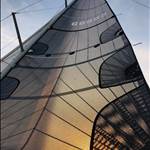
first fit of vectran main on Defiance
yeah I stuffed up the tack cut back
Went with effectively a 2nd and 3 rd reef with no first because I an getting old and lazy.


Sydney 38 IRC offshore main (no second reef)

Defiance with vectran No1 med/heavy and main.

 MAGNESIUM
9 months ago, 13 May 2025
MAGNESIUM
9 months ago, 13 May 2025