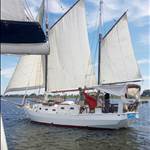
Never heard of a Skipper 14 but have now - links here which you are probably aware of - there are many other links. Designer Peter Milne did the Fireball among others and obviously knew what he was doing.
forums.ybw.com/threads/skipper-14-dinghy-any-good.160166/page-2 sailboatlab.com/data_sheet/6710/0/ You are all over the trailer so no comment needed - you can sort the Vic regs - but it sounds like a used trailer could be a lot cheaper than $750 to fix the one you have been gifted. From the web links the boat is 73kgs - assume this is just the hull mass and spars and other gear will add more to the towing weight.
A centreboard of cedar - even the strongest Australian red cedar let alone much weaker western read cedar which I assume you didn't mean, or paulownia - will snap as you say, even under sailing conditions let alone righting from capsized.
www.wood-database.com/paulownia/ Holmes Brothers wrote an excellent article on centreboard design and construction in Australian Sailing a long while back - I can't find it now.
This article is obviously useful.
www.epoxyworks.com/how-to-build-rudders-centerboards/ This one for GP14s mentions 3/4" ply and epoxy resin and glass reinforcement.
forums.ybw.com/threads/gp14-centre-board-replacement.86257/ I would gauge what use and longevity you and family are going to put into this boat and trailer before sinking a lot of time, effort and $S into it - but this is obviously none of my business.
Cost effective centreboards and rudders could be made of 18mm ply suitably aerofoil shaped, and reinforced with epoxy resin and suitable reinforcement. The reinforcement could range from S glass to carbon fibre - I have bought the latter from Ironbark Composites as per here and they were excellent. Carbon fibre is not hard to work with but it doesn't like small radius bends. You could do the leading and trailing edges with s glass tapes wrapped around tightly and then put the carbon fibre sheets on each side.
www.ironbarkcomposites.com.au/product-category/carbon-fibre-fabric Of course the finished foil thicknesses must be a suitable width less than the centreboard case and rudder case inside widths - I assume these are a daggerboard type or pivoting case type.
Finally and without making a meal of it righting a capsized dinghy normally needs weight of only one crew on the centreboard right up close to the hull not out at the tip of the centreboard. If more than one crew is needed have them both at that close into the hull location.

 Pete2
> 9 months ago, 26 Apr 2025
Pete2
> 9 months ago, 26 Apr 2025